
Office: (404) 975-4800

News

Truck

Top 3 Best Commercial Truck Financing Reviews

Truck


Are you in the market for new commercial vehicles, but don’t want to make hasty financing decisions? If you’re looking for the best commercial truck financing reviews, this article is for you!

We’re going to discuss the top 3 commercial truck financing options. This way, you can make the best decision for your business. Let’s explore the pros and cons of each option, as well as expected application processes, rates, and customer service.

Whether you’re a small business owner or a fleet manager, we’ve got you covered. Sit back, and read on, to find the perfect financing solution for your commercial trucks.

3 Best Commercial Truck Financing Reviews For You

We’ve selected the top 3 options that you should consider in your financing journey. These key players were ranked using the criteria outlined below.

Here’s how we reviewed the best commercial truck financing companies:

  • Financing options: Not all truck finance companies offer the same financing options. Some only provide repair loans, while others offer direct loans. The more financing options, the better!
  • Application process: Nobody wants to sift through hours of paperwork. The easier the application process is, the easier it is for you to finance your fleet.
  • Rates: Lower rates are highly sought after. This means less cash out of your pocket when you have to repay your loan.
  • Customer service: Commercial fleet financing can be complicated and daunting. Having superb customer service helps ensure you get the loan you deserve.

If you intend on financing a semi truck, you’ll want it to be as comfortable as possible. Read these articles to make the most of your journeys:

1. Mission Financial Services

On the Road to FINANCIAL INDEPENDENCE

As the best option for overall commercial fleet financing, we have Mission Financial Services. This company is a well-known choice for semi-truck owner-operators, as well as fleet services, seeking commercial fleet financing.

Mission Financial Services aims to streamline the semi-truck financing process. When it comes to financing anything of commercial use other than construction equipment, this company is your best bet.

They also strive to help owner-operators finance new trucks, repairs, or upgrades. Although this company will assess your credit report, note that credit score is not a determining factor in approving your loan.

Financing Options

Mission Financial Services provides professional commercial vehicle financing. They offer a wide variety of commercial and semi-truck loans, including:

  • First-time buyer loans.
  • An approved lender for 1000’s of Dealerships nationwide
  • Private party purchases
  • Truck repair loans.
  • Operating Capital.
  • Lease Purchase Buy-Outs.

Application Process

The application process at Mission Financial Services is as seamless as it gets. There are a few steps you’ll need to take to complete your loan application. We’ve outlined these below:

  • Determine eligibility: As with any loan application, your eligibility will need to be assessed. Mission Financial Services will consider your overall credit report and down payment, as well as your truck’s age and how long you’ve had a commercial driver’s license.
  • Gather documentation: The necessary documents you’ll need include bank statements, a CDL, references, cell phone contracts, and proof of insurance. Having the required documentation will help to streamline your application process.

White paper silver pen

  • Apply: Lastly, submit your documentation to Mission Financial Services. If all is in order, your new truck will be right around the corner.

Rates

Mission Financial Service offers affordable industry rates. The rates largely depend on the type of truck loan that you need. Chat with one of the friendly representatives at Mission Financial Services to determine the specific rates you’ll be liable for.

Customer Service

Mission Financial Services is known for top-tier customer service. Many customers praise their speedy application process and enthusiastic administration team. This team helps truck owners and fleet managers navigate the application process and find semi-truck loans suitable for their needs.

Summary

Applying for a commercial truck loan with Mission Financial Services is a breeze. The online application process is quick and easy, and you can complete it from your home or office.

The friendly and knowledgeable customer service team has received high praise from past customers. This team has been able to consistently help customers find the right loan deals. There are several loan options available, which makes it easy for customers to find the best fit for their needs.

2. Calfund

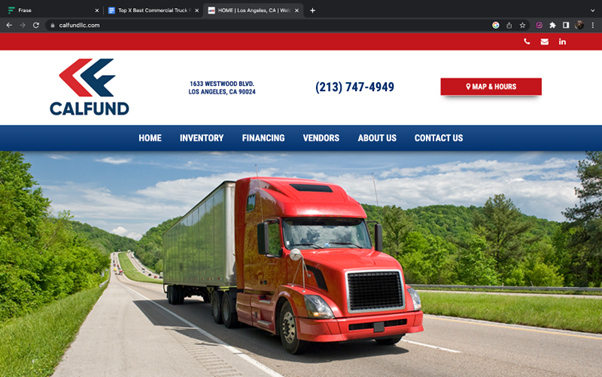
Screenshot

Next on our list of best commercial truck loan options is Calfund. Since 2002, Calfund has been a direct lender that provides titled equipment financing. They aim to help transportation industry customers and dealerships pursue new business opportunities through funding.

Financing Options

Whether you’re looking to acquire your first semi-truck or finance upgrades, consider looking at Calfund’s financing options.

Calfund will also assist with any maintenance or customization that could be necessar at a later stage. This financing option is available to even those with a C or D credit score. This makes it easier to receive a loan if your credit score isn’t the best.

Application Process

To apply for a semi-truck loan with Calfund, simply visit their website. All you need to apply for a quick, direct loan are key details about your vehicle and the down payment.

Rates

Since Calfund offers direct loans, their rates are higher than the industry standard. Some clients have found Calfund’s interest rates to be too high. With higher rates, fleet managers and truck owners take longer to repay loans.

Operator

Customer Service

Clients looking for a commercial truck loan have found Calfund’s customer service to be up to scratch. Customers can receive assistance through direct calls, emails, and an easy-to-navigate website. To reach Calfund, consider an immediate call. This seems to be the best way to get in touch with a friendly loan manager.

Summary

Calfund offers commercial truck loans to even those with subpar credit scores. This is a good opportunity for those looking to finance businesses that they may not be able to otherwise. Calfund’s application process is simple, and their customer service is accessible.

As Calfund is a direct lender, its rates tend to be higher than other companies in the industry. Higher rates mean that loans will take longer to repay.

3. Dakota Financial


Website screenshot


Dakota Financial is one of the oldest commercial truck financing companies around. They have over 20 years of experience in the industry and has served over 10 000 companies.

They offer great national funding programs to their clients, specifically those with prior bankruptcies, tax liens, judgments, repossessions, or slow pays.

Financing Options

This company offers commercial loans that range from smaller to relatively large amounts. Unlike bank truck loans, customers can be approved despite low credit scores. Dakota Financial’s options are geared to assist customers who have a past of bankruptcy, tax liens, or judgments.

Dakota Financial offers a custom loan solution for startups and companies with no credit record.

Application Process

This option does not offer a quick or easy online application process. Customers wishing to apply for a loan with Dakota Financial must contact the company via telephone or email to start the application process.

Customer Service

Dakota Financial has good customer service. Past customers have been happy with the capabilities of the team, and most have been satisfied with the level of assistance they received. This makes Dakota Financial a good option for individuals or companies who feel they will need extensive support.

handshake

Summary

Dakota Financial has been in the truck-loan industry for many years. This company is a reliable, well-known fleet financing option. Their customer service is  accessible and helpful. However, if you’re looking for the easiest application process, note that you’ll need to jump through a few more hoops with Dakota Financial.

Applying online is quick and easy, while starting an application process over the phone or by email might be a bit more staggered.

Final Thoughts

We’ve discussed the best commercial truck financing reviews for you. Each of these companies is a key player in the industry and is sure to help you finance your semi truck dreams.

Whether you’ve got one truck, or a small fleet, a loan can help you take your business to new heights. If you’re eager to start the financing process today, follow this link. Mission Financial Services promises a range of financing options, easy application processes, competitive rates, and great customer service.

5 Ways Women in Trucking Can Avoid Breast Cancer

pexels-padrinan-579474

October is Breast Cancer Awareness Month! We celebrate this month by sharing information regarding the prevention of breast cancer to eradicate this dreadful disease that affects one in eight women. But could women in trucking face even greater risk? According to Dr. John McElligott, co-founder and volunteer medical advisor of the St. Christopher Truckers Relief Fund, women truck drivers “don’t have as much access to healthcare with their lives on the road,” which could jeopardize early detection of breast cancer.

While the breast cancer mortality rate has decreased by 40%, the fight continues. In this article, we will go over breast cancer and discuss the top five ways women truck drivers can avoid it.

What is Breast Cancer?

Breast cancer is a type of cancer that starts in the breast and has the potential to spread to other parts of the body. While breast cancer typically occurs entirely in women, men can also be diagnosed.

Breast cancer can start from different parts of the breast, including:

  • Lobules. These are the glands that produce breast milk.
  • Ducts. The small canals come from the lobules and are the most common place for breast cancer to start.
  • Nipples. A less common type of breast cancer, called Paget disease, can often start in the nipples.
  • Fat and connective tissues. These portions of the breast surround the lobules and ducts.
  • Blood vessels and lymph vessels. Angiosarcoma, a less common form of breast cancer, can start in the lining of the vessels.
  • Armpits and upper chest. Lumps can be found in these areas during self-exams.

In most cases, breast lumps are benign and non-cancerous (malignant). However, any detected lumps or changes in your breast need to be checked by a healthcare professional.

While there are certain unavoidable risk factors for getting breast cancer, including your gender, age, personal cancer history, family cancer history/genetics, and breast density, there are some factors that you can change to reduce your risk.

Avoidable risk factors include:

  • Body weight
  • Physical activity
  • Alcohol use
  • Smoking
  • Drug use
  • Exposure to hormones (IVF, HRT, birth control, etc.)
  • Pregnancy and breastfeeding
  • Radiation exposure

Ultimately, the best way to reduce or eliminate your risk of breast cancer is to learn about your health, eliminate negative factors that are within your control, and know your screening options for early detection.

5 Ways Women Truck Drivers Can Avoid Breast Cancer

Simple lifestyle changes can decrease your risk of getting breast cancer, even for women who are considered high-risk. To lower your risk, you should:

  1. Limit alcohol consumption. The more alcohol you drink, the more you put yourself at risk of developing breast cancer. Based on research, the healthy limit for alcohol consumption is no more than one drink a day.
  1. Maintain a healthy weight. If you are at a healthy weight, put in the work to maintain it. There are simple ways you can achieve this goal while on the road, including maintaining a healthy sleep schedule. You can also reduce the number of calories you consume each day and incorporate physical activity into your daily routine.
  1. Incorporate more physical activity. To live in good health, adults should aim for at least 150 minutes of moderate activity per week or 75 minutes of vigorous activity per week. You should also incorporate strength training into your exercise routine at least twice a week.
  1. Eat a balanced diet. Eating a balanced diet on the road can be challenging, but it is possible. A healthy diet will not only reduce your risk of breast cancer, but it will reduce your risk for other types of cancer, heart disease, and stroke. Foods to incorporate into your diet include plant-based foods, fruits, vegetables, whole grains, extra-virgin olive oil, legumes, nuts, and fish.

5. Perform self-exams. The number one way to avoid breast cancer is through routine self-exams. Stay vigilant for changes in your breast, including new lumps or changes in your skin. You should also consult with your doctor on when to begin mammograms and other preventive measures and screenings.

More like this:

Women in the Trucking Industry

5 Ways Truck Drivers Can Avoid Heart Disease

Sleep Apnea: A Growing Concern for Truckers

How Inventory Shifts are Impacting Purchase Decisions

sijmen-van-hooff-kuDtwayYiSA-unsplash

When it comes to buying trucks and equipment, the majority of owner-operators prefer the used market, according to Overdrive’s Truck Purchase and Lease Survey. Out of all of the survey’s respondents, 56% of them reported buying used trucks, 32% bought new, and less than 10% leased their trucks or equipment.

However, while purchasing used trucks and equipment is preferred among owner-operators, finding said trucks and equipment at a fair price is more challenging than ever. Thanks to the COVID-19 pandemic and the delays in production, brought on by component shortages, many owner-operators are forced to consider other purchasing options.

Unfortunately, truck dealerships aren’t receiving much in the way of new inventory. In 2021, new trucks were being ordered, but they wouldn’t arrive until December. And, to top it off, fewer trade-ins are making their way onto the lots, thus pushing prices of used trucks through the roof. In 2021, used trucks retailed for the most they ever have in the modern era. For example, a used sleeper, with over 450,000 miles on it, sold for a little over $90,000. This price was approximately 85.5% higher than the previous year. And while some industry professionals anticipated a slow descent in used truck prices in 2022, others caved to the pressure of the market and sold off their fleets for substantial amounts of money.

Photo Credit: Overdrive

Are higher lending rates to come?

Industry experts also predict that new truck production will eventually catch up and balance out. Once trucks start rolling off of assembly lines, used-truck buyers will want to consider the potential financing impact new truck production could have on trade-ins with higher mileage than normal. 

Financing a used truck is already a challenge due to the higher risk lenders take since used trucks typically face engine problems. When the trade-ins that drivers clung onto in lieu of new inventory arrive at dealerships, they will arrive with higher mileage and a higher risk of performance issues. Thus, lenders will be even more hesitant when drivers request financing and likely raise lending rates.

For small fleets, experts believe it may be wise to consider extending the life of their trucks and equipment through maintenance rather than buying new or used. And for any owner-operators who are searching for a used truck in today’s market, they can also expect higher down payments. In fact, those just entering the industry should be prepared to put 25-35% down. Overdrive recently surveyed a group of drivers who recently bought a used truck to further prove the state of the market. They found that 38% of used-truck buyers paid in cash, and 57% of buyers financed with a bank loan or through a captive or specialty lender.

Is a lower interest rate possible?

Despite all of this, there are ways to acquire a lower interest rate on your loan. The main factors that lenders look at to calculate the monthly payment include your credit score, the model year of your truck, how much money you put down, the owner/driver’s business experience, and your resourcefulness. 

“I’d rather lend money to a guy with a 600 credit score whose father was an owner-operator, grandfather was an owner-operator, brother is a diesel mechanic, and maybe his credit score is down because of divorce,” Grivas said. “That’s a great risk compared to a guy with a 700 credit score who’s just getting started.” 

When buying a new truck, experienced owners and drivers can expect a single-digit interest rate. However, drivers financing a used truck will see interest rates ranging from 10-13% or higher.

How Mission Financial Services can help.

We understand that sometimes times are tough and we’re here to get you back on the road to financial independence. Whether you’re a first-time buyer, have limited driving experience, or have bad credit, we can help.

Mission offers direct lending for owner-operator purchases, lease purchase buy-outs, repair loans, and title loans for operating capital. And even better, we will perform a complete review of applications and get you an answer within four hours.

Our approvals are structured as simple interest contracts with limited terms that let you build equity in your loan quickly to avoid additional finance charges. Mission considers all applicants living in all states except Hawaii and Alaska. And we offer affordable loans and report to all major credit bureaus so you can start turning your credit around. Why wait?

More like this:

How is the Microchip Shortage Affecting Truck Prices in 2022?

Rising Fuel Prices: An Ongoing Problem for Drivers

How Does Prop. 22 Affect App-Based Drivers?


2022 Walcott Truckers Jamboree: Recap

Photo Credit: Iowa80truckstop

An Interview with Charles Smith, Mission Financial

Iowa 80 Truckstop, The World’s Largest Truckstop, recently celebrated America’s truck drivers at the 43rd Walcott Truckers Jamboree. Approximately 45,053 drivers attended the event, along with their beloved friends and families, members of the local community, and visitors from over 27 different states and two Canadian provinces.

The Walcott Truckers Jamboree has been a yearly celebration, rain or shine, since 1979. The three-day extravaganza offers tons of features, including over 175 exhibits, an antique truck display, Iowa-style cookouts, the Trucker Olympics, contests, live concerts, an epic firework show, and so much more. And attendees didn’t have to worry about admission or parking for the event, because both were FREE!

The most popular feature of the Jamboree was the Super Truck Beauty Contest. This year featured 92 registered contestants, and the winners were something to admire. Ranging from turn-of-the-century trucks to modern marvels, there was something for everyone to appreciate.

This year, Mission Financial Services’ very own Charles Smith had the opportunity to attend the Walcott Truckers Jamboree.

“This was my first year attending, and while I didn’t participate in any of the exhibits or events, I was able to explore potential prospects for the future,” Charles said when asked about his time at the trucker’s event.

Charles also noted that there weren’t any other financial companies in attendance, which presents a huge opportunity for the commercial lender. “Mission Financial will definitely be attending the 2023 Walcott Trucker Jamboree. I encourage people to stop by our booth next year so they can take advantage of the industry knowledge and financial offers we specialize in everyday,” he said.

The 2023 Walcott Trucker Jamboree is scheduled for July 13-15, 2023. Click here to see the schedule of events.

Stay tuned for more information about the Mission Financial booth and the 2023 Walcott Trucker Jamboree!

Photo Credit: Iowa80

More Like This

–> Q&A: Trucking Expert Talks Inventory Shortage

What Owner-Operators Need to Know About the Inflation Reduction Act

markus-winkler-GNuN-c94_aA-unsplash

On Tuesday, August 16, President Biden signed the Inflation Reduction Act of 2022 (Act) into law. The Act covers climate issues, taxes, healthcare, and other legislation in one bill, serving as a concise version of the Build Back Better bill.

What is the Inflation Reduction Act?

The main points of the Inflation Reduction Act of 2022 include:

  • 15% minimum corporate tax rate: Corporations that generate at least $1 billion in income will now have a 15% tax rate, and stock buybacks will have a 1% excise tax.
  • IRS investments: The IRS will receive $80 billion to hire new agents over the next ten years.
  • Prescription drug price reform: Medicare will now be able to negotiate the prices of particular prescription drugs, and in 2025 Medicare recipients will receive a $2,000 limit on annual out-of-pocket prescription costs.
  • ACA subsidy extension: The current medical insurance premiums under the ACA, which were set to expire January 1st, 2023, will now be extended through 2025.
  • Investments in energy security and climate change efforts: Households will receive tax credits to offset energy costs, the government will invest in clean energy production, and there will be tax credits for reducing carbon emissions.

On August 7, the Inflation Reduction Act went to the Senate and passed with 50 Democratic votes and zero Republican votes. Once it reached the House on August 12, bill 220-207 was passed.

Ultimately, small businesses and hardworking Americans will profit from this legislation through the investments in deficit reduction, increased manufacturing, lowered drug prices, and the push for corporations to give back to their community. But what does this bill mean for owner-operators within the transportation industry?

What Owner-Operators Need to Know

The Inflation Reduction Act will make significant changes to the United States environmental policies, health care policies, and tax codes. However, for owner-operators and other small trucking businesses, the Act’s extended changes to the ACA subsidies and IRS investments will likely be the most impactful.

The increased and extended ACA subsidies will allow owner-operators without employer-provided health insurance access to affordable health care coverage. Marc Ballard, who handles the NAIT’s various health care avenues, said, “We’re seeing about 90% of people who enroll can get a plan for $100 a month. Take, for example, a guy who may be 45 with a spouse and two kids, lives in Florida, and expenses a bunch of his income. … Let’s say his net adjusted income is $60,000. He grossed $200,000, but the reportable income is $60,000. He could literally be paying zero dollars for a health care plan.” Those making more money may face an increase in coverage costs by just a few hundred dollars a month.

And while the ACA subsidy changes won’t affect independent business people as much, it’s wise to use this extension period to shop for different health care plans. Freight rates are slowing due to the rise in fuel costs, and owner-operators’ incomes fluctuate as the pandemic period breaks down. So, now is the time to consider income projections and any potential family or personal status changes, which could unlock new health-expense savings.

The $80 billion investment in creating a larger Internal Revenue Service could also pose a threat to owner-operators with more frequent audits. The Associated Press did disclose that armed agents will not come knocking on owner-operators’ doors unless they are under criminal investigation for dealings in things such as contraband. Truck drivers must also be conscious of their increased chance of being audited. And while the IRS does have a backlog, the 87,000 incoming agents will quickly clear it, making time for them to look at newer returns. So, be sure to be extremely thorough when filing your taxes.

The Future is Green

The $369 billion investment in green energy will also notably change the trucking industry. In the next few years, trucking companies could receive tax incentives to purchase trucks that operate on alternative fuel sources, including electricity and biogas. Similar tax incentives will be made available for installing supportive infrastructure at trucking headquarters. The bill will also offer grant and loan programs to trucking businesses to encourage and fund their switch.


More Like This:

How Does California’s AB5 Affect Truck Drivers?

Rising Fuel Prices: An Ongoing Problem for Drivers

What is the COVID HOS Emergency Declaration?

Top 8 Ways to Celebrate Truck Driver Appreciation Week

Top 8 Ways to Celebrate Truck Driver Appreciation Week

Truck drivers have been essential to our nation since the end of the 19th Century. They work tirelessly to safely, securely, and on time transport 11.27 billion tons of freight every year.

Truck drivers carry significant responsibility. They manage long hours, heavy traffic, tight delivery schedules, and unpredictable weather while keeping goods moving across the country.

From restocking grocery stores to supporting local communities, their role in the economy continues to grow.

That’s why, every year, we take an entire week to pay respect to and thank the country’s truck drivers for their hard work and dedication to one of our nation’s most demanding jobs. We call this week National Truck Driver Appreciation Week.

What Is Truck Driver Appreciation Week?

America observes National Truck Driver Appreciation Week during the second week in September. 2026’s National Truck Driver Appreciation Week is from September 13th to the 19th.

Truck Driver Appreciation Week is a time to recognize drivers and honor their dedication to keeping the transportation system moving. Fleets, vendors, and industry partners across America use this week to show meaningful appreciation.

From small operations to larger fleets, every company has an opportunity to acknowledge the people behind the wheel who keep deliveries on track and customers satisfied.

Why Driver Appreciation Matters for Your Business

Driver appreciation directly impacts your operation. It is not just about recognition; it affects retention and long-term growth.

Replacing a driver takes time, increases costs, and creates unnecessary downtime. Recruiting, interviewing, onboarding, and covering missed loads can quickly disrupt your team and affect service for your customers.

When you consistently recognize drivers, you build loyalty. And employees who feel respected are more likely to stay and maintain consistent performance on every trip.

A strong driver appreciation week strategy can extend year-round, improving morale among truckers and helping your business stay stable in an increasingly competitive market.

Young African American garbage removal worker driving a waste tr

8 National Truck Driver Appreciation Week Ideas to Celebrate Your Drivers

The best Truck Driver Appreciation Week ideas focus on practical support that improves drivers’ daily lives on the road, not just one-time perks.

1. Take Advantage of Parts and Service Deals

Many companies offer special promotions on parts, maintenance, and repair services during Truck Driver Appreciation Week. This is a good opportunity to take care of routine maintenance or address issues you may have been putting off.

Saving on essential services like tires, inspections, or repairs can help reduce operating costs and prevent unexpected breakdowns later. Staying ahead on maintenance not only protects your truck but also keeps you on schedule and earning consistently.

Using these deals strategically allows you to improve reliability without taking on the full cost at once – something every driver and fleet can benefit from.

2. Run Weekly Incentives or Performance-Based Giveaways

If you’re a fleet owner, you can celebrate your drivers by hosting daily giveaways. Daily drawings will keep everyone excited throughout the week. But to build more enthusiasm, why not raffle off a grand prize at the end of the week?

Make those prizes useful. Cash bonuses, prepaid cards, and practical support like meal credits or extra paid time off have a direct impact on drivers’ day-to-day lives.

The most effective rewards are the ones drivers actually feel outside of their normal work expenses. When appreciation translates into real value – whether that’s time, flexibility, or extra income – it carries more weight and leaves a lasting impression.

For example, you could offer incentives for:

  • The highest on-time rate during the week
  • Zero preventable safety violations
  • The best fuel-efficiency improvement versus that driver’s normal average

This turns a fun initiative into a performance driver that benefits both your team and your bottom line.

Driver standing near his truck

3. Give Practical, Driver-First Gifts

A strong truck driver appreciation strategy focuses on gifts that solve real problems drivers face every day.

  • Cab interior accessories that help drivers sleep better after long night runs, improving alertness and reducing fatigue
  • Safety gear supports drivers dealing with unpredictable weather, roadside stops, and high-traffic environments
  • Technology tools reduce friction during dispatch, navigation, and communication, saving time on every trip

The goal is simple: give something that improves the driver’s experience behind the wheel, not something that sits unused in the cab.

4. Provide Meals or Food Credits on the Road

Some favorite food spots offer discounts to truck drivers during National Truck Driver Appreciation Week. Food is one of the most immediate ways to show appreciation, especially for drivers spending long stretches away from home.

Think in terms of places drivers can realistically access on a route: major travel centers like Pilot/Flying J, Love’s, TA, and Petro, quick-service restaurants inside those stops, or local diners with truck parking.

These are the kinds of locations where a prepaid card, meal stipend, or stop credit is actually useful on the road.

Access to a reliable meal, coffee, or quick snacks at a rest stop helps drivers recharge and stay focused.

5. Host a Driver Appreciation Event

Truck drivers spend long hours (sometimes even days) on the road and away from those they love. If you’re a fleet owner-operator, you could celebrate your drivers by throwing a family and friends event.

Events create connections beyond the job. Bringing drivers, their families, and your company together builds trust and loyalty in a way that a one-time gift or email never will.

For example, a small fleet could host a lunch at the yard with food, drinks, games for kids, and a short recognition segment.

During that time, you might recognize drivers for safe miles or extra effort during difficult runs, then give out a few practical prizes, such as fuel cards, maintenance credits, or branded hats.

If some drivers are still on the road, you can create a second option with mailed meal cards or a virtual shoutout so no one feels left out.

This kind of event gives drivers and their families a chance to meet the people behind the operation, put faces to names, and feel more connected to the team. That stronger relationship often leads to better retention, greater commitment, and more stable operations.

Delivery, container and happy truck driver moving industry cargo and freight at a shipping supply chain or warehouse. Smile, industrial and black man ready to transport ecommerce trade goods or stock

6. Recognize Drivers Publicly

Nothing says “I appreciate all you do” like a handwritten thank-you card to your favorite driver.

Recognition should be visible and specific. Call out drivers for safe miles, customer service, or going above expectations. Use internal channels, your website, or even social media to feature drivers and share their stories.

Simple actions like personalized letters or leadership acknowledgment help drivers feel seen. That sense of recognition builds pride and reinforces long-term loyalty.

7. Give Drivers Time Back

Time is one of the most valuable resources for drivers. Extra home time or additional paid days off allow drivers to reset and reconnect with their families.

After managing long hours, tight delivery windows, and constant time on the road, this kind of support stands out. From an operational standpoint, rested drivers make better decisions and improve overall safety, saving you money and boosting your reputation among drivers and clients.

8. Build Appreciation Into Year-Round Operations

The most effective driver appreciation efforts do not stop after one week. They become part of how your company operates every month.

That can look like checking in with drivers after difficult runs, responding quickly when they raise equipment concerns, or ensuring pay issues are fixed without delay. It can also mean providing drivers with a clear point of contact when they encounter delays or problems at a customer site.

For example, if a driver loses hours because a truck is down for repairs, year-round support might mean fast approval for the repair, regular updates while they are waiting, and a conversation afterward about how to prevent the same issue on the next trip.

If a driver has been covering extra loads during a busy stretch, it could mean recognizing that effort directly instead of letting it go unnoticed.

Long-term appreciation also shows up in small actions that drivers remember. For example, a dispatcher who communicates clearly or a manager who follows up after a hard night on the road.

Cheerful truck drivers have fun on parking lot.

Common Mistakes Companies Make During Driver Appreciation Week

Even strong driver appreciation week efforts can fall short if they are not aligned with what drivers actually need. The goal is to make drivers feel respected and genuinely appreciated in ways that improve their daily experience on the road.

To do that, avoid:

  • Treating driver appreciation week as a one-time event: A lunch or thank-you message helps but loses value without follow-through. If drivers feel overlooked again, the gesture is weak. The best company efforts link truck driver appreciation to year-round treatment.
  • Offering perks that do not help drivers day to day: Some perks seem appealing but don’t help the workers much. Gifts or novelty items are fun, but practical support like meal credits, fuel, maintenance, or extra time home often has a bigger impact by addressing actual challenges truckers face.
  • Ignoring drivers who are still on the road: Many truck drivers will be at a customer site, late trip, or rest stop during appreciation week. If they can’t participate, they should still get recognition through mailed gifts, meal cards, calls, or support that reaches them.
  • Not asking drivers what they actually want: A quick survey, one-on-one chats, or team feedback can prevent wasted effort. Drivers may prefer better food or practical resources over symbolic gestures. Asking first makes your appreciation feel more genuine.

The best truck driver appreciation week ideas come from listening to your drivers and responding with support that fits the way they actually work and live.

Conclusion

Driver appreciation is one of the most practical ways to improve your operation.

When you recognize drivers and support their day-to-day challenges, you reduce turnover, improve safety, and create a more reliable business. Stronger retention leads to better performance and more consistent growth.

That same mindset should carry into how you support your operation financially.

Whether you need help covering repairs, replacing a truck, or securing funding to grow, the right financing support can help you protect uptime and keep your team moving.

Mission Financial Services works with owner-operators and small fleets that need practical funding solutions, including drivers who may not fit traditional lending standards. Start your credit application today and let us help you and your drivers stay on the road and stay profitable.

More Like This

How to Retain Your Top Drivers During a Shortage

Where is the Best Place to Work as a Truck Driver?

How to Motivate Young Truck Drivers

Archives

Sign Me Up!

Stay up to date with the latest news in the commercial trucking industry.

Contact Us
close slider