Office: (404) 975-4800

News

Trucking: No Longer a Man’s World

How Women are Changing the Trucking Industry

pexels-cottonbro-7006162

Trucking is no easy job. With late nights and operating heavy machinery, truck driving is a demanding career that often has its employees far from home. It has been a male-dominated profession since it began, however, that is beginning to change. Over the past few years, women have started getting behind the wheel and becoming truckers themselves. This rise in women truck drivers is dramatically changing the trucking industry for the better. It has been the perfect solution to the shortage in truck drivers across the country, and it is empowering women to be more independent. However, while there are many positives to women entering the trucking industry, the change does not come without its challenges.

Women Truck Drivers Met with Skepticism

The gender gap is closing in the trucking industry, but women still have to prove their place at transportation companies. In an interview about her journey from truck driver to VP of environmental affairs and domestic plant engineering at UPS, Tamara Barker recounts her size coming into question when applying for a driving position. Referring to the human resources recruiter, Barker states, “She explained that the job of a UPS package delivery driver was a very difficult one, where candidates would be required to drive large vehicles safely and deliver 300 to 400 packages a day. She questioned my stature and ability to do that.” Despite the recruiter’s apprehension, Barker became a UPS driver and then worked her way to the top of the company.

Other women truck drivers have experienced similar skepticism and even recount male truck drivers closely watching as they back their rigs into decks. One driver with 15 years of experience states, “I’ve had men tell me, ‘Why aren’t you home having babies?’” However, it is these same women who encourage others to pursue their passions despite any challenges that may come their way.

Barker says in her interview. “I encourage women to know who they are, know what they want, and have a plan to get there. Find your style of management and be confident.”

How Women are Improving the Trucking Industry

While there may be growing pains, the influx in women truck drivers is doing a lot of good for the trucking industry as well as communities all over the country. Most importantly, women are helping end the trucker shortage. Trucking isn’t an easy job, and since it requires long hours and oftentimes dangerous weather conditions, the industry has suffered a deficit in interested candidates. However, thanks to the increase in women, the trucker shortage is ending. This means that less stress is being put on current truck drivers and trucking businesses, and communities are able to get their goods delivered more effectively.

New truck driver Faye Clark discusses why she enjoys her job as a truck driver saying, “My favorite thing is knowing I can handle something that big on the road, and be able to transport the merchandise people need these days.”

Looking to the Future

As of 2018, only 6% of the US’s truck drivers are women. However, there are many initiatives working to raise that number by showing women and girls that truck driving could be a good choice for their futures. The CDS Tractor Trailer Training program recently worked with Virginia Western to create a billboard ad on the back of a tractor trailer to help recruit women to their training program in Roanoke, Virginia. The ad has proven to be a success, and many women have said the billboard allowed them to see themselves behind the wheel of the tractor trailer for the first time. “We’ve seen a huge uptick in the number of women who have come into our program,” said Crystal Kennedy, of CDS Tractor Trailer Training. “We’re up to about 10 percent of our student population being women.”

As a way to introduce trucking as a career option to young girls, the Women in Trucking Associating worked with the Girl Scouts of America to create a Girl Scout Transportation Patch.

These initiatives, along with other recruitment tactics, will not only ensure that more and more women choose truck driving as a career, but they will also allow women to be educated about their career options at every age.

Overall, the rise of women in trucking is doing a lot of good for the industry. Not only is it filling job positions and helping end a trucking shortage across the country, but it is putting a stop to workforce stereotypes. Encouraging diversity in any industry allows new voices to be heard, which will lead to new ideas and progress in all areas of business. On the subject, Tamara Barker says, “While I have seen more women in leadership roles over the years and it’s important to be at the table, it is far more important to have a voice that is heard. Once the voices and opinions of all are equally considered, regardless of gender, we will see changes in the industry.”


Looking to start your trucking career? Mission Financial Services can help with all of your financing needs and get you behind the wheel in no time.

Lawmakers Consider Reducing Interstate Driver Age to 18


If you’ve been on the road for long, you may remember that the driving age for interstate commercial transportation is 21 years old. According to the Department of Motor Vehicles, a potential driver can obtain their commercial driver’s license (CDL) at 18 today, but only to drive within a given state’s lines. To haul across the country or handle hazardous materials, 21 is the minimum age. But lawmakers are now considering a bill proposed that would allow 18-year-olds to legally drive 18 wheelers nationally. Truck driving is a lucrative opportunity for young people and the industry is vying for new drivers. While lawmakers argue that this bill would ease the driver shortage, truckers around the country raise concerns over safety on the road.

Why Do We Need to Change Driving Age Laws?

Senator Duncan D. Hunter, a Republican from California, proposed the bill in March of 2018. Younger drivers have always been on the lower end of age demographics in the trucking industry. According to this chart supplied by the American Transportation Research Institute, drivers aged 20 to 24 made up less than 10% of the force in 1994, 2003 and 2013. In 2013 specifically, that percentage fell below 5%.

It’s no secret that the commercial transportation industry is undergoing a driver shortage. For example, the American Trucking Association reported in October of 2017 that the national trucking shortage reached 50,000 drivers—and this number could rise to 174,000 by 2026. Companies have increased pay and benefits in an attempt to incentivize potential drivers. In fact, some economists argue that wages in the trucking industry are still far below the necessary threshold to attract workers. If companies continue to raise wages in order to attract or keep drivers, this is likely to greatly ease the shortage.

But what happens when these measures aren’t enough? Senator Hunter argues that lowering the interstate driving age would positively impact young people with high school degrees who want stable, well paying careers. After all, the average income for a truck driver is still around $60,000 per year. Because many truckers are now retiring, it’s crucial that enough new drivers are hired within the next 10 years.

The Bill and Safety Concerns

On top of this, young people age 18 to 20 have the highest unemployment rate of any age group. This makes sense: industry opportunities aside from the military or higher education are scarce. Truck driving is a stable career with opportunity for upward mobility and pay raises. Compared to the limited similar opportunities in the retail, food service or construction industries, commercial transportation and commercial truck driving is worth diving into young.

The trucking community largely argues that bestowing drivers so young with this much responsibility is risky. This concerned is founded: In 2016, the Center for Disease Control actually reports that teenagers aged 15-19 years old were responsible for 8.4% of the total costs of motor vehicle injuries relative to their 6.5% of the U.S. population. Similarly, commercial vehicle drivers between 19 and 20 years old are six times more likely to be involved in fatal accidents. Younger drivers simply have less driving experience overall, not just with semi truck driving. Not only is preventing dangerous accidents a priority for truck drivers, semi truck accidents could lead to costly damages to loaded goods. Many believe that the industry would benefit more from direct improvement strategies than throwing cheap labor at the problem.

The Upside of Younger Drivers Nationwide

On the other hand, proponents of the bill argue that the drivers under 21 would be required to jump through preventative safety hoops. This includes an apprenticeship program requiring 400 total hours on-duty with 240 of those hours under supervision of an experienced driver. It gets better: all training trucks will have cameras and a maximum set speed of 65mph.  Senator Hunter also points out that there are already 18 and 19 year old drivers on the road anyway and that this change wouldn’t have a significant impact on road safety. But opportunities for work and advancement are more scarce within a single state’s lines as a driver, especially if your state is particularly small.

Providing extra incentive to young people considering a commercial driving career could promote relief from the driver shortage. Although there are safety concerns to consider, many believe that this law change would do more good than harm. A pilot program by the Federal Motor Carrier Safety Administration is set to launch at the end of this year, allowing 18 to 20 year-olds with a military commercial driving license to drive interstate in the U.S. As for other young drivers, the legislation is still out.

To learn more about your options to finance a commercial vehicle as a first time buyer, visit https://www.missionfinancialservices.net or read about how to obtain your commercial driver’s license.

Supreme Court Hears Important Trucking Case


You don’t often hear about high profile trucking cases gracing the supreme court. But that changed this fall with New Prime v. Oliveira, which could influence hundreds of thousands of American truck drivers and even consumers. Why is this case important, and what do truck drivers all over the country need to know about this case? Learn more about the scope and impact of New Prime v. Oliveira.

Dominic Oliveira filed suit three years ago against New Prime trucking company, a commercial transportation company that specializes in flatbed, refrigerated, tanker and intermodal divisions. Dominic Oliveira claimed that the company neglected to pay him even minimum wage and charged him for working. An incomplete panel of Supreme Court justices heard the case on Wednesday, October 3rd and considered the arguments.

Oliveira claimed that New Prime violated the Fair Labor Standards Act (FLSA) and that the company did not treat him as an owner-operator but rather as an employee. Oliveira claimed in the suit that New Prime controlled his work schedule and dictated him as an employee. According to the United States Department of Labor, the consequences of independent contractor misclassification include missing benefits like overtime, medical leave, unemployment insurance and a safe workplace.

If you’re new or unfamiliar with the trucking industry, there are two types of drivers on the road. Company drivers are usually employed by a company and paid cents on the mile. This might vary depending on the type of route you drive, as well as the division. Independent contractors, also known as owner-operators, usually make a percentage of their bill for each freight load. Independent contracting has several coveted advantages. As an independent contractor, drivers get to choose and finance their own semi truck or commercial vehicle. Owner operators are also posited for tax advantages and get to be their own boss. This means choosing your own hours, choosing your own holidays, and potentially building your own business.

Driving as an independent contractor has higher earning potential that employment as a company driver, but that doesn’t always ensure it will deliver that potential. The arrangement between owner operator and businesses should be mutually beneficial because companies can shell out less for labor while drivers take a percentage for their work. Independent contractors can cost companies up to 20% less than other employees according to CNBC. Trouble arises when it’s unclear if a driver is properly categorized as an independent contractor. Were Dominic Oliveira an employee of the company rather than an independent contractor, he would be owed compensation for any miles or hours spent driving.

This widely publicized case holds companies accountable for dodging lawsuits. According to the National Employment Law Project, the risk in these cases is that companies will lean on the Federal Arbitration Act to sidestep responsibility for underpaying workers. While it’s true that some trucking companies offer higher wages, bonuses and benefits to incentivize workers to sign up amongst a driver shortage, this isn’t universal. This case could be a breakthrough for American commercial vehicle drivers by forcing higher wages. This debate isn’t new, either: Fedex, Uber, and Amazon have all been in the hot seat for independent contractor related misclassification.

Higher Wages Mean Higher Prices for Consumers 

Thanks to external concerns like capacity shortage and a looming trade war, some experts are concerned about the effect of this supreme court decision on consumer prices. According to CNBC, consumers could wind up seeing an increase in prices between 10 and 20 percent. This could have lasting effects on the commercial transportation industry and semi truck drivers everywhere.

Case Outcome 

Oliveira’s case rested on the claim that his job, schedule and responsibilities were dictated by New Prime just as any other company employee. This would defeat the purpose and entire benefit associated with working as an owner-operator. Some state reforms have taken on this debacle, and the federal department of labor is intended to prevent unfair treatment of workers. Incorrect worker classification even impacts the government’s revenue due to taxes, workers compensation funds and unemployment insurance. Ultimately, the district called for further investigation to determine if Oliveira should rightfully be classified an employee or an independent contractor.

Positives On the Horizon For Truckers

Ultimately, pursuing your CDL and managing your own LLC as an owner operator is an empowering and lucrative opportunity. Cases like New Prime vs. Oliveira encourage companies to value the needs and rights of their employees. This case could be a turning point for semi truck owner operators everywhere by driving wages. New Prime vs. Oliveira has the potential to strengthen the integrity of the bond between commercial vehicle drivers and trucking companies. To learn more your options for financing your commercial vehicle directly or through a dealership, visit https://www.missionfinancialservices.net today.

Hurricane Season: What Does it Mean for the Freight Industry?


This year, hurricane season rocked the coast as we’ve grown to expect. This September, Hurricane Florence swept the Carolinas at a category 4, leaving destruction in its wake. When natural disasters arise, our focus shifts to families in need. When survivors need supplies, semi trucks are pulled from regular circulation to deliver aid to those in need. Many truck drivers and members of the commercial vehicle workforce may be wondering what this means—and how hurricane season influences the freight industry.

FEMA and Freight Load Demand

Mandatory evacuation is closely linked to the commercial transportation industry during a hurricane. In order to support the traffic flow associated with mandatory evacuation, some major highways usually need to be reversed. Simultaneously, September begins a busy season for the commercial transportation industry in preparation for higher consumer spending during the holidays. During emergencies, FEMA pulls trucking capacity from all over the country for help delivering supplies. Tight seasonal capacity compounded by the demand for capacity in an emergency has the power to affect the flow of goods nationwide. FEMA can even pay truckers competitive rates to incentivize help to affected areas quickly.

Considering that truck drivers today are already in great demand, it’s easy to see that a large storm carries implications for the efficacy of the freight industry. According to Dial-A-Truck, or DAT, the freight market is affected in three key stages during a natural disaster: before, during and after.

Before the storm hits, FEMA might increase demand for loads to be transported out of the storm’s path of destruction. During the storm volume will drastically decrease due to unsafe road conditions and closed roads. After the hurricane, FEMA will call for emergency freight, often posted on the DAT Load Boards.

The aftermath of a hurricane prevents trucks from safely returning to the road. Practically speaking, flooded roads, downed trees, and damaged infrastructure slow drivers ability to meet the demands waiting for them. For example, in 2017 following Hurricane Harvey, the number of freight loads nationally dropped 10%. Because Houston is a major city and transportation/freight hub, the potential effects on the industry were amplified. Freight loads out of Houston immediately following the storm fell 72%.

What This Means Today

Hurricane Florence affected the Carolinas including Charleston this September with winds strong enough to cause widespread power outages and uprooted trees. Large sections of I-95 and US Route 70 were flooded for days following the storm, and the North Carolina Department of Transportation instructed all drivers to avoid driving in the state completely. Recommended detours included routes through Tennessee and Virginia. While parts of major highways were cleared for use just ten days later, hundreds of other roads in North Carolina stayed down.

After a hurricane, floods can also damage warehouses and fulfillment centers, preventing drivers from returning to work. Days can translate into weeks when goods start to back up and overflow other centers. For some time after the storm, many shipments in and out of the area could be allocated to rebuilding damage. So how does the backup influence market prices?

Price Increases

Price increases are normal after a natural disaster. This has to do with the relationship between supply and demand. After an initial dip, demand increases following hurricane season, but supply can still be stifled. For example, according to the DAT Trendlines, load to truck ratios increased for van, reefer and flatbed equipment types in the week following Hurricane Florence. National average rates slipped in the week following the hurricane as well. Spot market loads have increased 2.9%  and spot market capacity has increased 1.4%. Following Hurricane Katrina, for example, spot rates rose 7 percentage points for a solid five month stretch.

After a hurricane, it’s also common for gas and food prices to increase. Following hurricane Florence in September, fuel prices are up .3%. This is mild compared to the influence of Hurricane Harvey, which made landfall in Texas last year. Because Texas is a major U.S. petroleum production site, the impact was significant. 14 refineries shut down as a result of hurricane damage. Gas prices nationally after Hurricane Harvey rose a whopping 15% according to CNN. Luckily, Hurricane Florence has made less impact on gas prices. This translates to good news for the trucking industry.

Positive Outlook

Ultimately, the commercial transportation industry is resilient. Following a hurricane or natural disaster, supplying relief and supplies to those in need takes priority.Our hearts go out to everyone affected by Hurricane Florence this September. To keep you on the road, remember that a semi truck repair loan could help you cover the cost of damages caused to your truck in the event of an emergency. To learn more about your options, visit https://www.missionfinancialservices.net today.

What Are Your Options To Cover the Cost of Semi Truck Repair?

If you’re a veteran of the open road, you probably know as an owner-operator just how expensive it is to maintain a semi truck. But how exactly does that cost break down? It’s no secret that truck driving can be a lucrative career. But how do the costs of repair maintenance compare to average income, and what are your options to cover repairs if you don’t have the cash up front?

Today, a successful commercial truck driver according to CNN can make a median annual wage of $73,000 working for a privately owned fleet (such as Wal Mart). According to the Labor Department, the median salary for all truck drivers is around $40,000 a year. However, trucker wages have been steadily increasing alongside a national shortage of commercial vehicle drivers. The demand for more drivers has influenced private fleet owners in particular to offer more enticing benefits and gains. Truck driving is also a sustainable career, with the median age for drivers landing at 49 years old, slightly higher than the median age for all American workers (42).

With all the financial opportunities and benefits that lie in the commercial transportation  industry, the costs of operation can still add up. Operating a commercial vehicle is expensive, and can cost up to $180,000 on a yearly basis by some estimates. Diesel fuel alone is one of the largest expenses, with semi trucks requiring up to 20,500 gallons a year in standard use. This equates to $70,000 of diesel fuel per year! This is 39% of total operating cost, or $0.54 per mile. If you operate a small fleet as a business owner, you’re especially attuned to these costs.  

Most importantly, year truck maintenance and repairs are estimated to cost around $15,000 annually. Common issues include air/line hoses, alternators, wiring, and brake repairs. Additionally, annual tire expenses can run around $4,000 a year to replace 16 out of 18 tires on an 18 wheeler. So what happens when you run into trouble and need cash to finance inevitable semi truck repairs or maintenance? Commercial vehicle lenders provide a range of financing options.

1. Commercial Vehicle Title Loans

Commercial vehicle title loans can function as a means toward cash for repairs. You can utilize commercial lending for title loans when you own your semi truck and want to use that capital for a loan to cover the expense of repairs. When you take out a title loan, the lender holds your title as collateral for your loan. You make payments to buy your title back and regain ownership. The terms of your loan may depend on the value of your truck as well as your overall credit. You may also be able to approximately determine the your monthly payments and down payment using a loan calculator, or even a commercial loan calculator. While these tools are not definitive, they could help put your finances in perspective. As you consider your options, note that many commercial vehicle financing companies offer commercial truck title loans as well.

2. Refinancing

If you already have a commercial vehicle loan but need fast cash for repairs, you may consider refinancing your loan. If you’re refinancing, you’re already familiar with commercial truck financing, but you may not realize that refinancing could help reduce your monthly payments and save you money. You can use the money you save monthly towards the repairs your semi truck needs. Refinancing can help you direct money toward the demands of your business including tires, regular maintenance and repairs.

3. Personal Loans

It might be tempting to pursue a personal loan when your truck needs repairs and you’re short on funds. However, commercial vehicle loans for bad credit are readily available. Commercial vehicle loan rates can be slightly higher, but are usually more flexible on issues like bad credit or child support issues. Factors like established credit, collateral, a history of payments on a semi truck or home, and a clean record of bankruptcy or repossession will improve your rates on a semi truck repair loan. If you decide to pursue a personal loan, know that a credit check will be a part of that process. Personal collateral as well as business collateral can be useful when you’re trying to obtain any type of loan.

4. Commercial Vehicle Repair Loan

Many lenders offer loans tailored to your truck repair needs. Repairs on one semi truck can frequently run between $10,000 and $20,000. When you work in the commercial transportation industry, you know that every day you’re off the road is a day of revenue or income lost. Many lenders have flexible requirements to qualify for a truck repair loan, and offer loans for less experienced drivers or drivers with bad credit.

If you’ve run into some trouble with your semi truck and need options fast, don’t hesitate. You can finance your repairs to get back on the road and continue earning your living. Consider refinancing, a title loan, a commercial vehicle repair loan, or a personal loan when you’re at a crossroads.

Understanding the Cass Freight Index in 2018

So, what is the Cass Freight Index, and how does it affect the daily lives of commercial truck drivers and owner-operators every day? Most people haven’t heard of the Cass Freight Index, but it’s actually directly relevant to the everyday lives of truck drivers across the United States. The Cass Freight Index reports how much cargo is being shipped and transported in all categories of commercial transportation like trucking, railway, and air. As a truck driver, the volume of shipments occurring across the United States every month and year directly affects your finances in the commercial vehicle industry.

What is the Trade War?

To understand how a trade war could affect the trucking industry, you first have to know what a trade war means. A trade war is a when two countries impose trade restrictions and taxes on goods from the other, and the escalation infringes on international trade volume. This is especially relevant today, as we enter a potential trade war with China. Although many people are worried about how the trade war will affect the U.S. economy, it’s actually possible that the United States will “win” while China ultimately suffers. The Chinese economy and growth rate are slowing. For example, in the last three months, U.S. equities have increased by 7.1% next to China’s nearly 10% fall. This could mean good news for American truck drivers looking to stay busy and paid.

In early March of this year, President Trump imposed a 25% tariff on steel imports and a 10% tariff on aluminum, both targeted at China. The U.S. economy and Chinese economy are two of the largest economies in the world, and stock markets across the world have already suffered in anticipation of a trade war with the EU. But the United States economy is in an upswing, and positioned to not only survive the trade war but thrive. So what does this mean for the men and women transporting cargo every day on the ground?

What Does the Cass Freight Index Tell Us Today?

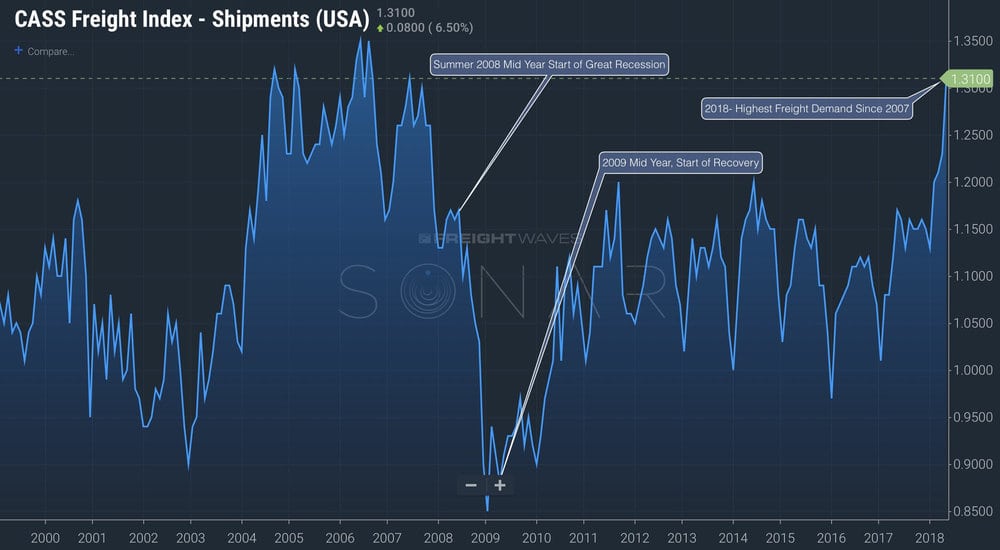
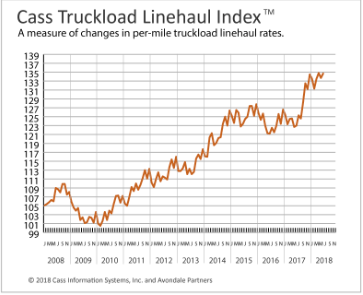
According to the Cass Freight Index from May 2018, the U.S. freight economy is very strong in the face of a burgeoning trade war. In fact, according to Freight Waves, freight volume is higher than it has been in a decade. At its lowest during the great recession of 2009, the Cass Freight Index sank to .85, compared to 1.31 in 2018. The chart pictured here is from SONAR, a tool that helps analysts gather data to get a picture of the freight market. According to May’s Cass Freight Index report, the first five months of 2018 have excelled even beyond 2014—another very strong year in recent history for freight volume. According to the report, demand is rapidly expanding.

The U.S. economy’s strength is also likely to accelerate, usually indicated by transportation. Because these kinds of percentage increases are no longer immediately following a recession (instead they are weighed against already strong statistics), this is a uniquely positive sign for the economy. The largest 25 trucking companies also collectively rose their combined revenue by 5.4% in 2017. Although this percentage sounds small, it actually equates to billions of dollars.

The June Cass Freight Index has also continued to rise, and at increased acceleration. It’s rising—and rising faster than before. According to the June Index, June was the 21st consecutive month of increases, and brings the three-month moving average up to 8.8%. These companies are growing: the number of companies with 500 million to 1 billion dollars in revenue rose compar

ed to previous years (there are now five). This is good news for those considering a career in commercial transportation. Whether you’d like to become an owner-operator or work for a trucking company, the demand for drivers is rising even higher.

Improvements in the U.S. economy like this are usually a great sign for truck drivers on the road every day. If consumer demand is up, it means that people are buying more goods which means more cargo to ship and transport. Carriers will be looking to put out more goods, and truck drivers gain more work trying to meet those needs. Advancements in consumer demand as well as technology have directly influenced the trucking industry simultaneously, according to Fleet Owner. For example, Amazon’s nationwide (and worldwide) shipment centers are now strategically placed in towns and cities to enable same day or next day delivery for people everywhere. The demand for Amazon deliveries is very high, and these deliveries are exceptionally time sensitive. In general, the practice of online shopping in the United States has skyrocketed, and many Americans shop online exclusively or primarily. This too creates higher demand for shipping. This means more demand for commercial vehicles and cargo transport in more cities and towns. However, the severe traffic congestion in major metropolitan cities is still a major concern for the commercial trucking industry because that time and fuel spent in traffic is expensive.

Because there is still a shortage of drivers in the commercial transportation industry and the trucking industry overall, this boom should provide an opportunity for truck drivers to thrive in the industry. Companies even offer bonuses contingent on performance on the road (safety, efficiency, productivity) as well as bonuses for signing up or referring someone. These incentives are a good opportunity to ensure some initial financial stability if you’re a new driver or considering getting your CDL and financing your commercial vehicle. However, these incentives have so far not improved the shortage of truck drivers in the United States.

Where to Start

The Cass Freight Index is a useful tool to determine the current state of the U.S. economy in terms of shipping volume and demand. As the economy continues to look optimistic, many Americans might consider their options in a field like commercial transport. Some potential drivers may be discouraged by the expense of financing a commercial vehicle to become an owner-operator. If you have debt, child support trouble, or credit problems, you might think that you don’t qualify for a commercial vehicle loan. This isn’t actually true—there are many lenders that are flexible to poor credit. Financing a loan can be a quick, easy process if you find the right lender for your needs. To learn more about direct lending or financing a loan through your dealership, visit https://www.missionfinancialservices.net to learn about the services available in your area.

Archives

Sign Me Up!

Stay up to date with the latest news in the commercial trucking industry.

Contact Us
close slider