


Office: (404) 975-4800

Adie Marais

Cass Transportation Index Report August 2026: Freight Shipments Turn Positive After 42 Months

Cass Transportation Index Report August 2026: Freight Shipments Turn Positive After 42 Months

Cass Transportation Index August 2026

The Cass Transportation Index Report for August 2026 shows freight shipments rose 2.1% year over year. That’s the first annual gain since January 2023, ending a 42-month downturn.

Freight spending jumped 18.7%, and truckload linehaul rates climbed 11.3% from a year ago.

Owner-operators can use these numbers to plan loads, costs, and truck purchases. Below, we break down each index, ACT Research’s outlook, and what it means for your business.

What Did the August 2026 Cass Report Show?

All three measures rose in August: shipments, spending, and truckload rates. Here are the headline numbers from the Cass August 2026 report.

Index August 2026 Year over year 2-year stacked Month to month Month to month (seasonally adjusted)
Cass Freight Index: Shipments 1.038 +2.1% -7.4% +5.6% +5.0%
Cass Freight Index: Expenditures 3.722 +18.7% +18.3% +5.8% +6.0%
Truckload Linehaul Index 153.9 +11.3% +12.6% +0.7% Not reported

Cass builds these indexes from the freight bills it pays on behalf of shippers. Our explainer on the Cass Transportation Index Report covers how each one is calculated.

Shipments Rose 2.1% Year Over Year
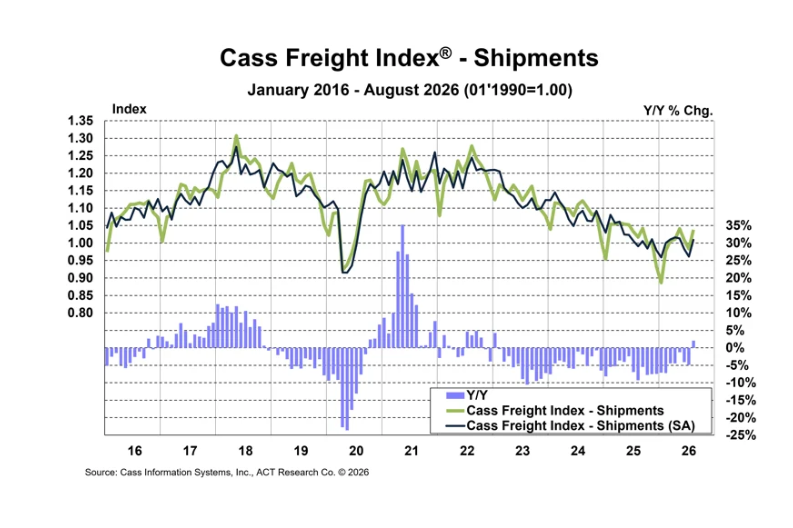
Cass Freight Index - Shipments August 2026

Shipments rose 2.1% year over year and 5.6% from July. On a seasonally adjusted basis, they rose 5.0%. That’s the first annual gain since January 2023. The 42-month slide was the longest downturn on record for this measure.

Don’t break out the confetti yet, though. Cass notes the August jump mostly reversed declines in June and July. ACT Research, which writes the report, is hesitant to call it a major improvement in freight demand.

The 2-year stacked figure is also still down 7.4%. If normal seasonal patterns hold, Cass expects shipments to be up about 1% year over year in September.

Volumes have climbed since spring. Our March 2026 Cass report recap showed shipments down roughly 4.5% year over year.

Freight Expenditures Jumped 18.7% Year Over Year
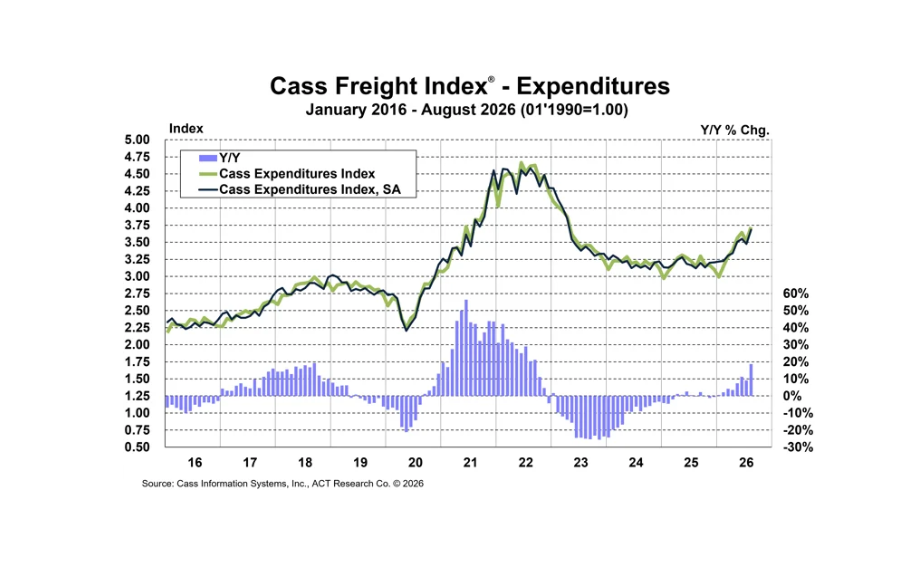
Cass Freight Index - Expenditures August 2026

Freight expenditures rose 18.7% year over year in August, up from a 9.1% gain in July. This index tracks the total amount shippers spend on freight, including fuel.

Year over year, shipments rose only 2.1%. That means higher rates and fuel costs drove most of the 18.7% jump in spending.

The monthly picture looks different. Seasonally adjusted, spending rose 6.0% from July while shipments rose 5.0%, which implies rates rose about 1.0%.

Fuel is a big part of the yearly gain. The national average diesel price hit $6.382 a gallon on September 28, 2026 (EIA). That’s $2.628 more than a year earlier.

The expenditures index fell 19% in 2023, 11% in 2024, and another 0.5% in 2025.

Truckload Linehaul Rates Climbed 11.3% Year Over Year
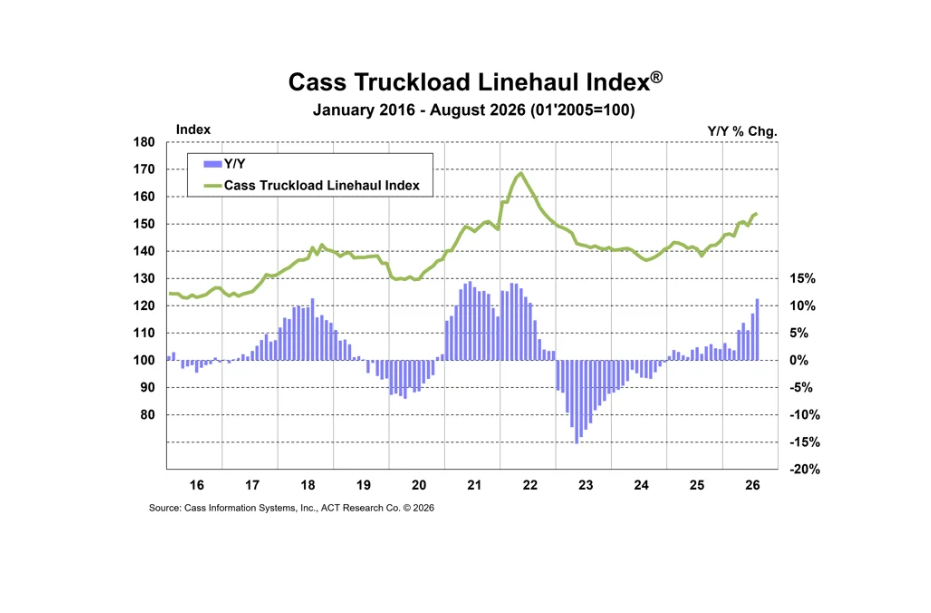
Cass Truckload Linehaul Index - August 2026

The Cass Truckload Linehaul Index rose to 153.9 in August. That’s up 0.7% from July and 11.3% from August 2025.

This index measures truckload rates without fuel and accessorial charges. It covers both spot and contract rates across the for-hire market.

Spot rates have cooled with small monthly declines. Contract rates, which make up the much bigger share of the market, keep adjusting higher.

The index fell 10% in 2023 and 3.4% in 2024, then rose 1.8% in 2025. Cass says it’s on pace for a 7% gain in 2026 if rates hold where they are.

What ACT Research Expects Next for the Freight Market

ACT Research thinks the freight market has probably hit bottom. It expects modest growth from here, with some risks attached.

ACT points to three things supporting freight volumes:

  • A growing economy: U.S. growth is strong, even with a soft job market.
  • Inventory restocking: Ocean import volumes are rising, which usually leads to more truck freight.
  • Tariff refunds: Refunds of IEEPA duties are giving shippers extra cash to rebuild inventory.

U.S. Customs and Border Protection now processes these refunds through a system called CAPE. ACT says the refunds helped push corporate profit margins to record highs in Q2.

Capacity Is Starting to Grow Again

Class 8 tractor sales rose above replacement levels in July and August. That lets the truck fleet grow for the first time after 18 months of shrinking.

New regulations and broker liability laws make it harder for new carriers to enter. ACT expects that to slow capacity growth.

In our experience, carriers with active authority and steady customers gain the most when fewer new trucks enter. Rate gains also tend to hold longer.

Risks to Watch

ACT lists oil prices, inflation, and interest rates as the biggest risks. Any of the three could slow consumer spending and freight demand.

Trucks of different sizes parked in a large lot

What the August 2026 Cass Report Means for Owner-Operators and Small Fleets

The August report points to better rates and slightly more freight. High fuel costs can eat much of that gain, though. Here’s how we’d use the data.

Know Your Cost Per Mile

An 11% rate increase doesn’t help much if your costs rose faster. Diesel is up more than $2.60 a gallon from last year.

If your truck gets 6.5 miles per gallon, that’s about 40 cents more per mile in fuel alone.

Fuel moves your cost per mile for commercial trucking faster than anything else, so recheck it every month.

Also make sure your contracts include a fuel surcharge that tracks weekly diesel prices.

Push for Better Contract Rates

Contract rates are rising while spot rates cool. That makes now a good time to lock in steady lanes with direct shippers or brokers.

We’ve found that owner-operators with a few reliable contract lanes handle rate swings much better. That base comes from finding truck loads through more than one channel, like brokers and direct shippers.

Time Truck Purchases Carefully

Class 8 sales are back above replacement levels, so more fleets are buying trucks again. If you’re planning a purchase too, start early.

Climbing repair bills and more frequent downtime are two signs it’s time to replace fleet vehicles.

If you’re adding trucks rather than replacing one, small fleet loans let you finance more than one vehicle. Compare current commercial truck financing rates before you shop, so you know what payment your lanes can support.

Final Thoughts

The August 2026 Cass report shows freight shipments back in positive territory for the first time in 42 months. Linehaul rates are up 11.3%, and contract rates are still climbing.

High diesel prices and soft demand mean the recovery will likely be slow. Watch your cost per mile, lock in solid contract lanes, and plan equipment moves early.

If you need to replace a truck, cover a repair, or add to your fleet, start your credit application. We’ll get back to you within four hours.


What Is Trucking Equipment Financing and How Does It Work?

What Is Trucking Equipment Financing and How Does It Work?

Person counting cash over financial reports, a phone calculator, and a laptop while budgeting for a truck purchase

Trucking equipment financing is a loan or lease that pays for the trucks, trailers, and other gear your business needs. You pay it back in fixed monthly payments over a set term.

The equipment itself is the collateral. That makes approval easier than with an unsecured business loan, even if your credit has a few dings.

What Is Trucking Equipment Financing?

Trucking equipment financing is funding for the business equipment that keeps your loads moving. Common examples include:

  • New and used semi trucks and other commercial vehicles
  • Dry van, reefer, and flatbed trailers
  • Box trucks and dump trucks
  • Specialized equipment, like refrigeration units, liftgates, or tires

Equipment financing companies fund restaurant equipment, medical equipment, manufacturing equipment, and plenty more. In 2023, 82% of businesses that acquired equipment or software used some form of financing.

A semi truck is the biggest capital investment most owner-operators make. Few can buy equipment outright, given what a semi truck costs. Most buyers finance instead. The best fit is a lender who knows the trucking industry and how age, mileage, and engine affect value.

New equipment adds a 12% federal excise tax to the first retail sale of most heavy trucks and trailers (26 U.S. Code 4051).

How Does Trucking Equipment Financing Work?

A lender pays the seller for the equipment, and you repay the lender over time with interest. Here’s how it typically plays out:

  1. You pick the truck or trailer and get a written quote from the seller.
  2. You apply with a lender and make a down payment.
  3. The lender pays the seller and records a lien on the title.
  4. You make monthly payments until the loan is paid off.
  5. The lender releases the lien, and the equipment is fully yours.

If you stop paying, the lender can repossess the equipment, which is why approval is easier than for unsecured loans.

Person using a calculator and writing figures on paper to estimate semi-truck loan payments

Example of Equipment Financing

Say you buy a used semi truck for $50,000 and put 25% down ($12,500). You finance the remaining $37,500 at a 20% contract rate for 42 months.

Your payment would be about $1,249 a month, with about $14,943 in total interest.

Our 16% prepaid finance charge and $495 doc fee add about $6,500 on top of that. If you roll them into the loan, your payment comes to about $1,465 a month.

Always compare lenders on APR, since it includes fees as well as the contract rate.

Types of Trucking Equipment Financing

The main equipment financing options are equipment loans, leases, bank loans, SBA loans, and dealer financing.

Equipment Loans

An equipment loan is a business loan you use to purchase equipment, like a specific truck or trailer. You own it from day one, and the lender holds a lien until you pay it off.

Some lenders call this an Equipment Finance Agreement (EFA). Lenders structure financing around the truck’s age, the loan amount, and your credit, so terms vary.

Equipment Leasing

With equipment leasing, the leasing company owns the truck. You pay to use it for a set term. Leases usually come with lower upfront costs than a purchase.

  • Capital lease: Works like a purchase. You usually buy the equipment at the end for a set residual price.
  • Operating lease: Works like a rental. You return the equipment at the end, often with mileage limits.

Bank and Credit Union Loans

Banks and credit unions usually offer the lowest interest rates, but they’re the hardest to qualify for.

They favor established businesses with 2+ years of history, strong credit, and a newer truck. Many banks don’t finance commercial trucks at all.

Specialty truck lenders finance the used trucks banks turn down, with equipment financing solutions built for owner-operators.

SBA Loans

The Small Business Administration guarantees loans made by partner lenders, which helps borrowers get longer terms.

SBA 7(a) loans go up to $5 million, and you can use them to finance equipment (SBA).

SBA 504 loans work through certified development companies. They only cover equipment with at least 10 years of useful life left. That likely rules out most used trucks.

Approval involves a stack of paperwork, so SBA loans suit planned equipment purchases better than quick buys.

Dealer and Manufacturer Financing

Dealers and truck makers often arrange financing at the point of sale. It’s convenient, and new-truck promotions can be hard to beat if your credit is strong.

Compare the dealer’s offer with at least one outside lender before you sign. Mission Financial is a preferred lender for dealerships, so you can often use us through the dealer, too.

Two men shaking hands and smiling in front of a blue semi-truck, one wearing a cap and overalls with a lanyard, the other in a plaid shirt.

What Credit Score Do You Need for Equipment Financing?

There’s no single minimum credit score. Each lender sets its own.

Banks usually want a score above 700, plus two or more years in business. Online lenders go as low as 550.

Some lenders check business credit scores too. If you’ve just formed your LLC, though, lenders usually rely on your personal credit.

We’ve helped owner-operators get loans with credit scores as low as 460. We look at your overall credit, including on-time payments on your home or car. Past bankruptcies and repossessions don’t rule out bad credit truck loans if they’re more than a year old.

Equipment Financing Rates and Down Payments

FreightWaves puts commercial truck loan APRs in 2026 at about 6% to 35%. Well-qualified borrowers pay 4% to 8% at banks and 7% to 12% at specialty lenders.

Specialty lenders offer terms up to 84 months. Trucks over 10 years old with 700,000+ miles get harder to finance, though some lenders go up to 15 years.

Our contract rates run from 18% to 29.95%, with terms up to 42 months. Trucks from 2012 and newer can qualify for 48 months.

Those rates are higher because we approve credit profiles that banks turn down. We also finance trucks as far back as model year 2000.

First-time buyers with us typically put down 20% to 30%.

Rates shift with the market, so check current commercial truck financing rates before you sign. Your term matters just as much, since how long you finance a commercial truck changes your total interest.

Pros and Cons of Trucking Equipment Financing

Financing gets you working equipment without a huge cash outlay, but you pay interest and risk losing the truck.

Close-up of a hand using a desk calculator next to a keyboard to work out monthly payments

Advantages of Financing

  • Keeps working capital free: Your cash stays available for fuel, insurance, and repairs.
  • Builds equity: Every payment brings you closer to owning the truck outright.
  • Easier approval: The equipment secures the loan, so lenders take on less risk.
  • Tax benefits: The tax code’s Section 179 lets you expense up to $2,560,000 of qualifying equipment in 2026 (IRS).

Property acquired after January 19, 2025, can also get 100% bonus depreciation.

With a loan, you can’t deduct the whole monthly payment. You deduct the interest and write off the truck through depreciation or Section 179.

The rules depend on your setup, so talk to a tax professional before you count on a deduction. Our list of truck driver tax deductions covers other write-offs owner-operators can claim.

Potential Challenges and Risks

  • Interest adds up: Higher rates for weaker credit can add thousands to the total cost.
  • Down payment: You’ll still need cash upfront.
  • Depreciation: Trucks lose value, so you can end up owing more than the truck is worth.
  • Personal guarantees: Many lenders make you personally responsible if the business can’t pay.

A personal guarantee puts your personal assets on the line, even if you’ve set up an LLC. An LLC can still protect you from business debts you haven’t guaranteed, so your trucking company’s business structure matters.

How to Apply for Trucking Equipment Financing

Getting your financial documents ready before you shop speeds up approval. Most lenders ask for the same basics:

  • A completed credit application
  • Your CDL
  • Recent bank statements or tax returns
  • A written quote or bill of sale for the equipment
  • A spec sheet with the year, make, model, VIN, and mileage
  • Proof of insurance
  • Your LLC agreement or articles of incorporation (the filing that forms a corporation), if you have them

Some lenders also ask for business licenses or operating authority, like an MC number.

Trucking business owner reviewing paperwork and filling out a financing application at a desk

Final Thoughts

Trucking equipment financing lets you put a truck or trailer to work now and pay for it over time. Compare loans, leases, and SBA options on total cost, along with the monthly payment.

When you’ve found the right truck, start your credit application with Mission Financial.

Frequently Asked Questions

Is Collateral Required for Equipment Financing?

Yes, but the equipment you’re buying usually serves as the collateral. Some lenders ask for other business assets as extra collateral if your credit is weak.

What Is the Minimum Credit Score to Buy a Semi Truck?

It depends on the lender. Banks usually want a score above 700, while Mission Financial Services has approved scores as low as 460.

Can Startups Get Trucking Equipment Financing?

Yes. Many lenders work with a new trucking company, though you’ll likely need a bigger down payment. Mission Financial Services’ first-time buyer loans are built for new owner-operators.

How Long Can You Finance a Commercial Truck?

How Long Can You Finance a Commercial Truck?

A white semi truck pulling a curtain-side trailer drives down a rural highway under a clear blue sky.

Most commercial truck loans run between 24 and 84 months. The exact length depends on the truck’s age, your credit history, and your down payment.

In our experience with owner-operators and small fleets in the trucking industry, the right term isn’t the longest one. It’s about matching the loan to how long the truck will actually earn money.

This guide covers typical loan terms for your trucking business, what stretches them, and how to find the right fit.

TL;DR

  • Commercial truck loan terms typically run 24 to 84 months. Most owner-operators land in the 36 to 72 month range (3 to 6 years).
  • Newer trucks with strong buyer credit can stretch to 84 months. Older or high-mileage trucks usually top out at 60 months.
  • SBA 7(a) loans allow up to 10 years for equipment. Most truck purchases don’t need the full term.
  • Credit score, down payment, truck age, and lender type all affect how long you can finance.
  • Shorter terms cost less overall. Longer terms free up cash flow. The right pick depends on how you plan to use the truck.

How Long Can You Finance a Commercial Truck?

You can typically finance a commercial truck for 24 to 84 months. Banks and credit unions often cap terms around 60 months. Specialty commercial truck lenders regularly extend terms to 72 or 84 months for well-qualified buyers.

Most lenders also weigh whether you’re buying a new semi-truck or a used one before setting your final term.

Where you land in that range depends on the truck and the borrower. A late-model truck with low mileage and a buyer with strong credit supports a longer term. An older, high-mileage truck, or a first-time buyer with thin credit, usually gets a shorter one.

Lenders want the loan to end before the truck’s usable life does.

Rates and terms move together too. Our guide to current commercial truck financing rates breaks down what different credit profiles can expect right now.

Hand holding a fan of hundred-dollar bills for a semi truck loan down payment

What Loan Terms Are Available for Commercial Truck Financing?

Loan terms for commercial trucks fall into three general bands. Each one fits a different buyer: an owner-operator, a growing fleet, or a landscaping company financing its first box truck.

Short-Term Loans: 12 to 36 Months

Short terms suit buyers who want to build equity fast and pay less interest overall. A shorter term also usually comes with a lower interest rate. They’re common for older trucks and smaller loan amounts. Monthly payments run higher, but you own the truck outright much sooner.

Mid-Range Terms: 36 to 72 Months

This is where most owner-operators land. It balances a manageable monthly payment against a total interest cost that doesn’t spiral. Many lenders offer flexible terms in this range, which helps match the payment schedule to seasonal revenue swings.

Mid-range terms work well for used trucks in solid condition and average to good credit.

Extended Terms: 72 to 84 Months

Extended terms are reserved for newer, higher-value trucks and buyers with strong credit and business history. They mean lower monthly payments, but more interest paid over the life of the loan. You may also owe more than the truck is worth for a stretch of the loan.

What Factors Determine Your Commercial Truck Loan Term?

Four things drive how long a lender will let you finance a truck. They are your credit, the truck’s age, your down payment, and your lender type. Together, these four factors shape your financing terms more than anything else.

Your Credit Score and Business History

A stronger credit profile opens the door to longer terms and lower rates.

Traditional banks often want a personal credit score in the high 600s or above. They typically ask for a personal guarantee on top of that. Specialty and alternative lenders will work with scores well below that, sometimes into the 500s. In exchange, they often ask for a shorter term or a bigger down payment.

First-time buyers with limited credit history usually see fewer term options until they build a track record.

Lenders also treat different business entities differently. An LLC with steady business revenue may see better approval odds than a brand-new sole proprietorship.

You’ll typically need to show proof of a commercial driver’s license alongside your application too.

If your credit needs work, approval is still possible. Our guide on bad credit semi-truck financing covers what to expect.

Business owner calculating monthly payments for commercial truck financing

New vs. Used Truck Age

Newer trucks support longer terms. They have more useful life left and hold their value longer. A new semi truck with low mileage will often qualify for the full 84-month window. Newer models frequently deliver better fuel efficiency too and come with a manufacturer warranty.

Used vehicles tend to depreciate faster, so lenders shorten the term accordingly.

Older or higher-mileage units come with shorter available terms since lenders don’t want a loan outlasting the truck’s productive years.

Down Payment Size

A larger down payment lowers the lender’s risk. And it often unlocks a longer term or a better rate.

Down payments on commercial trucks commonly range from 5% to 30% of the purchase price. Good credit borrowers typically fall into the 10 to 15% down payment range.

A used truck with a lower purchase price often needs a smaller down payment in dollar terms. Some lenders will also accept additional collateral, such as a second vehicle, in place of a bigger down payment.

Sales tax, title fees, and other closing costs are usually rolled into the loan rather than paid separately.

First-time buyers usually sit at the higher end of the down payment range.

If putting money down isn’t an option right now, see our breakdown of zero-down semi-truck financing. It offers lower upfront costs in exchange for a higher rate.

Lender Type

Banks tend to offer the lowest rates but the shortest terms and strictest credit rules. Established businesses with years of steady revenue often qualify for the most competitive rates across all lender types.

Specialty commercial truck lenders often stretch terms further and work with a wider range of credit profiles. The truck serves as collateral for the loan, which gives them more flexibility.

Online and alternative lenders sit somewhere in between, trading flexibility for a higher rate.

Truck driver behind the wheel with a model semi truck on the dashboard

Can You Finance a Commercial Truck for Longer Than 84 Months?

Yes, but it’s uncommon outside of SBA financing. An SBA 7(a) loan is designed to help small businesses secure equipment terms up to 10 years. This can include a commercial vehicle used in your business. Most SBA loans also require a personal guarantee from the business owner. These loans involve more paperwork and can slow the approval process significantly. They’re worth a look if you want the lowest possible payment and meet the SBA’s business criteria.

Outside of SBA lending, most conventional and specialty truck lenders cap terms at 84 months. That’s roughly where a truck’s depreciation curve and the loan balance stop lining up. A much longer term risks leaving you owing more than the truck is worth.

Tax treatment matters here too. Under Section 179, businesses can often deduct a truck’s full purchase price in the year it’s placed in service. This beats spreading the deduction across several years, per IRS Publication 946. That upfront tax benefit is worth weighing alongside your loan term. It can help offset the cost of a shorter, higher-payment loan.

Should You Choose a Longer or Shorter Loan Term?

Neither option is automatically better. It depends on your cash flow and how long you plan to keep the truck. It also depends on how much interest you’re willing to pay.

When a Longer Term Makes Sense

Choose a longer term if you need lower payments to protect cash flow for fuel, repairs, and insurance. It also fits if you plan to keep the truck for its full service life. The same goes for multiple trucks financed together during a fleet expansion, since it preserves cash for growth.

When a Shorter Term Makes Sense

Choose a shorter term if your business has steady revenue and you want to build equity fast. It’s also the better fit for an older truck. You don’t want to still owe money on it once major repairs start piling up.

Owner-operator standing with arms crossed in front of his semi truck

Semi Truck Financing vs. Leasing: Which Fits Your Timeline?

Financing turns a commercial vehicle into a long-term asset you own outright. Leasing trades that ownership for lower payments and more flexibility.

If your business needs are still changing, leasing may fit better than a long-term loan. Our guide on whether leasing a semi truck is right for you breaks down the trade-offs.

If you already know you want to keep the truck long-term, financing is usually the more cost-effective route.

How To Choose the Right Loan Term for Your Truck

Start with your monthly budget. Look at what you can comfortably pay after fuel, insurance, maintenance, and permits, and work backward from there.

Then think about how long the truck will realistically stay productive in your operation. A term that outlasts the truck’s useful life tends to cause problems later, even when the payment looks manageable today. Ask your lender for a full payment schedule and check for prepayment penalties before you sign.

We’ve found that borrowers who compare the annual percentage rate, not just the sticker rate, end up with better financing. A shorter term with a higher payment can still cost less than a longer one that looks easier on paper.

The best term is the one that fits your financial situation today, not just the truck’s price tag.

Ready to Find Your Loan Term?

We know every borrower’s situation looks a little different. The truck, the credit profile, and the down payment all pull your loan term in different directions.

Finding the right financing means matching your loan term to your truck and your business, not the lowest payment alone.

Our team at Mission Financial Services can pull your options together fast. We’ll walk you through the trade-offs in plain language. Then we’ll help you land on financing that actually fits your business, not just your budget.

Frequently Asked Questions

What is the average commercial truck loan term?

Most commercial truck loans run 36 to 72 months. Newer trucks and stronger credit can extend that to 84 months. Older or high-mileage trucks often max out at 60 months or less.

Can I get a 10-year loan for a semi-truck?

It’s possible through an SBA 7(a) equipment loan, which allows terms up to 10 years. A standard semi-truck loan through a bank or specialty lender rarely stretches past 84 months.

Does a bigger down payment get me a longer loan term?

It can. A larger down payment lowers the lender’s risk. That sometimes opens the door to a longer term or a better rate, especially on an older or higher-mileage truck.

How to Reduce Fleet Costs and Improve Your Bottom Line

How to Reduce Fleet Costs and Improve Your Bottom Line

Close-up of hands stacking coins into growing piles, representing steady financial gains from reducing fleet costs

Running a truck costs more in 2026 than at any point on record. If you’re managing 1 to 10 trucks, every extra cent per mile eats directly into your margin.

This guide breaks down where fleet costs come from and how to calculate your real numbers. And it covers the strategies that actually move them, from fuel and maintenance to financing and insurance.

TL;DR

  • The average cost to run a truck hit $2.336 per mile in 2025, the highest on record, according to ATRI.
  • Diesel prices have jumped over $1.70 a gallon in the past year, so fuel savings matter more than ever.
  • Tracking cost per mile by truck, not by fleet, is the fastest way to spot which vehicles are losing you money.
  • Idling, driver behavior, and preventive maintenance are the quickest wins. Financing and insurance decisions drive the bigger, longer-term savings.

What Is Driving Up Fleet Costs Right Now?

Fleet management costs are rising because almost every major expense category went up in 2025. Fixed costs like insurance stay fairly steady. Variable costs and indirect costs, fuel, tolls, and repairs, are climbing fastest for fleet managers and owner-operators alike.

ATRI’s 2026 report found average operating costs to run a truck reached $2.336 per mile in 2025. That’s up 3.4% from $2.260 the year before, the highest per-mile cost on record.

Repair and maintenance costs rose 8.6% to $0.404 per mile. Aging trucks are especially prone to these higher maintenance costs as parts wear out.

Tolls jumped 13.2%, driver benefits climbed 6.6%, and tire costs rose 6.4%. Truck and trailer lease payments also increased, up 3.6% to roughly $0.40 per mile.

Small fleets spent less on vehicle acquisition in 2025 than in 2024. That’s a sign many are holding off on new fleet vehicles while operational costs settle.

Diesel prices also spiked hard in 2026. The EIA’s weekly survey put the national average retail diesel price at $5.454 per gallon in mid-August. That’s up more than $1.70 from a year earlier. That swing alone can wipe out a season’s margin for a small fleet.

White semi truck with a trailer driving on a two-lane highway past forested mountains

How Much Does It Cost to Run Your Truck?

The two numbers that matter most are total cost of ownership (TCO) and cost per mile (CPM).

TCO adds up everything you spend on a truck over its vehicle life. That’s purchase or financing costs, fuel, maintenance, insurance, tolls, administrative costs, and driver pay, minus resale value.

For example, say you finance a truck for $150,000 and spend $400,000 more on fuel, repairs, and insurance over five years. Your TCO is $550,000 minus whatever you sell it for at the end.

CPM divides that total by the miles the truck drove over the same period.

A truck with a $550,000 TCO that ran 500,000 miles over five years costs $1.10 per mile to run. That single number tells you whether a load, a lane, or a rate is actually worth taking.

Here’s what CPM and TCO help you do:

  • Spot the one truck losing money on repairs before it drains your cash.
  • Decide whether a load or lane covers your real cost to run, not just your fuel and driver pay.
  • Know when a truck has crossed from a cost-efficient asset into a money pit, so you can plan a repair, sale, or replacement instead of reacting to a breakdown.
  • Compare financing, insurance, or leasing offers against your actual numbers instead of guessing.

Running the math per truck, every month, is the only way to catch a problem while it’s still cheap.

5 Best Strategies to Reduce Costs for Small Fleets

The strategies that move the needle fall into five areas: fuel, maintenance, technology, financing, and insurance. Some pay off within weeks. Others take longer but deliver bigger, more lasting savings.

Here’s how to tackle each one to help reduce fleet expenses.

Coins in a glass jar with a small plant sprouting from them, symbolizing how small changes can grow into real savings on fleet costs

1. Cut Fuel Costs

Fuel is one of the highest costs in your budget, and it’s tied directly to fuel consumption for every truck.

Start by cutting excessive idling. The U.S. Department of Energy estimates that idling wastes more than 6 billion gallons of fuel every year across U.S. vehicles. That costs over $11 billion at a $2-per-gallon baseline.

Cutting idling during rest periods is one of the simplest ways to reduce fuel consumption.

Next, address driving habits. Aggressive driving, speeding, hard braking, and rapid acceleration can lower fuel economy by 15% to 30% at highway speeds. In stop-and-go traffic, the loss climbs to 10% to 40%.

Learning to anticipate traffic flow and brake gradually protects your fuel budget. If you’re due for a replacement, moving toward more fuel-efficient vehicles compounds these savings over time.

A few other ways to reduce fleet costs pay off quickly, without new equipment:

  • Keep tires properly inflated and aligned. Proper tire care is one of the cheapest ways to improve fuel efficiency.
  • Use fuel cards to track spending by driver and station. This helps you optimize fuel consumption and catch unusual purchases early.
  • Plan routes more efficiently to cut empty miles and avoid unnecessary detours.

Together, these habits add up to real fleet efficiency gains for smaller operations. We break down more tactics in our guide to fuel-efficiency strategies for semi-trucks.

2. Lower Maintenance and Repair Costs

You can lower repair costs by catching small problems before they become expensive ones. Reactive repairs, the kind that follow a breakdown, almost always cost more than a scheduled fix.

A single costly breakdown can spiral into thousands of dollars in emergency repair costs. On top of that, you lose days waiting on a shop appointment.

A proactive fleet maintenance program of oil changes, tire rotations, and inspections keeps small issues from becoming major failures.

Many small fleets are updating their maintenance procedures to include predictive maintenance. That means using engine hours and sensor data to schedule maintenance before a part fails. Predictive maintenance also helps you avoid unnecessary service, since parts get replaced based on real wear.

A clean maintenance history for each truck also helps you spot patterns and avoid repeat maintenance expenses.

Train yourself or your drivers to catch early warning signs, too. A failing carrier bearing, for example, often gives off clear signals before it fails. Catching it early is far cheaper than a roadside breakdown and helps protect the truck’s vehicle lifespan.

Set up a repeatable pre-trip and maintenance routine so vehicle repairs don’t pile up unnoticed.

Two technicians review a fleet maintenance checklist together in front of a blue semi truck in a service bay.

3. Use Telematics and GPS Tracking

Telematics data, GPS tracking, and fleet management software give you the cost visibility to see where money is being wasted.

These systems combine fleet tracking, vehicle location, and driver behavior data in real time. That lets you monitor driver behavior without guessing from fuel receipts and mileage logs.

Telematics helps in several ways:

  • It can trigger maintenance alerts based on vehicle condition, flagging problems before they become a shop visit.
  • It can lower fuel costs. Fleets using GPS tracking reported an average 12% decrease in fuel costs. Much of that comes from catching idling and aggressive driving early.
  • It supports route planning and optimizing routes, cutting empty miles and out-of-route stops that quietly drain your fuel budget.

Together, these capabilities raise operational efficiency without adding headcount.

For small fleets, the value is in catching patterns early. That might be a truck with poor vehicle utilization or weak asset utilization. It could also be a route that runs long or a driver who brakes hard.

Left unaddressed, each adds up over a year.

4. Review Financing and Leasing Decisions

Every truck eventually reaches a point where repair and maintenance costs outpace what it can still earn. Holding onto an aging truck past that point usually costs more than replacing it, even with a new loan payment. When you do replace it, how you pay for the truck matters as much as when you buy it.

Start by reviewing current commercial truck financing rates before you commit to a loan. Rates shift, and locking in an old quote can cost you thousands over the life of the loan.

Leasing a semi-truck instead of buying is worth considering too. It’s especially useful if cash is tight or you won’t keep the truck long. As a rule of thumb, financing suits fleets running the truck for years with cash to weather a slow month. Leasing suits fleets that want to preserve cash flow now or avoid the resale risk of owning it.

Truck driver sitting in the cab of a semi truck reviewing paperwork on a clipboard before a trip

5. Lower Insurance Costs

You lower fleet insurance costs mainly by reducing risk and proving it. Insurers increasingly look at real driving data instead of just claims history. Fleets that adopt safer habits often qualify for lower insurance premiums over time.

Dash cams are one direct way to support this. They provide evidence in the event of an incident, which can protect you from liability. Over time, that evidence supports a case for lower premiums. Our guide to the best dash cams for semi trucks covers what to look for.

Beyond equipment, consistent driver training and a clean maintenance record both shape how insurers assess your risk.

Shopping your policy every year or two, rather than renewing automatically, helps you avoid paying more than the market rate.

Where Should You Start Cutting Fleet Costs Today?

Start with your numbers. Calculate cost per mile for each truck, not just your fleet as a whole. That’s the fastest way to reduce costs you can’t otherwise see. From there, tackle idling, driver behavior, and fuel card monitoring first. Those usually show results within weeks.

Preventive maintenance and telematics take longer to pay off, but they save money more consistently over time. Financing and insurance decisions matter most over the life of the truck. Review them at least once a year instead of letting old terms roll forward.

At Mission Financial Services, we’ve worked with owner-operators and small fleets across the country. The businesses managing costs best treat financing as part of their overall fleet management strategy, not an afterthought. Whether you need a repair loan, operating capital, or financing for your next truck, we’re here to help.

8 Fleet Maintenance Best Practices for Owner-Operators

8 Fleet Maintenance Best Practices for Owner-Operators

A smiling technician in a plaid shirt and overalls leans against the cab of a blue semi truck in a repair shop.

Fleet maintenance is the routine inspections, repairs, and scheduled service that keep fleet vehicles safe and on the road.

For any commercial fleet running one to ten trucks, it’s also one of your biggest controllable costs. Skip it, and a small, cheap fix can turn into a major repair bill. Stay on top of it, and you protect your equipment, your CSA score, and your bottom line.

Effective fleet management starts with a routine you can actually stick to. This guide covers the maintenance schedules, checklists, and tracking habits that support fleet operations of any size.

TL;DR

  • Preventive maintenance, done on a schedule, costs less over time than reactive repairs and emergency repairs.
  • Fleets with fewer than five trucks often carry the highest repair costs per mile. A plan matters even more for small operations.
  • Set a fleet maintenance schedule by mileage, engine hours, or time, whichever comes first for each truck.
  • Daily driver inspections and clean recordkeeping catch problems before they become breakdowns.
  • A maintenance reserve or financing option can protect your cash flow when something big goes wrong.
  • A few fleet management best practices, followed consistently, reduce operating costs and vehicle downtime.

What Is Fleet Maintenance?

Fleet maintenance is every inspection, repair, and scheduled service needed to keep a commercial vehicle safe and legal. For owner-operators and small fleets, it covers everything from daily pre-trip checks to major engine work. It also directly shapes vehicle reliability and vehicle uptime.

The Federal Motor Carrier Safety Administration requires every carrier to inspect, repair, and maintain the vehicles under its control. This falls under 49 CFR Part 396. It’s also one of seven categories that make up your CSA score and reflect your fleet safety record.

Preventive Maintenance vs. Reactive Repairs

Preventive maintenance follows a set schedule of routine maintenance tasks. Oil changes, filter swaps, brake inspections, and tire rotations happen at planned intervals, whether or not anything looks wrong yet.

Reactive maintenance happens after something has already failed. It costs more, keeps trucks out of service longer, and puts drivers at risk. Unexpected failures like these are exactly what a maintenance plan is built to prevent.

Planned, proactive maintenance almost always beats paying for surprises and helps reduce downtime.

A white semi truck pulling a curtain-side trailer drives down a rural highway under a clear blue sky.

Benefits of Fleet Maintenance

A consistent maintenance program pays off in several ways at once. The biggest benefits include:

  • Fewer breakdowns. Catching worn parts early keeps trucks off the shoulder and on schedule.
  • Lower repair costs. Small, planned fixes cost far less than an unplanned shop visit after a failure.
  • Better fuel efficiency. Properly inflated tires and clean filters help trucks burn less fuel per mile.
  • Stronger driver safety. Reliable brakes, tires, and lights reduce the risk of accidents on the road.
  • Cleaner compliance record. Fewer maintenance violations protect your CSA score and insurance rates.
  • Longer vehicle lifespan. Routine care extends the life of your trucks and protects resale value.

8 Fleet Maintenance Best Practices to Improve Efficiency

Good fleet maintenance follows a clear schedule and a checklist your team actually uses. These management best practices help reduce costs and keep your trucks in optimal condition, so you’re hit with fewer nasty surprises.

1. Build a Maintenance Schedule by Mileage, Hours, or Time

Stick to regular service intervals based on mileage, engine hours, or calendar time, whichever comes first. Start with the manufacturer’s guidelines, then adjust for actual vehicle usage.

A truck running stop-and-go city routes wears brakes faster than one on steady highway miles. A truck hauling heavy loads through mountain grades needs earlier transmission checks. A truck sitting idle for weeks still needs time-based service, even at low mileage.

Many small fleets combine two triggers to stay covered. One example: service every 25,000 miles or twelve months, whichever comes first. That way, a truck with light mileage still gets attention on schedule.

Regular servicing can cut total maintenance costs by 12% to 18%.

2. Create a Checklist and Assign Ownership

A maintenance checklist only helps if your team follows it every time. Organize it by system: engine, brakes, tires, electrical, steering, and body, matching each truck’s maintenance requirements. That way, nothing gets missed during a service visit.

For a full breakdown by component, our truck maintenance checklist for owner-operators walks through each system step by step.

Two technicians review a fleet maintenance checklist together in front of a blue semi truck in a service bay.

3. Cover the Core Preventive Maintenance Tasks

A solid preventive maintenance list covers fluids, filters, tires, brakes, wheel ends, batteries, and the electrical system. Each of these wears down gradually and affects vehicle performance if ignored.

Tires, Brakes, and Wheel Ends

Check tire pressure and tread depth on a schedule, not just when something looks off. Underinflated tires wear faster and hurt fuel efficiency. Regular tire service and rotation also helps extend vehicle lifespan.

Brake pads and drums need regular inspection. Brake and tire problems are among the most common issues flagged at roadside inspections.

Also check wheel ends. A failing carrier bearing often gives off warning signs like grinding noise or wheel wobble before it fails. A bearing failure on the road means real fleet downtime.

Fluids, Filters, and Engine Care

Engine oil, lubricants, coolant, and diesel exhaust fluid all need regular checks. Don’t just top them off when a warning light comes on. Contaminated or low fluids speed up engine wear, hurt engine performance, and trigger costly downtime.

Air and fuel filters protect the engine from dust, debris, and moisture that build up over thousands of highway miles. Clean filters help keep fuel usage predictable and improve fuel efficiency.

Oil changes are one of the most routine services a truck needs. Staying on schedule protects the engine more than any single fix after the fact.

Warning Lights and Diagnostic Checks

Modern trucks come with dozens of dashboard warning lights, and not all of them mean pull over right now. Knowing what each dashboard warning light means helps you gauge vehicle health and decide whether to keep driving.

Telematics and onboard diagnostics can flag fault codes before a light even comes on. Many systems also monitor driver behavior and feed fleet data back to your maintenance team.

Trucks with advanced driver assistance systems need extra care during windshield or sensor repairs to stay properly calibrated.

A close-up of a dark semi truck dashboard showing illuminated warning lights, including a hazard triangle icon and digital display.

4. Run Daily Driver Inspections

Driver inspections catch small problems between scheduled service visits. Federal regulations require drivers of most commercial vehicles to inspect the truck daily. They must also complete a written report after each day’s work.

Drivers must report any defect that could affect safety. Carriers must fix flagged issues before the truck goes back on the road.

A consistent routine turns your drivers into an early warning system. It also gives you a clearer read on driver performance over time.

Our pre-trip inspection checklist for truck drivers gives your team a consistent format to follow.

5. Train Drivers to Reduce Wear and Fuel Use

Driver behavior directly affects your maintenance costs. Hard braking, fast acceleration, and excess idling wear down brakes, tires, and engines faster than normal driving.

A short training refresh on smooth braking, steady acceleration, and proper shifting can cut wear on major components over time.

It also improves fuel efficiency, since aggressive driving and unnecessary idling both burn extra fuel per mile. Pairing training with telematics data gives you a clear picture of which habits to coach.

6. Protect Your CSA Score and Insurance Rates

Poor maintenance shows up directly in your CSA score through the Vehicle Maintenance category. That score reflects your fleet safety record. It can also drive up your insurance premiums.

Clean inspection records protect both and help you maintain compliance year after year.

FMCSA tracks Vehicle Maintenance violations for 24 months. A poor score can trigger a warning letter or a compliance investigation. Insurers also review your maintenance history when they set your premium.

Keeping repair receipts, inspection reports, and DVIRs organized protects you in an audit.

7. Track Maintenance Costs, KPIs, and Records

Managing fleet maintenance well comes down to one habit: tracking with a simple, consistent system. Centralized tracking can help to reduce compliance and safety risks.

A log per vehicle should show date, mileage, service performed, cost, and technician.

A spreadsheet works fine for a handful of trucks, as long as someone updates it after every service. Many fleets outgrow spreadsheets once they add a second or third truck. Dedicated fleet maintenance software makes sense to use once manual tracking starts taking up real time. It also keeps fleet management operations simple and supports better operational efficiency as you grow.

Cost per mile is one of the simplest fleet maintenance KPIs you can track. Maintenance is one line item inside it, alongside fuel, insurance, and financing.

Tracking it separately shows you which trucks cost more than they’re worth and highlights vehicle utilization patterns worth addressing so that you know when to replace your trucks.

A hand holds a tablet displaying bar charts and performance data, used for tracking fleet maintenance costs and KPIs.

8. Budget and Finance for Maintenance Before You Need To

Build a maintenance reserve for routine costs. Consider financing for major repairs or unplanned breakdowns, so that a single bill doesn’t wipe out your working capital.

Repair and maintenance costs have climbed sharply across the industry in recent years. Higher parts prices, aging equipment, and rising labor costs are the main drivers.

In our experience working with owner-operators, planning for maintenance costs up front makes a real difference. Operators who do this handle a blown turbo or a transmission rebuild far better than those who don’t.

A repair loan or a short-term operating capital loan can cover a major fix. That keeps your trucks earning instead of sitting in a shop.

If a truck is getting expensive to maintain, weigh financing a replacement against another round of repairs. That could mean a repair loan now, or a vehicle acquisition down the line.

Conclusion

These eight fleet maintenance best practices work whether you run one truck or ten. A clear schedule, a checklist your team actually uses, and daily driver inspections go a long way on their own. Layer in cost tracking and a plan for paying for the big repairs, and you’ll reduce costs while keeping your trucks on the road and your business moving forward.

Maintenance is manageable when you plan for it. It’s the surprises that hurt, and that’s usually where cash flow gets tight fastest.

Need Help Covering a Repair or Upgrading Your Fleet?

The right financing keeps a maintenance issue from turning into a bigger cash flow problem. Mission Financial Services offers repair loans, operating capital, and direct lending for truck purchases. We built our process for drivers who don’t have time to wait on a slow approval. See what you could qualify for today.

Frequently Asked Questions

How often should a commercial truck get an oil change?

Follow the engine manufacturer’s recommended interval, usually tied to mileage or engine hours. Shorten that interval for stop-and-go routes or extreme temperatures.

What is the difference between preventive and reactive maintenance?

Preventive maintenance follows a set schedule regardless of whether something looks wrong yet. Reactive maintenance happens after a part has already failed, and it usually costs more.

What is the difference between fleet maintenance and fleet maintenance management?

Fleet maintenance is the hands-on work: inspections, repairs, and part replacements on each truck. Fleet maintenance management is the bigger picture. It covers scheduling, budgeting, and recordkeeping across your whole operation.

Do owner-operators need a written maintenance program?

FMCSA doesn’t require a specific template. It does require every carrier to inspect, repair, and maintain their vehicles, and to keep records that prove it.

How can I pay for a major truck repair?

Options include a maintenance reserve fund, a dedicated repair loan, or a short-term operating capital loan. Which one fits depends on how urgent the repair is and how it affects your cash flow.

When to Replace Fleet Vehicles: Signs It’s Time to Upgrade

When to Replace Fleet Vehicles: Signs It’s Time to Upgrade

Three white box trucks parked side by side at loading dock bays, front view in evening light

Most fleets aim for a vehicle replacement policy of 3-5 years or 400,000-500,000 miles (for Class 8 vehicles).

You should replace a fleet vehicle when it costs more to keep than to swap out, usually because of one or more of these signs:

  • a single repair over 50% of the truck’s value
  • annual maintenance above 150% of your fleet’s average
  • downtime that keeps climbing
  • resale value that’s dropping fast

Fleet managers running several trucks face this decision on repeat, often for more than one vehicle at a time. Getting that timing right can save you thousands over the life of your fleet operations.

Here’s how to spot the signs and calculate the right moment to replace.

TL;DR

  • A single repair that costs more than half a truck’s value, or annual maintenance that runs above 150% of your fleet’s average, is a strong signal to replace instead of repair.
  • Cost per mile is the clearest number to track. It rolls fuel, repairs, downtime, and financing into one figure you can compare truck to truck.
  • Resale value drops fastest in the first few years, so selling before a major breakdown almost always protects more of your investment.
  • Section 179 and bonus depreciation can make replacing a truck this year cheaper than it looks on paper.
  • MFS works with owner-operators and small fleets to structure financing around the right replacement timeline, not just the sale price.

What Is a Fleet Vehicle Replacement Strategy?

A fleet vehicle replacement strategy is a plan for deciding when a truck moves from “keep repairing” to “time to replace.”

Instead of guessing based on gut feeling, you track a handful of numbers: repair costs, downtime, mileage, and resale value.

An effective fleet replacement strategy also accounts for usage patterns, since a truck running long hauls wears differently than one used for regional runs.

For a one-truck operation, this can be as simple as a spreadsheet you update every quarter on a fleet replacement schedule. For a small fleet of five to ten trucks, it means ranking each vehicle against the others, based on where each one sits in its vehicle lifecycle, so you know which one to replace first.

Trucks at different points in their vehicle lifecycles often need very different plans.

A row of white delivery vans and box trucks parked in a lot lined with trees, illustrating a small fleet ready for replacement planning

5 Signs It’s Time to Replace a Fleet Vehicle

When several of these signs show up together, it’s usually time to plan a replacement instead of another repair.

1. Hefty Repair Costs

Compare a truck’s repair spending over the past 12 months with similar trucks in the same vehicle class, or with that truck’s own history.

As vehicles age, frequent repairs and rising maintenance costs creep up gradually. So it helps to watch repair frequency over time and track those costs.

Once total maintenance costs cross a threshold you’ve set in advance, it’s time to consider replacing that vehicle. If one repair costs more than half of what the truck is worth, replacement usually makes more financial sense than fixing it again.

Major repairs on aging vehicles usually have to do with engine, transmission, or drivetrain work, and ongoing repairs on a truck past its prime can cost more than a truck payment would.

2. Downtime Keeps Getting Worse

Track how many days each truck sits in the shop every quarter. A truck that goes from two days down to five, then nine, is telling you something even if the individual repair bills still look manageable.

Missed loads and rescheduled deliveries add downtime costs that never show up on a repair invoice.

3. Cost per Mile Is Increasing

Cost per mile pulls fuel, maintenance, insurance, depreciation, and downtime into one number, which makes it the clearest way to compare an aging truck against a newer one and see your true total cost of ownership.

According to the American Transportation Research Institute, industry-average operational costs to run a truck reached $2.336 per mile in 2025, up 3.4% from the year before, with repair and maintenance costs climbing 8.6% to 21.5 cents per mile on their own.

If your operating costs are rising faster than that, your truck is likely past its prime. Newer vehicles also tend to be more fuel-efficient, which brings down your overall operating expenses even before you count fewer repairs.

Rear view of a semi truck hauling a covered trailer on a two-lane highway through a desert mountain pass

4. The Truck Keeps Failing Inspections

A single failed inspection can be bad luck. Repeat inspection failures involving brakes, tires, steering, or lighting point to a bigger problem.

Under the North American Standard Out-of-Service Criteria, an inspector can pull a truck from service on the spot if a defect creates an immediate safety hazard, and a truck with repeat violations indicates that its condition is declining faster than routine maintenance can keep up with.

5. Resale Value Is Dropping Fast

Trucks lose value fastest in their first few years (20-25%). Then the depreciation curve flattens while maintenance costs start to rise.

Selling vehicles before a major component failure almost always preserves more resale value than waiting until an aging truck can barely make it under its own power.

Older fleet vehicles tend to carry more unexpected costs the longer you hold onto them.

Newer models also tend to come with updated driver safety features, and reliable equipment supports higher driver satisfaction.

How to Calculate Your Replacement Point

Cost per mile is calculated as your total operating and ownership costs divided by miles driven.

Fuel, maintenance, repairs, insurance, depreciation, and downtime are the key factors, and using the same categories for every truck keeps the comparison fair.

Run this calculation quarterly for each truck in your fleet.

When a truck’s cost per mile starts climbing instead of holding steady or dropping, you’ve found your optimal replacement point.

Comparing the projected cost of keeping a truck against the cost of replacing it gives you lifecycle cost projections you can plan around.

Simple Replacement Schedule for a Small Fleet

You don’t need enterprise fleet software to run a replacement schedule well. A strong fleet replacement strategy comes from reviewing the same data on a set schedule, not from reacting to breakdowns.

Review each truck’s cost per mile, downtime days, and repair spending every quarter.

Rank your trucks from most to least expensive to keep running.

Plan financing for your top candidate before it fails, not after.

Many fleet professionals treat this as a cycle of continuous improvement: review, rank, finance, replace, then start again, which keeps fleet optimization and replacement decisions grounded in your actual numbers instead of guesswork.

Small fleet management gets harder as you add trucks, since each vehicle needs its own repair history, downtime log, and replacement timeline rather than one blanket rule for the whole operation.

A lineup of semi trucks in different colors parked at a truck stop, representing the range of vehicles to evaluate when deciding to replace fleet vehicles

How Financing Rules Can Change Your Replacement Timeline

In our experience financing trucks for owner-operators across the country, we’ve found that tax rules can change the math on replacement timing.

For 2026, businesses can deduct up to $2,560,000 in qualifying equipment under Section 179, with the deduction phasing out once total equipment purchases for the year exceed $4,090,000.

Most semi-trucks and other heavy vehicles over 6,000 pounds GVWR aren’t subject to the lower Section 179 cap that applies to SUVs, so a qualifying truck can often be expensed in the year you buy it when combined with bonus depreciation.

That can make financing a replacement now more affordable, and the cost savings can be significant once you factor in fewer repairs.

Speak with your accountant before you count on this, since Section 179 is limited by your taxable business income and requires more than 50% business use.

Financing Options for Replacing an Older Truck

We’ve found that owner-operators replacing a truck usually fall into one of a few situations, and the right financing depends on which one fits. Some are moving up to new fleet vehicles, while others are simply trading one set of older vehicles for something more reliable.

If your credit and down payment are solid, zero-down semi truck financing can help you preserve cash during the transition instead of tying it up in a down payment.

If you’d rather ease into ownership with lower payments upfront, lease-to-own structures let you build toward buying the truck over time instead of financing the full price on day one.

Either way, lining up financing before a truck fails puts you in a much stronger position than scrambling to replace it after a breakdown.

Mission Financial works with owner-operators every day to structure financing around their timeline, not just their credit score. Reach out and we’ll help you find the right fit before your next repair bill makes the decision for you.

Frequently Asked Questions

How often should I replace a semi truck?

There’s no single mileage or age that works for every truck, but many fleets set a baseline around 400,000 to 500,000 miles or three to five years of service, since that’s typically when maintenance costs start climbing ahead of a truck’s first major engine overhaul.

Duty cycle, repair history, and how hard the truck works matter just as much as age alone. Most owner-operators use that baseline as a starting point, then rely on cost per mile and repair cost thresholds to fine-tune the actual replacement decision for each truck.

Is it better to repair or replace an older truck?

Compare the repair estimate with the truck’s current market value and your recent maintenance spending. If a single repair costs more than half the truck’s value, or annual maintenance runs above 150% of similar trucks in your fleet, replacement usually pays off faster than another repair.

Can I finance a truck with high mileage?

Yes. Lenders look at the full picture, including maintenance records, remaining useful life, and your business’s cash flow, not just the odometer. Financing options exist for older and higher-mileage trucks, so a high number on the dash doesn’t rule out approval on its own.

Archives

Sign Me Up!

Stay up to date with the latest news in the commercial trucking industry.

Contact Us
close slider