Office: (404) 975-4800

commercial vehicle financing

How Much Down Payment Do You Need to Buy a Semi-Truck?

How Much Down Payment Do You Need to Buy a Semi-Truck?

How much down payment do you need for a semi truck

For most first-time buyers, the down payment is the biggest cash hurdle to owning a truck.

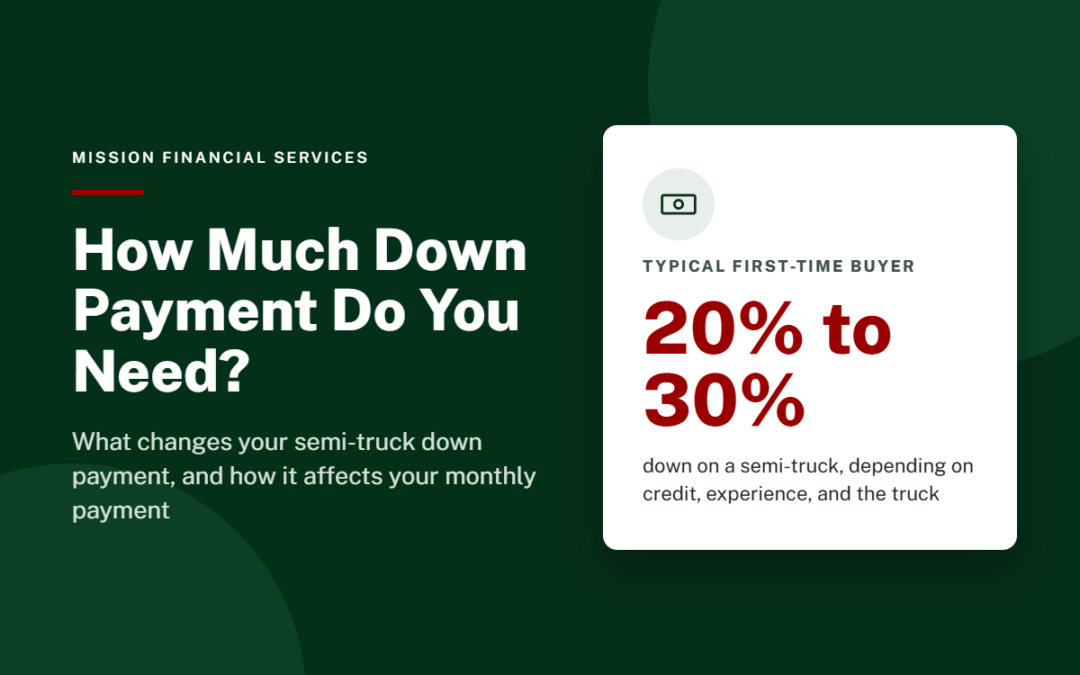
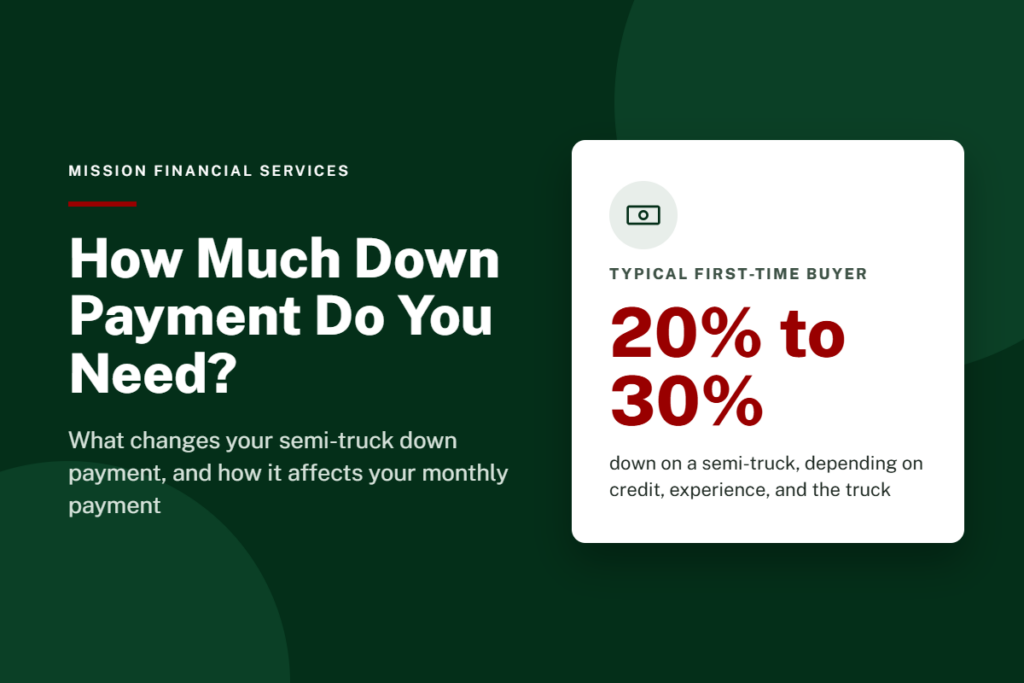
In our experience, first-time buyers usually put 20% to 30% of the purchase price down. Your number can land higher or lower, because lenders set it from your credit, your driving experience, and the truck you want to buy.

This guide shows what moves your down payment, how it changes the monthly payment, and how to lower it.

Quick answer

Most first-time semi-truck buyers put 20% to 30% down, depending on credit, driving experience, and the truck. Older trucks and lower credit scores usually call for a larger down payment. A bigger down payment lowers your monthly payment and the interest you pay. Apply first to see what your lender will ask for.

Typical Semi-Truck Down Payment Ranges

A first-time buyer financing a used semi-truck should plan on 20% to 30% down.

That’s the range we see most often in semi-truck financing at Mission Financial Services. Where you land depends on your credit and other factors:

  • Strong credit and a newer truck: closer to the low end, and some lenders may ask for less.
  • Limited driving experience: toward the high end or above it.
  • Bad credit or an older, high-mileage truck: often above 30%.

The percentage only means something once you know the purchase price. Start with what a semi-truck costs for the truck type you need, then work out the dollar amount. Our first-time buyer loans don’t require prior truck credit or homeownership.

What Changes Your Down Payment
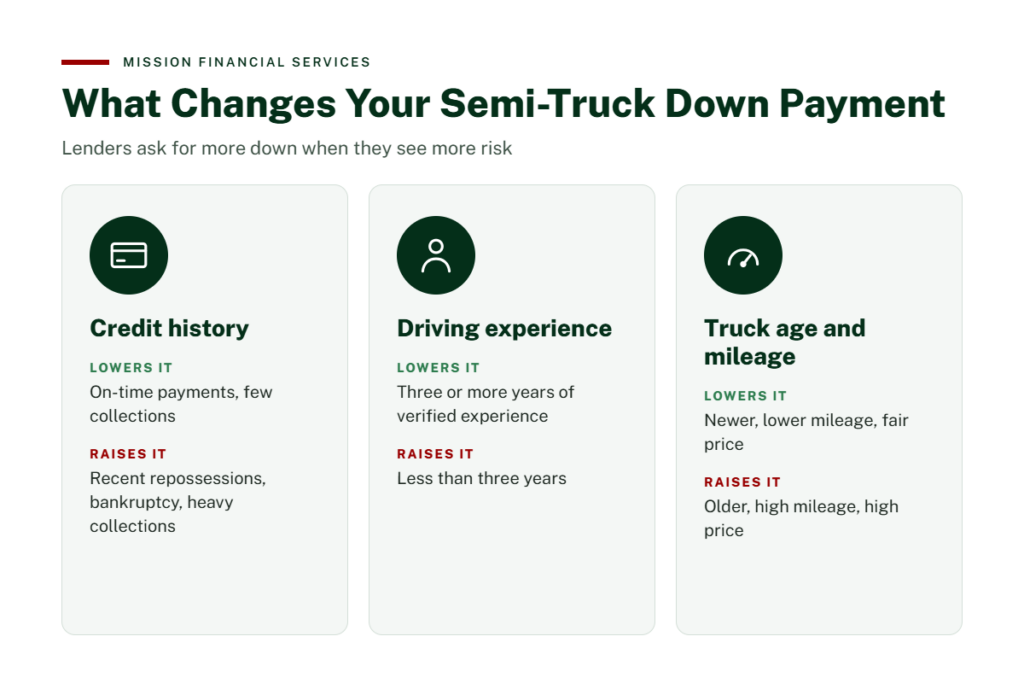
Infographic showing what affects your down payment on a semi-truck

In commercial truck financing, lenders ask for more down when they see more risk, and they judge that risk from three areas: your credit, your experience, and the truck.

Factor Lowers your down payment Raises your down payment
Credit history On-time payments, few collections Recent repossessions, bankruptcy, heavy collections
Driving experience Three or more years of verified experience Less than three years
Truck Newer, lower mileage, fair price Older, high mileage, high price

Credit Score and Credit History

Your credit score and credit history affect both approval and the down payment a lender asks for.

Many truck lenders review personal credit, especially for new businesses with no business credit yet. Checking your own score first is a soft credit pull, and according to myFICO, soft inquiries don’t affect your FICO score.

At Mission Financial Services, we look at your whole credit report rather than the score alone, so on-time car or mortgage payments count in your favor.

The credit score you need varies by lender, so ask each one what it looks at.

CDL and Driving Experience

Lenders weigh driving experience alongside credit, because time in the trucking industry shows you can keep the truck earning.

We look for drivers with at least three years of verified driving experience. Drivers with less experience can still qualify, and we review those files case by case with a larger down payment. Bank statements or tax returns showing steady income help your case too.

Truck Age, Mileage, and Price

Older trucks with high mileage usually need a larger down payment.

Choosing a used truck under 10 years old in good condition can lower your down payment and monthly payment. An older truck requires more upkeep, so if you’re financing an older truck, budget for a bigger down payment and a repair fund. Paying a fair price keeps the loan amount down.

How Your Down Payment Changes the Monthly Payment
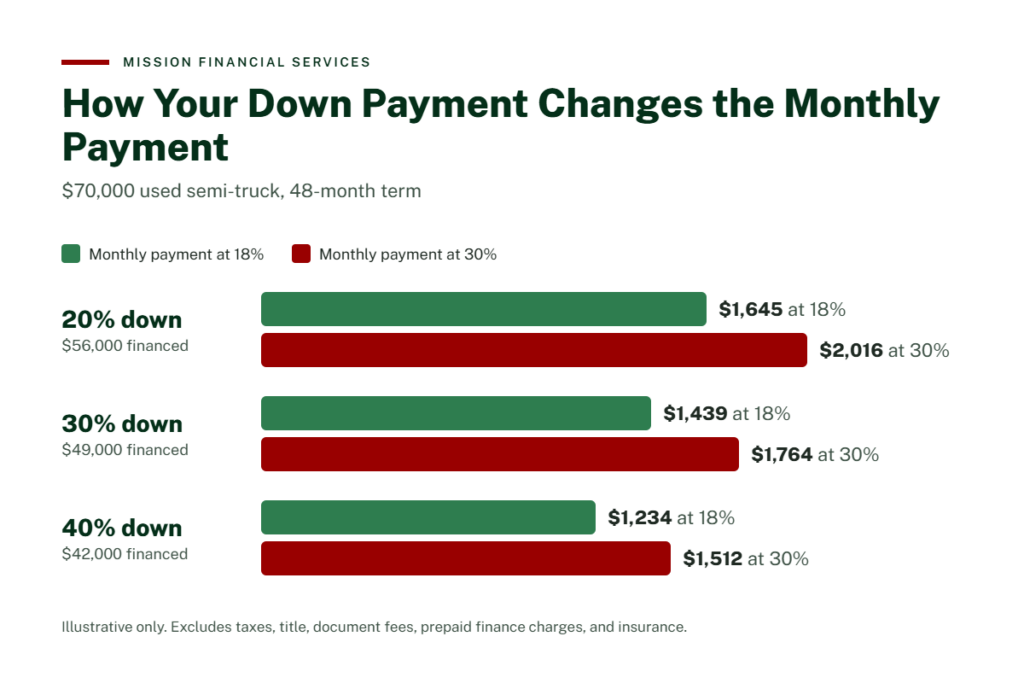
Payment chart showing how your down payment affects your monthly payments for a semi truck

A larger down payment lowers your monthly truck payments, because you borrow less.

The table uses a $70,000 used truck, a 48-month term, and two rates.

Down payment Amount financed Monthly payment at 18% Monthly payment at 30% Total interest at 18%
20% ($14,000) $56,000 $1,645 $2,016 $22,960
30% ($21,000) $49,000 $1,439 $1,764 $20,090
40% ($28,000) $42,000 $1,234 $1,512 $17,220

Illustrative only. Excludes taxes, title, document fees, prepaid finance charges, and insurance. Your interest rates and loan terms depend on your application and the lender.

Moving from 20% to 40% down saves about $411 a month at 18%, and $5,740 in interest over the loan. Before you compare offers, check the APR, because it includes fees the rate leaves out.

Getting pre-approved before you visit a dealer tells you your own down payment and gives you an offer to compare with the dealer’s financing, a step the CFPB recommends for vehicle buyers. To find out your own number, start your credit application before you shop.

Semi-Truck Down Payment With Bad Credit

With bad credit, expect to put more down, often above 30%. A larger down payment lowers the lender’s risk, which improves your approval odds. These steps also help:

  • Show steady deposits. Recent statements showing steady income tell a lender your truck can generate revenue.
  • Bring proof of on-time payments. A car loan or rent paid on time counts.
  • Choose a newer, cheaper truck. A lower purchase price means a smaller down payment in dollars.
  • Add a co-signer. We accept co-signer statements on some applications.

Our bad credit financing options are built for owner-operators with past credit problems. Lenders offering no credit check financing usually make up for skipping the check with a larger down payment or a higher rate.

Can You Use a Trade-In as a Down Payment?

Yes, many lenders let trade-in equity count toward your down payment.

Equity is your current truck’s value minus what you still owe on it. If your truck is worth $30,000 and you owe $18,000, you have $12,000 in equity.

Get the trade-in value written on the sales order so the lender can see it.

Ways to Lower Your Down Payment

You can lower the down payment by reducing the lender’s risk or the price of the truck:

  1. Buy a lower-priced truck. The same percentage on a cheaper truck means less cash.
  2. Pick a newer used truck. Trucks under 10 years old often need less down.
  3. Improve your credit before you apply. Pay down collections and keep current accounts on time.
  4. Add a co-signer with stronger credit.

Zero down financing is rare for first-time buyers, and it usually costs more over the life of the loan.

Stack of $100 bills fanned out of a black leather wallet

Loan vs Lease Down Payments

Leases often ask for less cash up front than a purchase loan, but you don’t build equity in the truck. A lease down payment buys use of the truck for the lease term, while a loan down payment buys equity from day one.

Mission Financial Services offers purchase loans only, so every dollar you put down goes toward a truck you’ll own.

Final Thoughts

Most first-time buyers need 20% to 30% down, and your credit, experience, and truck decide where you land.

Know your number before you shop, so you can match the truck to your budget. Apply for your truck loan and we’ll get back to you with what you’ll need.

Frequently Asked Questions

How much down payment do you need for a semi-truck?

Most first-time buyers put 20% to 30% of the purchase price down. Strong credit, three or more years of driving experience, and a newer truck push you toward the low end. Bad credit, limited experience, or an older, high-mileage truck push it higher. Your lender sets the final number after reviewing your application.

Can I buy a semi-truck with no money down?

It’s possible but rare, especially for first-time buyers. Zero down loans usually go to buyers with strong credit and business history, and they often carry higher rates. Without a down payment, you borrow more and pay more interest. Mission Financial Services requires a down payment on its purchase loans.

How much down payment do I need with bad credit?

With bad credit, expect to put down more than the usual 20% to 30%. Lenders ask for more because a larger down payment lowers their risk. Steady bank deposits, on-time car or rent payments, and a fair-priced truck can improve your odds and terms.

Does a bigger down payment lower my rate?

A bigger down payment always lowers the amount you borrow, your monthly payment, and your total interest. It can also improve your approval odds. Whether it lowers your rate depends on the lender, so ask each one how your down payment affects the rate it offers.

How much is the monthly payment on a $70,000 semi-truck?

With 20% down, you’d finance $56,000. Over 48 months, that’s about $1,645 a month at 18% or $2,016 at 30%. With 40% down, the payment drops to about $1,234 at 18%. These figures exclude taxes, fees, and insurance.

Can I use my current truck as a trade-in?

Yes, many lenders count trade-in equity toward your down payment. Equity is the truck’s value minus your loan payoff. Get the trade-in value written on the sales order. Ask your lender whether it accepts trade-ins before you shop, because policies vary.
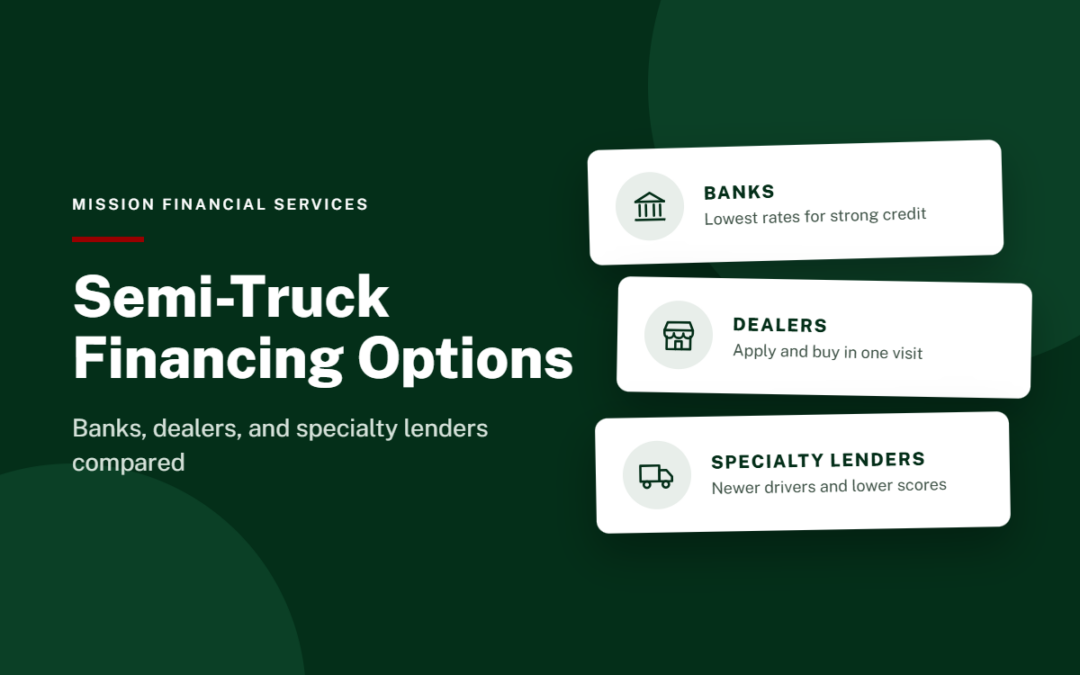
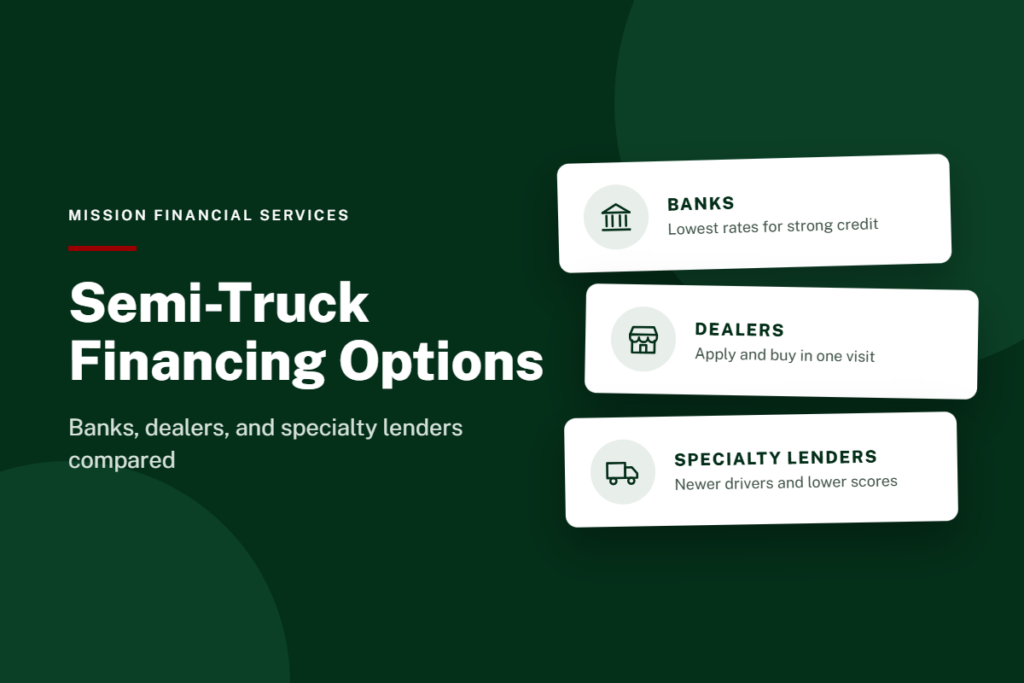
Semi-Truck Financing Options: Banks, Dealers, and Specialty Lenders Compared

Semi-Truck Financing Options: Banks, Dealers, and Specialty Lenders Compared

Semi truck financing options

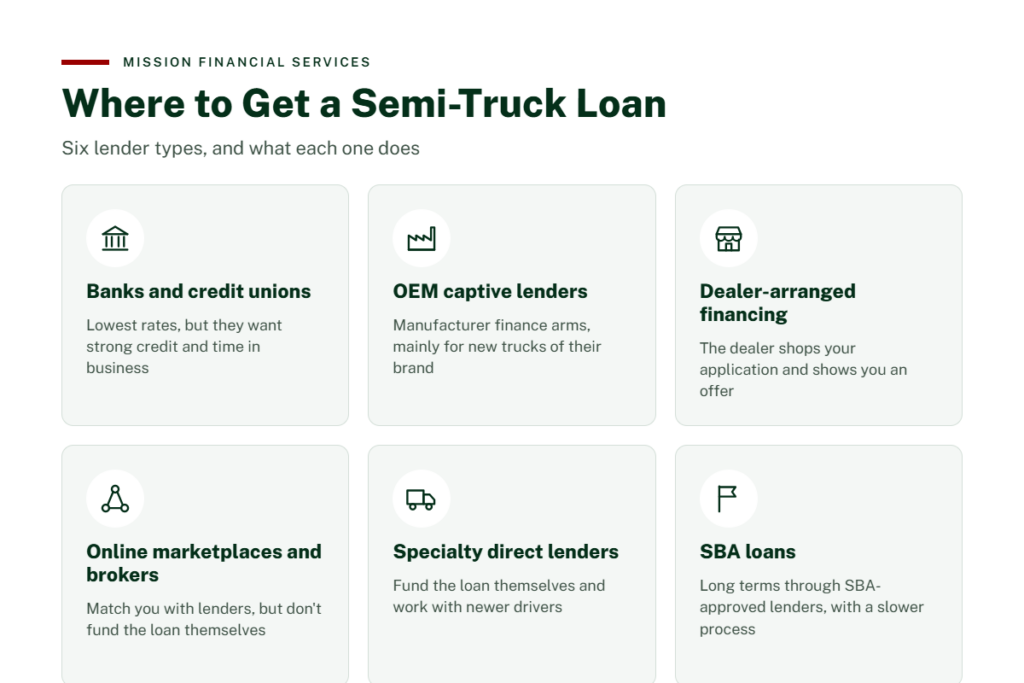
There are more places to borrow for a semi-truck than most first-time buyers realize. Banks, credit unions, truck manufacturers, dealers, online brokers, and specialty truck lenders all offer commercial vehicle financing.

Many new owner operators apply at their bank first, but a bank turning you down doesn’t mean every lender will. Each lender type sets its own rules for credit, down payment, and truck age, so how semi-truck financing works for you depends on where you apply.

This guide compares every option, shows who each one suits, and lists the questions to ask before you sign.

Quick answer: Your semi-truck financing options are banks and credit unions, OEM captive lenders, dealers, online brokers, and specialty truck lenders. Banks usually offer the lowest rates but want strong credit and time in business. Specialty direct lenders work with newer drivers and lower scores. Compare APR, fees, and truck age limits before you apply.

Semi-Truck Financing Options at a Glance

The table compares the main truck financing options on credit, approval speed, down payment, and truck age.

Lender type Credit requirements Approval speed Down payment Truck age limits Who it suits
Banks and credit unions Strong credit and business history Days to weeks Lower for strong credit Often prefer newer trucks Established businesses with strong credit
OEM captive lenders Usually strong credit Fast, at the dealer Promotions for qualified buyers New and select used trucks of their brand Buyers of new trucks
Dealer-arranged financing Set by the lenders the dealer uses Often same day Set by the approving lender Set by the approving lender Buyers on a dealer lot
Online marketplaces and brokers Wide range Fast to match, slower to fund Set by the lender Set by the lender Buyers who want several quotes
Specialty direct lenders Flexible, often review overall credit Hours to days Often larger for newer drivers Often accept older trucks First-time and credit-challenged buyers
SBA loans Strong credit and business history Weeks to months Set by the lender Set by the lender Established businesses that can wait
Mission Financial Services Overall credit, not just your score Answer within four hours First-time buyers usually 20% to 30% Used trucks up to 15 years old First-time buyers, limited experience, bad credit

Banks and Credit Unions

Banks and credit unions usually offer the lowest rates, but they want strong credit and time in business.

Banks often set tighter limits on truck age and mileage, which is important to note if you’re looking to finance older trucks. Many banks won’t finance a used semi-truck for a first-time owner-operator.

A bank suits an established business with strong credit, steady revenue, and a newer truck in mind.

Credit unions can also offer competitive rates, but you need to become a member first.

OEM Captive Lenders

OEM captive lenders are the finance arms of truck manufacturers. They mainly finance new trucks of their own brand, although some will also finance select used trucks sold through their dealer network.

Their main advantage is promotional rates on new trucks, which usually go to buyers with strong credit and an established business.

If you’re buying a used truck from another brand, a captive lender usually isn’t an option.

Dealer-Arranged Financing

With dealer-arranged financing, the dealership sends your credit application to outside lenders and shows you the offer it picks.

It’s convenient, because you can often apply and buy in the same place. The trade-off is that you usually see one offer, even if several lenders reviewed your file. The dealer can also add a markup to the lender’s rate.

Getting pre-approved somewhere else first gives you a rate to hold against dealer financing offers.

Online Marketplaces and Brokers

An online marketplace or broker matches you with lenders, but it doesn’t fund the loan itself. That can get you several quotes quickly, but some brokers charge a fee and your file may reach multiple lenders.

Ask up front whether each lender will run a hard credit check, because several hard inquiries can lower your score.

Specialty Direct Lenders

Specialty direct lenders focus on commercial vehicle financing and fund the loan themselves, so they set their own approval rules.

Many offer flexible financing solutions to buyers a bank would turn down, including newer drivers, borrowers with lower credit scores, and buyers of older trucks. In exchange, their rates are usually higher than bank rates.

Mission Financial Services is a direct lender. We review your overall credit, including on-time car and home payments, not just the number on your credit report. We work with drivers who have at least three years of verified driving experience, and we review newer drivers case by case.

SBA Loans for Trucking

SBA loans come from banks and other SBA-approved lenders, with the U.S. Small Business Administration guaranteeing part of the loan.

According to the SBA, 7(a) loans provide long-term financing for a range of business purposes. Longer terms can mean lower monthly payments, but the application takes more paperwork and time than most truck loans, and the lender sets the eligibility rules.

SBA financing suits an established trucking business that can wait. It’s not the best route for someone who needs a truck next month.

Where to get a semi-truck loan: graphic outlining the different options and lender types

How Interest Rates Compare by Lender Type

Semi-truck loan rates in 2026 run from roughly 6% to 35% APR, according to FreightWaves’ May 2026 review of the truck financing market. Your rate depends on your credit, your time in business, the truck’s age and mileage, and the lender you choose.

  • Banks: About 4% to 8% APR, per the same FreightWaves review. For comparison, banks reported median rates of 6.7% to 7% on new variable-rate small business term loans (all industries) in Q2 2026, according to the Kansas City Fed’s Small Business Lending Survey. Those low rates go to borrowers with strong credit and years of business history.
  • Dealer financing: The rate depends on the lender the dealer picks, plus any markup the dealer adds.
  • Specialty lenders: FreightWaves found that a credit score below 680 adds roughly 2 to 5 percentage points at most specialty lenders. So a carrier with a 620 score buying a 2017 truck with 650,000 miles could see rates of 15% to 25%.

A lender only gives you your actual rate after a full application, so compare APRs on written offers, not advertised starting rates.

A few things can move you toward the lower end of your lender’s range:

  • Documented income: Bank statements or tax returns that show steady income give the lender proof you can make the payments, which can help you get a better rate.
  • A newer truck: Newer, lower-mileage trucks are easier to finance.
  • A business plan: A plan that shows your lanes, expected revenue, and operating costs can strengthen your application. The SBA notes that business plans can help you get funding.

Bank Loan vs Specialty Truck Lender: Which Is Better?

A bank loan is a decent option if you have strong credit, an established business, and a newer truck. A specialty truck lender is better if you’re new, have damaged credit, or want an older truck.

Pick based on where you stand today:

  • Choose a bank if you can wait, your financial history is clean, and you want the lowest rate.
  • Choose a specialty lender if a bank turned you down or you need flexible financing and a fast answer.
  • Apply to both if you’re on the line. Then compare the offers on APR and total repayment.

A larger down payment can help with either lender. It lowers the amount you borrow and your monthly payments, which protects your cash flow for fuel and repairs.

Questions to Ask Any Truck Lender

Ask every lender the same questions so you can compare offers side by side:

  1. What’s the APR? The APR includes fees as well as interest, so it’s a better comparison than the rate alone.
  2. What fees apply? Ask about document fees, prepaid finance charges, and hidden costs outside the payment.
  3. Is there a prepayment penalty? Paying early without a charge gives you payment flexibility in a strong month.
  4. Is there a balloon payment? Balloon financing lowers monthly payments, then ends with a large final payment.
  5. Do I sign a personal guarantee? If you do, your personal assets back the loan.
  6. What insurance do you require? Lenders usually require physical damage coverage before they fund.
  7. What’s your truck age limit? This decides which equipment you can shop for.
  8. What’s the total repayment? Multiply the monthly payment by the number of payments, and add any balloon payment. Add your down payment to see what the truck costs in total.
  9. Are you a broker or a direct lender? A broker passes your file on.

With the answers side by side, you can choose a truck lender on total cost rather than the monthly payment.

Truck driving at night

What About Leasing?

Leasing usually comes with lower monthly payments than a loan, but you don’t build equity in the truck.

Most leases also set mileage limits, which can cost you if you run long routes. Over time, a loan usually costs less than a lease because you end up owning the truck. Our loans are for purchases, and we also finance lease-purchase buyouts.

Final Thoughts

The right lender depends on your credit, your time in business, and the truck you want to buy.

Banks tend to look for strong credit and a long business history. Dealer financing is quick when the truck is on the lot, but you’ll usually see only the one offer that the dealer has picked.

A specialty lender like Mission Financial Services gives you more ways to get approved and helps you navigate the financing process.

We fund semi-truck loans through dealerships in 28 states and lend directly to owner-operators in the lower 48, so you can buy from a dealer or a private seller. We work with first-time buyers, drivers with limited experience, and borrowers with bad credit.

Found your truck? Start your credit application today.

Frequently Asked Questions

What are the best semi-truck financing options for owner-operators?

The best option depends on your credit and time in business. Banks and credit unions suit established owner-operators with strong credit. Specialty direct lenders suit first-time buyers, drivers with limited experience, and buyers with bad credit. OEM lenders suit buyers of new trucks. Apply where you meet the lender’s rules, then compare APR and total repayment.

Is a bank or a specialty truck lender better?

A bank is a good option if you have strong credit, an established business, and a newer truck, because its rates are usually lower. A specialty lender suits you better if you’re new, have a low score, or want an older truck. Specialty lenders also tend to approve faster. It’s always best to compare a few options before making your decision.

Can I get a semi-truck loan as a new owner-operator?

Yes, if you apply with a lender that accepts limited business history. Mission Financial Services offers first-time buyer loans to drivers with at least three years of verified driving experience. Drivers with less experience may qualify with a larger down payment, reviewed case by case. Banks usually want more time in business.

Do banks finance used semi-trucks?

Some banks finance used semi-trucks, but they often set tighter limits on age and mileage. A bank may only consider trucks a few years old with low miles. If you’re buying an older used truck, a specialty lender is more likely to approve it, although an older truck can also mean a larger down payment.

What questions should I ask a truck lender?

Ask for the APR, all fees, and whether there’s a prepayment penalty or balloon payment. Ask if you must sign a personal guarantee and what insurance the lender requires. Check the truck age limit and the total repayment over the full term. Ask whether you’re dealing with a broker or a direct lender.

What is the difference between a broker and a direct lender?

A broker shops your application to other lenders and may charge a fee for the match. A direct lender reviews your application and funds the loan itself, so you deal with one company from approval to payoff. Mission Financial Services is a direct lender.

Dealer Financing vs Direct Lender: Where Should You Finance Your Semi-Truck?

Dealer Financing vs Direct Lender: Where Should You Finance Your Semi-Truck?

dealer financing vs direct lender

You’ve found the semi-truck you want, and now you need to decide where the money comes from.

Most dealer financing vs direct lender advice is built around a car loan, and it says your bank wins.

Semi-truck financing works differently, because private sales, truck age limits, and commercial underwriting change the answer. This guide compares both routes and the steps to get pre-approved.

Quick answer

Dealer financing is convenient because the dealer arranges the loan where you buy the truck. A direct lender approves you first, so you can compare offers and buy from a dealer or a private seller. Walking in pre-approved helps you spot a marked-up interest rate. Mission Financial Services funds semi-truck loans both ways, through dealers and directly.

How Dealer Financing Works

With dealer financing, the dealership arranges the loan at the point of sale, through outside lenders or its own money.

Dealer-Arranged Financing

When a dealer places your loan with a lending partner, part of the interest rate can go to the dealer. FreightWaves’ truck financing review calls this a yield spread and notes the rate isn’t always competitive.

Ask your truck dealer whether the rate includes a markup, and get the APR in writing before you sign. Also check the sales order for dealer fees and markups.

In-House or Buy-Here-Pay-Here Financing

With in-house financing, the dealer is the lender and keeps your loan on its own books. Some buy-here-pay-here lots offer financing to buyers with bad credit. Ask for the APR and repayment terms in writing before you sign.

How Direct Lender Financing Works

With a direct lender, you apply first, get approved, and then shop for the truck. Direct lenders include banks, credit unions, and specialty finance companies.

A pre-approval tells you the interest rate, loan terms, and maximum loan amount before you shop. You can then budget around monthly payments.

A bank loan can work well if you have good credit (over 700), a long credit history, and are wanting to finance a truck that is new or in excellent condition.

It’s a harder fit if you’re a first-time owner-operator buying a used semi-truck, because many banks won’t finance that deal.

Specialty commercial vehicle lenders focus on truck loans and would be a better bet in that case. At Mission Financial Services, for example, we specialize in first-time and hard-to-finance loans.

We lend directly to owner-operators in the lower 48 states, for dealer and private-party purchases. Our direct lending process starts with one credit application, then a truck spec sheet. We review your overall credit, including on-time home or vehicle payments, not just your credit score.

Dealer Financing vs Direct Lender: Side-by-Side

The biggest differences are convenience, rate shopping, and where you can buy.

Factor Dealer financing Direct lender
Convenience Apply and buy in one place Apply before you shop
Rate shopping Dealer picks one offer to show you You compare rates yourself
Markup risk Rate can include a dealer markup You see the lender’s rate
Pre-approval leverage None unless you bring an offer Your approval is a number to beat
Private-party purchases No Yes
Speed Can close the same day Varies; Mission Financial Services answers within four hours
Paperwork Dealer collects most of it You gather it up front
Who it suits Buyers on a dealer lot Private-party and first-time buyers, rate shoppers

Pros and Cons of Each

Dealer financing saves you time, and a direct lender gives you more say over your rate.

Dealer Financing

  • Pro: One credit application reaches multiple lenders in the same visit.
  • Pro: New-truck dealers may offer manufacturer promotional rates.
  • Con: The rate may include a dealer markup, and you see fewer offers.
  • Con: It doesn’t cover trucks from private sellers.

Direct Lender Financing

  • Pro: You can compare interest rates and chase competitive rates before you pick a truck.
  • Pro: You negotiate the price much like a cash buyer would.
  • Con: You gather more paperwork up front, and banks often set stricter credit requirements.
  • Con: Final terms vary depending on the truck’s year and mileage.

When Each Route Makes Sense

The better route depends on several factors, starting with where the truck is and how strong your credit is.

Buying From a Dealer Lot in a Hurry

If other buyers are eyeing the truck, dealer financing can close fastest.

A direct lender’s pre-approval still helps: compare it with the dealer’s offer and take the better interest rate.

Quick approvals tell you nothing about the engine, so get an inspection when you’re buying used commercial trucks.

Buying From a Private Seller

A private seller usually can’t arrange a loan through a lender, so you’ll need a direct lender.

Get approved before you agree on a price, or the seller may sell to someone else while you wait.

First-Time Buyers and Buyers With Bad Credit

A lender that reviews your whole financial situation can approve files a bank turns down. The trade-off is that bad credit usually means higher interest rates.

You’ll also need more money upfront. At Mission Financial Services, first-time buyers usually make down payments of 20% to 30% of the truck’s price.

A bigger down payment shrinks what you borrow, which gives you lower monthly payments. Longer loan terms can also bring the payment down, but you’ll pay more interest over the life of the loan.

Stack of $100 bills fanned out of a black leather wallet

How to Get Pre-Approved Before You Visit a Dealer

Pre-approval means a lender has reviewed your application and set your loan amount and terms.

  1. Gather your documents. Have your CDL, bank statements or tax returns, references, and proof of insurance ready. Most lenders check these core financing requirements.
  2. Submit a credit application. Apply with one lender or several lenders within a short window. Under FICO scoring, auto loan inquiries within a 14- to 45-day shopping window count as one. Commercial lenders may report inquiries differently, so ask each lender.
  3. Get your approval in writing. Ask for the loan amount, interest rate, APR, term, and down payment. Ask whether you’ll sign a personal guarantee.
  4. Send the truck spec sheet. The lender needs the truck’s year, make, model, VIN, mileage, engine, and transmission. Confirm the title is clean before buying a commercial truck.
  5. Compare the dealer’s offer. Ask the dealer to beat your pre-approval. Compare APR with APR, plus the total you’ll repay.

Comparing offers this way helps you make an informed decision and sometimes find lower interest rates.

Final Thoughts

Dealer financing is faster on a dealer lot, and a direct lender gives you more choices. Pre-approval lets you weigh both financing options against your financial goals.

Mission Financial Services funds semi-truck loans either way, so you can get pre-approved and buy wherever the right truck is. Start your credit application online, and we’ll get back to you within four hours.

Frequently Asked Questions

Is It Better to Finance a Semi-Truck Through the Dealer or a Direct Lender?

Neither route always wins. Dealer financing is faster when the truck is on a dealer lot. A direct lender lets you compare rates and buy from a private seller. Mission Financial Services offers both, through dealers in 28 states and directly in the lower 48.

Do Dealers Mark Up Truck Loan Rates?

Yes, dealers can mark up the rate. When a dealer places your loan with a lending partner, part of the interest rate can go to the dealer as a yield spread. Ask for the APR in writing, including all fees, and compare it with a direct lender’s offer.

Can I Finance a Semi-Truck From a Private Seller?

Yes, but you’ll need a direct lender, because a private seller usually can’t arrange a loan. Mission Financial Services finances private-party purchases as well as dealer sales. Send the lender the truck’s spec sheet and a sales order with the price, taxes, and fees.

Does Getting Pre-Approved Hurt My Credit?

A pre-approval can involve a hard inquiry, which may lower your score slightly. FICO scoring treats several auto loan inquiries within a 14- to 45-day window as a single inquiry, depending on version. Shop within two weeks so several applications count as one inquiry on your credit report.

How Fast Can Dealer Financing Close?

A dealer deal can close the same day if the lender approves quickly. Having your documents ready matters more than other factors you control. Bring your CDL, bank statements, and proof of insurance, since most lenders need them before funding.

What Documents Do I Need for Direct Truck Financing?

Most direct lenders ask for a current CDL, bank statements or tax returns, references, and proof of insurance. You’ll also need a truck spec sheet with the year, VIN, mileage, engine, and transmission. Some buyers also need LLC or corporate documents.

Truck Loan vs Line of Credit: Which Fits Your Trucking Business?

Truck Loan vs Line of Credit: Which Fits Your Trucking Business?

Truck Loan vs Line of Credit

Truck loans and lines of credit both get cash into your business, but they’re for different things. A truck loan pays for one specific truck, and you repay it with fixed monthly payments over a set term. A line of credit is a revolving limit you draw on for fuel, repairs, and slow weeks.

This guide compares how each one works, what lenders look for, and when each fits. It also explains why working capital for a trucking company usually belongs on a line rather than a loan. Then it covers the risks of mixing the two up and your options if a bank turns you down.

Quick answer

Use a truck loan to purchase equipment, because the truck secures it and the payment stays fixed. Use a line of credit for short-term costs like fuel and repairs. If you can’t get a line, repair and title loans can cover urgent costs.

Truck Loan vs Line of Credit at a Glance

The main difference is what each one pays for. A truck loan funds a long-life asset, while a line of credit funds operational expenses.

Feature Truck loan Line of credit
What it pays for One truck or piece of equipment Fuel, repairs, insurance, payroll, and slow weeks
How you get the money One lump sum at purchase Draw what you need, up to your credit limit
Repayment Fixed monthly payments over a set term Repay and draw again; minimum payments vary
Collateral The truck Often none
Typical approval needs Down payment, driving experience, and overall credit Time in business, revenue, and business credit
Speed Specialty lenders can respond within hours Fast once it’s open, but setup takes longer
Cost Interest on the balance you still owe Interest only on what you draw, plus fees; often variable
Best for Buying or adding a truck Steady revenue with uneven payment timing

How a Truck Loan Works

A truck loan is a term loan — a type of business loan secured by the truck you’re buying. You make a down payment, borrow the rest, and repay it over a fixed term.

The lender can repossess the truck if you stop paying, so its age, mileage, and condition shape the offer.

In our experience, first-time buyers usually put 20% to 30% down. At Mission Financial Services, we write simple interest contracts. Interest accrues daily on what you still owe, so paying early lowers your total cost.

Your rate depends on several key factors, including your credit history and the truck’s year, model, and condition. Older, higher-mileage trucks can raise the rate.

Most equipment financing for tractors and trailers works the same way. Longer loan terms lower the payment but add total interest.

Some bank loans exclude semi-trucks, so owners often use alternative lenders that focus on commercial trucks, like Mission Financial.

How a Business Line of Credit Works

A business line of credit is revolving credit, with a credit limit you borrow against as costs come up.

You pay interest only on what you draw, and the credit line opens back up as you repay it.

Unlike traditional loans, you don’t reapply each time you need cash. After a set draw period, most lines renew, close, or switch to repayment.

Rates are often variable, and some lenders charge draw fees or annual fees.

Banks usually want two or more years in business and fair to good credit. Credit approval also weighs your business credit score and revenue.

Not every applicant clears that bar. If a bank turns you down or offers a smaller limit, ask about an SBA-backed line instead. The Small Business Administration (SBA) guarantees part of the line, so the bank loses less if a borrower doesn’t repay. That lower risk can make a bank more willing to approve you. The SBA’s 7(a) Working Capital Pilot backs lines of credit up to $5 million.

An SBA-backed line still isn’t a sure thing. The bank reviews your credit and finances and decides whether to approve your application.

Truck Loan vs Line of Credit: When Each One Fits

Match the tool to what the money pays for and how fast you can repay it. The scenarios below come up often with the owner-operators we finance.

Buying Your First Truck or Adding One

Use a truck loan, because a truck earns money for years and a fixed term spreads the cost over that time.

Uneven Cash Flow Between Broker Payments

If you can get one, a line of credit helps you manage cash flow here. Many trucking companies face unpredictable cash flow because brokers can take weeks to pay. Draw for fuel while a load is unpaid, then repay when the broker pays.

If you can’t get a line of credit from a bank, freight factoring is an alternative to explore. A factoring company buys your unpaid invoices and pays you most of their value upfront.

Factoring is a form of working capital financing, but it isn’t a loan. You’re selling the invoice, and the factor keeps a fee for paying early. With recourse factoring, you buy back any invoice the customer doesn’t pay. Some lenders offer invoice financing instead, which is a loan against unpaid invoices rather than a sale.

A $15,000 Engine Repair With No Line in Place

Look at a repair loan or a title loan. Both can pay for a big repair when you don’t have a credit line to draw on.

A title loan uses your truck’s title as collateral. The truck’s value and condition help set how much you can borrow.

A repair loan is built for the repair itself. Mission Financial Services offers semi-truck repair loans that directly cover the cost of large and small repairs.

Person holding a pencil over a notebook while using a calculator to add up truck loan fees and costs

Risks to Avoid

Avoid using a line of credit to buy a truck. A line of credit is meant for short-term costs you repay within weeks or months. A truck takes years to pay off.

Many business lines run for a set term, often a year or two, and the lender decides whether to renew. Rates are usually variable, so your cost can rise while you still owe money on the truck. If the lender doesn’t renew or the rate climbs, you could owe a large balance with little time to repay.

A truck loan avoids the renewal and rate risk. The term and monthly payment are set when you sign, and they spread the cost over years.

A line of credit also gets expensive if you never pay it down. It’s built for short gaps, like covering fuel until a broker pays. If you carry the same balance month after month, you keep paying interest on it. That balance also uses up part of your credit limit, so less is left for a surprise repair.

How you manage that credit affects your next application: lenders can see how much of your limit you’re already using.

Before you sign either, compare the true cost of borrowing, including every fee on top of the rate.

Options When You Can’t Get a Line of Credit

You still have multiple financing options if a financial institution turns you down. Most look at your truck, your invoices, or your overall credit instead of years in business.

  • Repair loans: These cover the cost of a specific repair, large or small.
  • Title loans: Commercial vehicle title loans are short-term loans secured by your truck’s title.
  • Operating capital loans: These short-term loans cover day-to-day costs like fuel, insurance, and payroll. You get one lump sum and repay it on a set schedule.
  • SBA loans: These have capped interest rates for small businesses, but approval can take weeks.
  • Business credit cards: These work as a smaller revolving line for tolls and parts, but carrying a balance gets expensive.
  • Merchant cash advance: Treat this as a last resort. Repayment often comes out of your daily sales or deposits, which squeezes cash flow.

If your truck is in the shop now, a commercial truck repair loan gets it rolling without draining your reserve.

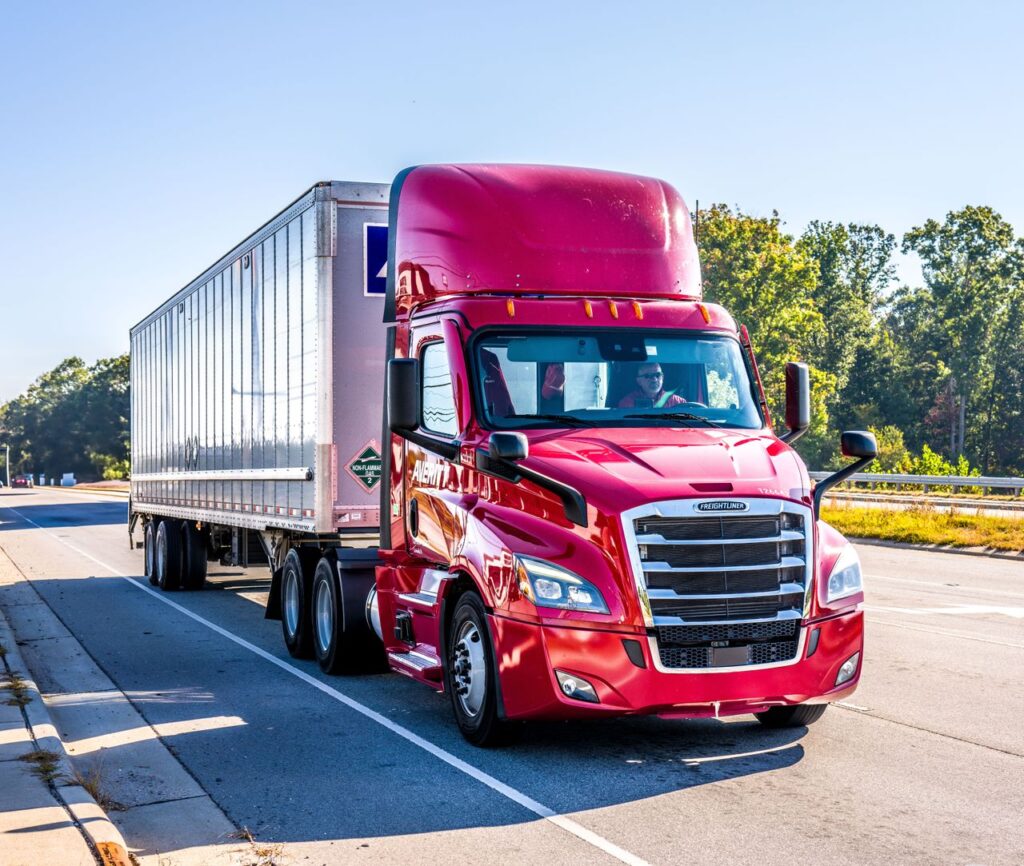
Red semi-truck with a day cab pulling a dry van trailer on a sunny road

Final Thoughts

Use a truck loan for the truck and a line of credit for the bills between paydays. Keeping the two separate protects your financial health when freight slows down.

You don’t need a bank’s line of credit to keep your truck moving. Mission Financial Services offers truck loans, repair loans, and title loans for owner-operators and small fleets.

We review your overall credit and payment history, and we’ll respond to your application within four hours. Fill out our credit application today to buy your next truck or get your current one back on the road.

Frequently Asked Questions

Can I use a line of credit for a down payment?

You can, but it adds risk. Lenders use a down payment to make sure you have your own money in the truck. Borrowing it means line payments and truck payments start at the same time. The new balance also counts as debt when a lender reviews your application, which can work against you.

Can I get a line of credit with bad credit?

It’s harder. Banks usually ask small business owners for fair to good credit and two or more years in business. Some online lenders approve weaker credit at higher rates. If you’re turned down, a title loan looks at your truck’s value and your overall credit.

Is a line of credit cheaper than a truck loan?

It depends on the rate, the fees, and how long you carry a balance. A line can cost less for short draws you repay quickly. For a truck you’ll keep for years, a fixed-rate loan is usually more predictable. The CFPB suggests you compare APR to APR, since APR includes lender fees.

Is a truck loan or line of credit easier to qualify for?

A secured truck loan from a specialty lender is often easier for new or credit-challenged owners. The truck backs the loan, so the lender relies less on your time in business. Mission Financial Services, for example, reviews your overall credit and payment history along with your credit score.

What is working capital for a trucking company?

Working capital is the cash a trucking company uses for fuel, insurance, repairs, and payroll while it waits on payments. Brokers and shippers in the trucking industry often pay weeks after delivery, so working capital keeps trucks running until the money arrives. Healthy working capital also supports business growth and financial stability.

Does “No Credit Check” Semi Truck Financing Exist?

Does “No Credit Check” Semi Truck Financing Exist?

Does No Credit Check Semi Truck Financing Exist

You have a CDL, steady freight to haul, and a credit score that got you turned down last time. Then a dealer ad promises a truck with no credit check. But is it too good to be true? Usually, yes.

Few lenders actually offer a true no-check loan. And most deals using that phrase end up costing more over time.

This guide explains what those offers are, what they cost, and how to get approved with bad credit instead.

Quick Answer

Semi-truck financing without a credit check is rare. Most offers are lease-to-own deals, in-house dealer programs, or soft-pull prequalifications that still lead to a credit review. These deals often cost more through bigger down payments and higher total payments. A direct lender like Mission Financial Services that weighs your overall credit, not only the score, is usually the safer route.

Does No Credit Check Semi-Truck Financing Really Exist?

Rarely, if you mean a loan where nobody looks at your credit. The phrase is generally used as a marketing term by lenders that look at factors beyond your credit score like your income and down payment rather than having credit score as the main qualifier for financing.

Sellers often aim these offers at new owner-operators and drivers with poor credit. Behind the “no credit check” label, you’ll usually find one of these four deal types:

  • Soft-pull prequalification: The lender checks your credit without affecting your score. A full credit review still comes before final approval.
  • In-house dealer financing: The dealer lends its own money and sets its own terms and pricing.
  • Lease-to-own or rent-to-own: You lease the truck and only own it after a buyout payment at the end.
  • Title-based deals: The truck serves as collateral, so the lender relies on its value more than your score.

Why Lenders Check Credit

Lenders check credit to price their risk. Your credit history helps determine your interest rate, down payment, and loan terms.

There’s no single minimum credit score across lenders, because each one sets its own.

A lender that skips the check covers its risk another way, like more cash up front.

Man stacking piles of coins, representing costs

How No Credit Check Truck Deals Work

Each deal type shifts risk back to you through a bigger down payment, tighter terms, or delayed ownership.

Deal type How it works Typical trade-offs Who it suits
Soft-pull prequalification Shows likely terms without touching your score Final approval still needs a full credit review Buyers comparing lenders
In-house dealer financing The dealer finances the truck itself Bigger down payment, higher pricing, shorter terms, possible GPS or starter-interrupt device Buyers with no other approval
Lease-to-own or lease-purchase Weekly or monthly lease payments, then a buyout No equity until the buyout, possible carrier-only hauling, payments taken from settlements Drivers testing ownership
Title-based deal The truck’s value secures the money Repossession if you fall behind Owners with a paid-off truck

Lease-to-Own vs. Financing

Leasing means you’re renting the truck, not owning it. Lease purchase programs let you buy the truck after the lease term ends.

Lease-to-own semi-trucks are a common no-check offer, so read the contract details closely. Carrier lease-purchase agreements often require you to haul freight only for that carrier. Payments may come straight out of your settlements, and some agreements take a percentage of your earnings.

Leasing may come with lower maintenance responsibilities.

Financing leads to full ownership of the truck, but you cover all maintenance costs. Miss payments on some lease deals, and you can lose the truck along with everything you paid toward the buyout.

The Cost of Skipping the Credit Check

No-check deals usually charge higher interest rates and higher upfront costs. A big down payment drains the working capital you need for fuel, insurance, and repairs.

Ads that promise flexible terms rarely show the total you’ll pay. Ask for the sum of every payment plus the buyout, then compare it with a purchase loan. That total exposes the hidden costs that a low weekly or monthly payment can mask.

Some buyers chase zero down financing at the same time. With no down payment, you borrow the full price of the truck, so you pay interest on every dollar of it. That means a bigger monthly payment and more interest over the life of the loan.

Man in a blue shirt looking up thoughtfully against a background of dollar signs while weighing truck financing costs

Warning Signs of a No Credit Check Scam

Some no credit check offers are advance-fee scams that take your money and deliver nothing.

The FTC lists these warning signs of advance-fee loan scams:

  • Guaranteed approval: No honest lender can say yes before it’s seen your application.
  • Upfront fees: A “processing” or “paperwork” fee before you get any money is a reason to walk away.
  • No credit review: A firm offer from a real lender comes only after it checks your credit report.
  • Unsolicited calls: Be wary of a loan offer you didn’t ask for, especially a recorded phone message.

Soft vs. Hard Credit Checks

A soft credit check doesn’t affect your score. A hard check can lower it slightly.

Some lenders use a soft inquiry to prequalify you without affecting your score. Applying for a loan usually triggers a hard inquiry, though. Before you apply, ask which kind of check the application triggers.

A single new inquiry usually costs most people under five FICO Score points, according to myFICO. The inquiry can stay on your report for two years but counts toward FICO Scores only in year one.

How Mission Financial Services Reviews Your Credit

At Mission Financial Services, we review your overall credit, not only the number on your report. We’re a common-sense lender, and we don’t offer no credit check programs.

Alternative lenders like us look at your driving history and the cash flow in your bank statements. We’ve served the trucking industry since 2000 and regularly finance drivers with collections, charge-offs, and past bankruptcies.

Factors that help your file:

  • On-time payments on a home or car loan
  • Three or more years of verified CDL experience (we review newer drivers case by case)
  • A solid down payment
  • Bank statements that show steady income

Factors that make approval harder:

  • A bankruptcy or repossession in the last 12 months
  • Large unpaid tax liens or child support problems

Higher rates are common for loans with bad credit, and older, high-mileage trucks can increase them further.

Our bad credit loans are purchase contracts for new or used trucks from dealers or private sellers. The approval process starts with one application, and we respond within four hours. To see where you stand, start your credit application.

Three men talking and smiling around a laptop at an office table while reviewing truck loan options

How to Get Semi-Truck Financing With Bad Credit

You can finance a semi-truck with bad credit by building a file a lender can approve. Your odds of success with bad credit semi-truck financing go up with steady income and cash to put down.

Work through these five steps before you apply:

  1. Check your credit reports. Pull your free reports from Equifax, Experian, and TransUnion at AnnualCreditReport.com, and dispute any errors.
  2. Save a bigger down payment. A larger down payment lowers lender risk and your monthly payments. In our experience, first-time buyers put down 20% to 30% of the truck’s price. Setting aside part of your profits for a few months helps you get there.
  3. Pick a truck the lender will finance. Older trucks may require a larger down payment. A truck under 10 years old in good condition usually lowers both your down payment and monthly payment.
  4. Gather your paperwork. Bring bank statements or tax returns, your CDL, and proof of insurance. You’ll also need a sales order showing the price, taxes, and fees. Our financing requirements also cover references and LLC documents for your business. Depending on your file, we may also ask for a co-signer statement.
  5. Apply with a direct lender. A direct lender decides on your loan itself, with no broker in between.

Final Thoughts

Very few lenders offer a true no-check loan. Deals sold under that name trade the check for more cash up front or no ownership until the buyout. A purchase loan from a lender that reviews your whole file builds equity with every payment.

If your credit score has kept you out of a truck, apply with Mission Financial Services. You’ll get an answer within four hours.

Frequently Asked Questions

Can I get a semi-truck loan with no credit check?

Rarely. Most legitimate lenders look at your credit in some form before they commit to terms. Deals advertised as no credit check are usually lease-to-own programs, in-house dealer financing, or soft-pull prequalifications. They often cost more through bigger down payments, higher interest, or a final buyout.

Can I finance a semi-truck with a 500 credit score?

Yes, some lenders finance semi-trucks for borrowers with a 500 credit score. Expect a higher rate and a bigger down payment. Mission Financial Services reviews your overall credit, including on-time home or car payments, CDL experience, and your down payment. A bankruptcy or repossession in the last 12 months makes approval harder.

Is lease-to-own the same as no credit check financing?

No, but the two are often marketed together. Lease-to-own means you rent the truck and own it only after a final buyout payment. Many no-check programs use this setup, and you build no equity until the buyout. Mission Financial Services offers purchase loans only, so every payment builds equity.

How much down payment do I need with bad credit?

Expect to put more down with bad credit than with strong credit. In our experience, first-time buyers usually put down 20% to 30% of the truck’s price. Lower credit often means more money down. A newer truck in good condition can also lower the down payment you need.

Are guaranteed approval truck loans legit?

No. A lender can’t approve you before it reviews your application. The FTC lists guaranteed approval and upfront fees as warning signs of advance-fee loan scams. If someone asks for a processing fee before you get any money, you should walk away. A real lender checks your credit first.

financing older commercial trucks

Can You Finance an Older Semi Truck? What to Know

financing older commercial trucks

Financing older commercial trucks can feel like an uphill battle. But it’s often the smartest way for owner-operators and small fleets to get on the road without overspending.

Many lenders hesitate to work with high-mileage or older models but the right financing partner can still help you land a dependable truck at a manageable payment.

Whether you’re buying your first used semi or adding an older rig, this guide covers the benefits and challenges. It also walks through current rates and the step-by-step process.

TL;DR

  • Older commercial trucks (5 to 15+ years old) come with tighter age and mileage caps than new truck loans. Expect higher rates and stricter paperwork too.
  • 2026 rates for semi-truck financing generally run from about 6% APR for well-qualified buyers. Borrowers with credit challenges may see 25% APR or higher.
  • A $70,000 truck loan typically runs $1,350 to $2,265 a month over a 60-month term, depending on your rate.
  • Mission Financial Services works with credit scores as low as 460. We evaluate each truck’s condition individually, not by a blanket age or mileage cutoff.

What Does It Mean to Finance an Older Commercial Truck?

Financing an older commercial truck means using a loan or lease on a vehicle that’s 5 to 15 years old. It often comes with six figures on the odometer.

New truck financing comes with strict credit and age requirements. Older truck financing instead focuses on getting you into road-ready equipment at a lower price point.

Semi-truck financing options range from traditional banks to specialized equipment lenders built for older rigs.

You’ll make monthly payments plus interest over an agreed term, just like with a newer truck loan. The difference is that many mainstream lenders cap the age or mileage they’ll finance. That’s why you need a lender that specifically offers financing for older rigs.

New vs. Used Commercial Trucks: Weighing the Trade-Offs

Choosing between a new and a used commercial truck comes down to price, risk, and upfront budget. Here’s how the two compare.

Factor New Truck Used or Older Truck
Purchase Price $170,000+ on average Around $61,000 on average
Loan Approval Stricter credit and income requirements Often easier to qualify, even with imperfect credit
Depreciation Loses value fastest in the first 2 to 3 years Already past the steepest part of the depreciation curve
Repairs and Technology Advanced emissions and telematics systems, costly when they fail Simpler systems, but repairs tend to happen more often
Warranty Coverage Usually covered under a manufacturer warranty Rarely covered; budget for repairs yourself
Financing Rates Often lower APRs from mainstream lenders Slightly higher APRs; a specialized lender usually helps

Where Used Trucks Win

Older trucks carry a smaller price tag, which lowers your financing burden. That frees up cash for fuel, insurance, and permits.

A smaller loan amount also makes approval easier, even with imperfect credit.

Where New Trucks Win

A new truck comes with a manufacturer warranty, so unexpected repair bills are less likely in the early years. Maintenance costs are also more predictable, since there’s no unknown history from a previous owner.

New trucks meet current emissions standards out of the gate, too, which matters as EPA 2027 approaches. That can mean fewer compliance surprises down the road, even though the upfront price is steeper.

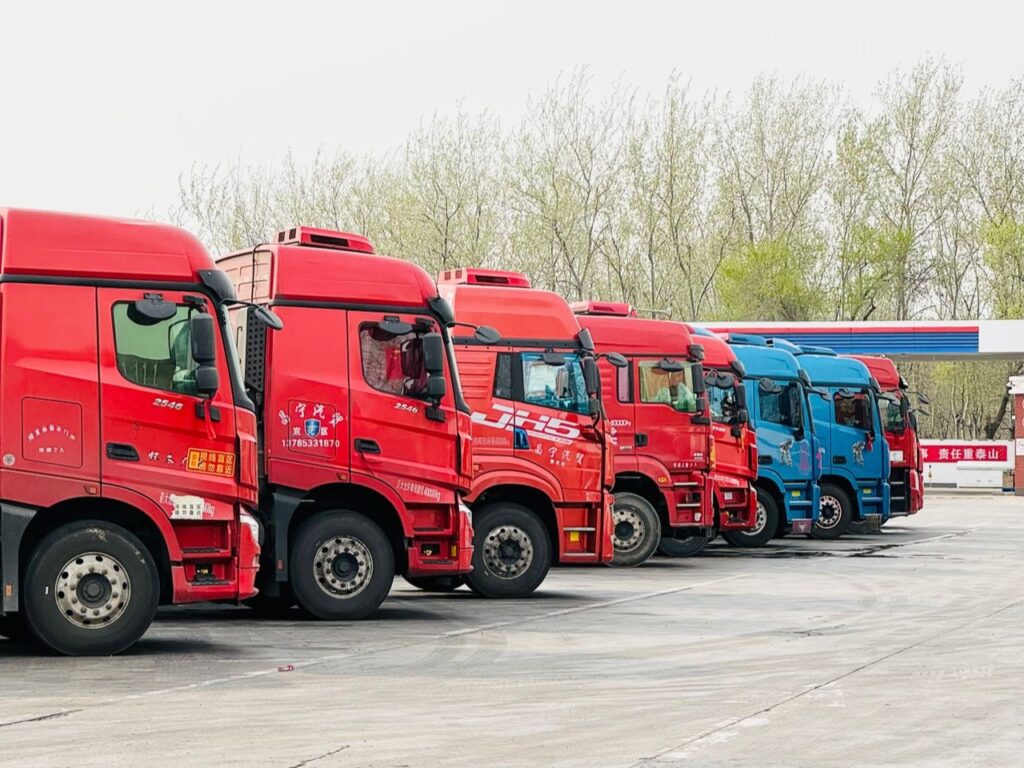
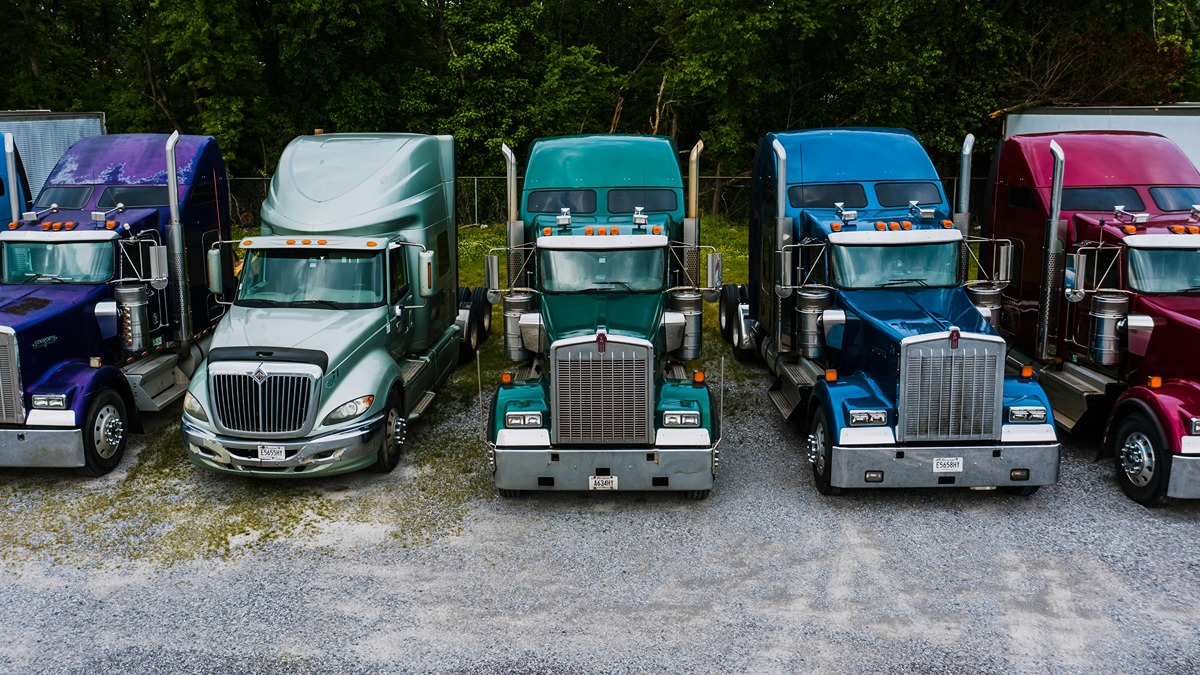
A lineup of semi trucks in different colors parked at a truck stop, representing the range of vehicles to evaluate when deciding to replace fleet vehicles

Why Do Some Lenders Avoid Financing Older Trucks?

Not every lender will finance an older commercial truck. Traditional banks often avoid them for three main reasons.

Age and Mileage Restrictions

Many lenders set strict limits on truck age and mileage. Older vehicles carry higher financial risk in a lender’s eyes.

As a truck accumulates years and miles, resale value drops and repair costs climb. That makes it harder for a lender to recover its money in a default.

For that reason, a traditional bank may refuse to finance a rig over 7 to 10 years old. The same goes for trucks with more than 700,000 miles on the odometer.

Safety and Emissions Standards

Older trucks may not meet current emissions or safety regulatory requirements, especially in states with strict environmental rules. Lenders see this as a risk.

Noncompliant equipment could face fines, operational restrictions, or costly upgrades. Any of those could affect your ability to keep up with payments.

Higher Risk of Breakdowns

The older the truck, the greater the chance of a breakdown. Lenders view this as a risk because the truck itself is the collateral.

If it loses value too quickly or becomes inoperable, the lender has less to recover in a default. This is why working with a specialized lender matters. We understand the realities of older equipment and offer financing even when other companies won’t.

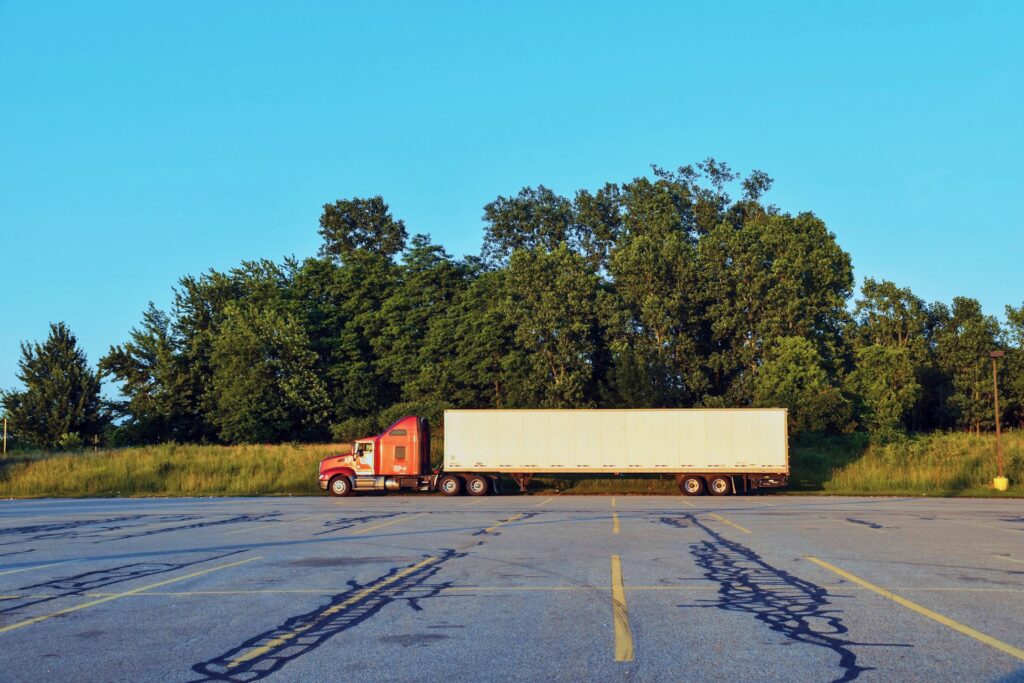
Red semi-truck with a white cargo trailer parked in an empty lot at golden hour, representing the older commercial trucks owner-operators often finance

How Tariffs and EPA 2027 Are Reshaping the Older-Truck Market

Tariffs and the upcoming EPA 2027 emissions rule are pushing more buyers toward used trucks in 2026. Both trends are tightening supply and pushing prices up.

New Class 8 prices have climbed roughly $10,000 due to tariffs on components, on top of years of steady increases.

At the same time, fleets are pulling purchases forward ahead of EPA 2027. The rule is expected to add several thousand dollars more to new truck prices once it takes effect.

That pre-buy activity is pulling late-model used trucks off the market. It’s also nudging used pricing upward.

For owner-operators shopping for an older rig, acting sooner may get you a better deal. It’s part of why working with a fast-moving lender matters more than ever.

How Much Does It Cost to Finance an Older Commercial Truck?

The cost of financing an older semi-truck depends on multiple factors: credit profile, down payment, vehicle age, mileage, and term. As of 2026, interest rates typically fall into three broad bands.

Credit Profile Typical APR Est. Payment on $70,000 (60-mo term)
Strong credit, established business 6% to 12% $1,350 to $1,555
Average credit, newer operators 12% to 20% $1,555 to $1,855
Credit challenges, startups 20% to 30%+ $1,855 to $2,265+

Estimated payments assume a $70,000 loan over a 60-month term and are for illustration only. Your actual rate and payment depend on the lender, down payment, and truck condition.

Loan terms also matter. Shorter terms mean higher monthly payments but less interest paid over time. Stretching a loan to 60 months lowers the payment but raises the total interest cost.

Truck age and condition factor in as well. A 5- to 7-year-old truck in solid shape usually qualifies for better terms. A 12-year-old, high-mileage unit typically won’t.

These costs are lower upfront than new truck financing. But because interest rates run higher on older equipment, your total financing cost over time may end up greater. That’s why it pays to work with a lender that balances flexible approvals with fair terms.

man in suit

Requirements for Older Semi-Truck Financing

Financing an older commercial truck comes with a few more hurdles than buying new equipment. Lenders weigh several factors before approving a loan for a high-mileage rig.

Requirement What Lenders Typically Want
Credit Score 650+ at traditional banks; as low as ~460 with Mission Financial Services
Down Payment 10% to 30% of purchase price; a larger down payment improves approval odds
Truck Age and Mileage Many lenders cap at 7 to 10 years or 700,000 miles; we finance used trucks up to 15 years old
CDL Experience At least 3 years of verified driving experience; less experience may still qualify with a larger down payment
Business Documentation Proof of income, recent bank statements, or tax returns
Insurance Proof of commercial truck insurance with at least a $1,000 deductible
Title and Registration Clean title and updated registration; salvage titles are much harder to finance

Keep in mind older trucks rarely carry a manufacturer’s warranty. Factor potential repair costs into your budget before you sign.

It’s also worth asking about prepayment penalties, since paying off a loan early can sometimes cost extra.

Meeting these requirements shows lenders you’re a serious operator. Even if you fall short on credit history, a specialized lender gives you a better shot at approval.

How To Secure Your Older Truck Loan in 5 Steps

Financing an older commercial truck doesn’t have to be complicated. With the right approach and the right lender, you can move from application to funding quickly.

Here’s a five-step process that works for most truckers.

White bus on road near mountain

Step 1: Decide Between a Lease or a Loan

Your first choice is whether to lease or finance outright. A commercial truck lease gives you use of the truck for a set period with lower monthly payments. At the end of the term, you can return it, extend the lease, or buy the vehicle.

Truck leasing companies typically ask for less money down than a purchase loan. A loan lets you buy the truck and build equity as you pay it down. Upfront costs and monthly payments may be higher, but you own the truck once the loan is complete.

Mission Financial Services structures every deal as a purchase contract, not a lease. If a true lease fits your situation better, you’d work with a leasing company or dealer instead.

Step 2: Understand Your Credit History and Score

Credit history plays a major role in approval and interest rates. A higher score gets you lower rates and better terms, but imperfect credit still leaves you options. Other factors, like time in business and down payment size, affect your rate too.

Mission Financial Services works with drivers who have scores as low as 460. We’re a common-sense lender, so we weigh your overall credit history, not just the number on your report. That makes financing possible for first-time buyers and drivers with bad credit.

Step 3: Get Pre-Approved

Fill out a short semi-truck loan application to see exactly how much you can finance before you start shopping. That makes negotiating with dealers easier and keeps you from wasting time on trucks outside your budget.

Mission Financial Services offers a fast online credit application. Our team reviews every submission and guarantees a response within four hours.

big truck

Step 4: Choose the Right Older Truck

Once you know your budget, look for the best used truck for your business needs. Reliable older trucks from brands like Kenworth, Peterbilt, Freightliner, Mack, and Volvo hold up well.

Proven engines from Cummins, Detroit, and Paccar can run past 500,000 miles with the right care. Check the truck’s age and mileage against your budget.

Ask the seller for accident records and maintenance logs before you commit. Confirm the truck matches your hauling needs, whether that’s long-haul freight, regional delivery, or specialty cargo.

Step 5: Submit Documentation and Get Funded

After selecting your truck, provide your lender with the make, model, mileage, and purchase price. You’ll also need proof of insurance, title documents, and income verification. Most lenders will ask for your Social Security number too.

Once approved, funding is released to your account and you can get on the road.

Alternatives If You Can’t Finance an Older Semi-Truck

If financing an older truck isn’t an option right now, truck leasing and other options can still get you moving.

  • Lease-to-Own Programs: Some dealers and lenders offer funding programs that let you lease an older truck, then buy it later. This spreads out costs while you build equity.
  • Refinancing an Existing Loan: If you already own a financed truck, refinancing could free up cash or lower your payment. That can make it easier to fund a second truck.
  • Title Loans: If you own a truck outright, a commercial vehicle title loan uses your existing equipment as collateral. It’s a fast way to access cash.
  • Zero-Down Options: Some lenders offer zero-down financing for qualified buyers. This can help if you don’t have cash for a down payment right now.
  • Cash Purchase with a Smaller Loan: For lower-cost trucks, combine savings with a smaller loan. This reduces your monthly burden and makes approval easier.

cars on road

3 Tips to Improve Your Chances of Approval

Getting approved for older-truck financing often comes down to preparation. These three steps can set you up for success before you apply.

Strengthen Your Credit Profile

Even small improvements make a difference. Pay down existing debt where possible, dispute errors on your credit report, and avoid missed payments before applying.

Lenders see consistent payment history as a sign you’ll handle loan installments reliably.

Save for a Larger Down Payment

A bigger down payment lowers the amount you need to borrow. It also shows lenders you’re invested in the truck.

For older rigs, aim to save 20% to 30% of the purchase price. It can also offset the higher interest rates that sometimes come with used truck loans. Comparing a few offers side by side helps you find competitive rates.

Work With a Lender That Understands Older Equipment

Traditional banks often reject applications for older trucks over age or mileage caps. We regularly approve drivers that mainstream institutions turn away.

That includes drivers recovering from bankruptcy or navigating lender protection issues. If you’re financing multiple trucks for a growing fleet, ask about volume-based terms too. If your freight volume swings seasonally, ask whether payment structures can flex with your seasonal cash flow.

Conclusion

Financing older commercial trucks is one of the smartest ways for independent drivers and small fleets to control costs. You still get access to reliable equipment.

From lower purchase prices and simpler repairs to easier approval, older trucks can be the right call when managed carefully.

Traditional lenders often turn away high-mileage rigs. Mission Financial Services makes financing possible for customers with bad credit or small budgets. We’re a direct lender in 48 states and a preferred dealership partner in 28 more. Our regional offices span the country.

Ready to finance your next truck? Start your credit application with Mission Financial Services today. Get on the road with flexible terms built for truckers like you.

Frequently Asked Questions

Who finances older semi-trucks?

Specialized equipment lenders, credit unions, and lenders like Mission Financial Services typically finance older semi-trucks. Traditional banks often cap financing at 7 to 10 years old. Mission Financial Services finances trucks up to 15 years old.

What credit score is needed to finance a semi-truck?

Traditional banks generally want a credit score of 650 or higher. Specialized lenders like Mission Financial Services consider applicants with scores as low as 460. A stronger score still gets you access to the best rates.

How much is a $70,000 truck payment?

A $70,000 truck loan typically runs $1,350 to $2,265 a month over a 60-month term, depending on your rate. Well-qualified buyers land at the low end. Borrowers with credit challenges pay more.

How many years can you finance a semi-truck?

Most semi-truck loans run 24 to 60 months. Some lenders extend qualified buyers to 72 or even 84 months. Older-truck loans usually stay closer to 60 months, since resale value drops faster on higher-mileage equipment.

Archives

Sign Me Up!

Stay up to date with the latest news in the commercial trucking industry.

Contact Us
close slider