
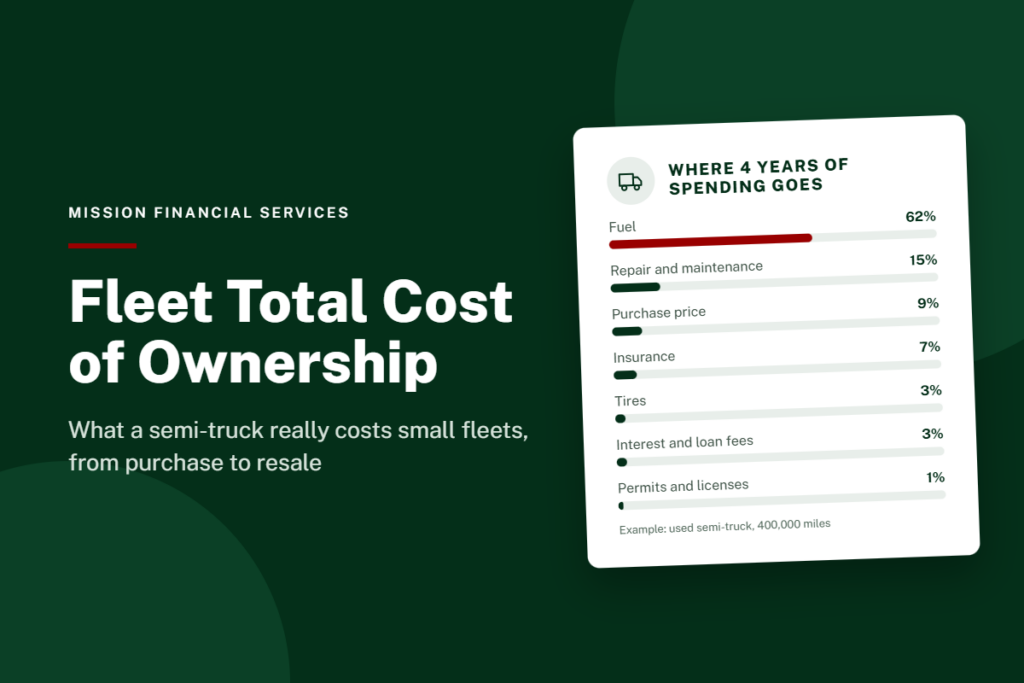
When you’re adding a truck to your fleet, the easiest cost to pin down is the asking price. However, fuel, repairs, insurance, and financing add a lot more to the total cost of ownership of a semi-truck over the years you run it.
For a small fleet, underestimating those costs on even one truck can squeeze your margins for years.
In this guide, we’ll walk through each cost that goes into fleet TCO and show you how to calculate it. We’ll also work through a four-year example for a used semi-truck and show how loan terms change the true cost. That way, you’ll know whether the next truck will earn more than it costs to run.
Quick answer
Fleet total cost of ownership (TCO) is everything a truck costs you from purchase to sale. That includes the price, financing, fuel, repairs, insurance, taxes, and downtime, minus resale value.
Financing terms are part of TCO, so compare loans on total cost as well as the monthly payment.
What Is Fleet Total Cost of Ownership?
Fleet total cost of ownership is what it costs to buy, run, and sell each truck while you own it.
The basic TCO calculation is:
TCO = acquisition costs + financing costs + operating costs + downtime costs – resale value
Breakdown of terms:
- Acquisition costs: the purchase price plus sales tax, title, and registration.
- Financing costs: the interest and loan fees you pay over the loan term.
- Operating costs/expenses: fuel, repairs, insurance, and other running costs.
- Downtime costs: the revenue you lose while a truck sits in the shop.
Fleet managers at large carriers use TCO to plan replacements across fleet vehicles. You can use the same math to decide whether one more truck makes money.
What Goes Into TCO for a Semi-Truck?
Truck total cost of ownership covers the purchase and loan, fuel, repairs, insurance, and depreciation. Smaller lines like tires, taxes, and downtime count too.
Purchase Price and Financing Costs
Ask the seller for the out-the-door price, so sales tax, title, and registration are in your number from the start. Interest, doc fees, and dealer add-ons are financing costs that belong in your TCO too.
Fuel
Fuel costs are the largest operating expense a small fleet controls, and they’ve climbed fast since 2025.
The EIA’s weekly U.S. average for diesel was $5.937 a gallon for the week of November 16, 2026. At 6.5 mpg, that’s about 91 cents per mile.
At these prices, every extra mile per gallon lowers your cost per mile. Speed, idle time, and truck spec all affect fuel efficiency, so check them first when a truck’s fuel bill climbs. Fuel cards with per-truck limits also show what each truck burns, which makes fuel theft easier to spot.
Repair and Maintenance
Maintenance and repair costs rise as a truck ages, so plan for them before the bills arrive.
The simplest way is a per-mile repair reserve. Set aside a fixed amount for every mile the truck runs. For example, saving 20 cents a mile builds about $20,000 a year on a truck running 100,000 miles.
Keep the reserve in a separate account so it’s ready when parts and labor costs come due.
Preventive maintenance catches worn parts before they fail, and predictive maintenance uses engine fault codes to flag problems early.
Insurance
Insurance is a fixed annual cost, so spread it across your expected miles. Commercial truck insurance costs depend on your driving record, cargo, radius, and the truck’s value.
Depreciation and Resale Value
Depreciation is the value a truck loses while you own it. Resale value, or residual value, is what’s left when you sell, and it depends on mileage, condition, and service records.
Depreciation affects your taxes too. The Section 179 deduction may let you write off much of a truck’s cost in the year you buy it. Check with your tax advisor first.
Tires, Permits, Taxes, and Downtime
These costs are smaller than fuel or repairs, but they add up quickly across a fleet. Give each one its own line in your TCO so none of them slips through.
Tires averaged 5 cents per mile in ATRI’s 2025 data, up 6.4% in a year. That’s about $5,000 per truck at 100,000 miles. Steady tire maintenance (correct inflation, alignment, and rotation) helps each set last longer.
Trucks at 55,000 pounds or more owe the federal heavy vehicle use tax (HVUT). It starts at $100 a year and rises with weight, up to $550 for trucks over 75,000 pounds.
If you run in more than one state, budget for apportioned plates and fuel tax reporting too. Plate costs depend on your truck’s weight and the states you run in.
Downtime is the opportunity cost of a truck that isn’t earning. To estimate it, multiply the days a truck sits in the shop by what it usually earns per day. For example, a truck that grosses $1,000 a day loses $5,000 during a five-day repair. That’s before you pay the repair bill. A missed load can also cost you a customer who needed the freight moved on time.
Track downtime per truck to see when an older truck’s lost loads cost more than a newer truck’s payment.

How to Calculate Fleet TCO
Calculating total cost for a fleet starts with one truck. Total its costs over your ownership period, subtract resale value, then add the trucks together.
- Set the ownership period and miles. For example, four years at 100,000 miles.
- Add acquisition and financing costs. Include the purchase price, taxes, loan fees, and total loan interest.
- Estimate operating and downtime costs. Multiply fuel, repairs, insurance, tires, and permits per mile by total miles. Then add the revenue you expect to lose to shop days.
- Subtract the expected resale value. Base it on recent sales of similar trucks.
- Divide by total miles. Compare that TCO per mile with the rate per mile your loads pay.
If you already track your cost per mile, you have most of the operating inputs. An accurate TCO calculation uses your own receipts and shop invoices, with industry averages only filling gaps.
Fleet TCO Example for One Used Semi-Truck
Here’s an illustrative example of a four-year TCO for a used Class 8 truck at 100,000 miles a year:
- A $55,000 truck with 20% down, and $44,000 financed at 18% simple interest for 48 months, paid on time.
- Diesel at $6.00 a gallon and 6.5 mpg, with other costs at ATRI’s 2025 averages.
- A $25,000 resale value after four years.
Driver pay and downtime are left out, since both depend on your own loads and rates.
| Cost line (4 years, 400,000 miles) | Amount |
| Purchase price | $55,000 |
| Loan interest (48 months) | $18,040 |
| Loan fees (assumed) | $495 |
| Fuel (92 cents per mile) | $369,231 |
| Repair and maintenance (21.5 cents per mile) | $86,000 |
| Insurance (10.6 cents per mile) | $42,400 |
| Tires (5 cents per mile) | $20,000 |
| Permits and licenses (0.8 cents per mile) | $3,200 |
| Resale value | -$25,000 |
| Total cost of ownership | $569,366 |
| Annual cost | $142,342 |
| TCO per mile | $1.42 |
Fuel makes up about 65% of this truck’s TCO, and the purchase price is under 10%. Going from 6.5 to 7.5 mpg would save this truck about $49,000 in fuel over four years.
New vs Used Trucks: How TCO Compares
A used truck costs less to buy and loses value more slowly. A new truck usually costs less to repair and run.
| Factor | New truck | Used truck |
| Purchase price | Highest upfront cost | Lower upfront cost |
| Financing | Larger loan, more total interest | Smaller loan, but some lenders limit truck age |
| Maintenance costs | Lower early on, often under warranty | Higher, and rising with miles |
| Fuel efficiency | Newest engines and aerodynamics | Depends on age, spec, and upkeep |
| Depreciation | Steepest in the first years | Slower, since the first owner took the biggest drop |
| Downtime risk | Lower | Higher without service records |
We’ve found that service records predict a used truck’s repair costs better than mileage alone.
How Financing Affects Fleet TCO
Your down payment, loan term, and interest rate set how much the loan adds to TCO. A longer term lowers monthly payments but raises total interest, as this $44,000 loan at 18% shows:
| Loan term | Monthly payment | Total interest |
| 36 months | About $1,591 | About $13,265 |
| 48 months | About $1,292 | About $18,040 |
| 60 months | About $1,117 | About $23,039 |
Going from 48 to 60 months saves about $175 a month but adds about $5,000 in interest.
A bigger down payment shrinks both the loan and the interest you pay on it.
At Mission Financial Services, our loans are simple interest contracts, so interest accrues daily on the balance you still owe. Paying on time or early lowers your total interest. We finance truck purchases only, so every payment builds equity in fleet assets you own.
Ways Small Fleets Can Lower TCO
The biggest cost savings come from fleet costs that repeat every mile. These cost saving strategies fit small fleet operations:
- Spec for the work. Match engine, gearing, and aerodynamics to your lanes and loads.
- Keep asset maintenance on schedule. Routine vehicle maintenance prevents the major repairs that push maintenance expenses up.
- Coach fuel habits. Cut idle time and review fuel use by truck every month.
- Time vehicle replacement. Replace older vehicles once their repair and downtime costs per mile pass a newer truck’s payment.
- Track fleet expenses by truck. Logging asset expenses per truck helps you enhance budget accuracy and reduce unnecessary expenses.
These TCO fleet management habits are the everyday side of good small fleet management. Applied truck by truck, they keep reliable vehicles running and operational expenses predictable.
Final Thoughts
Fleet TCO shows what a truck will cost from purchase to sale. Run it for each truck you’re considering, using current diesel prices and total loan interest.
When you’re ready to add a truck, Mission Financial Services can help with one of our small fleet loans. As a common-sense lender, we look at your payment history and the bigger picture as well as your credit score. We offer direct loans across the lower 48 states, and respond to applications within four hours.
Frequently Asked Questions
What is the formula for total cost of ownership?
The formula for total cost of ownership is acquisition costs plus financing, operating, and downtime costs, minus resale value. Add up each cost over the years you own the truck. Divide that total by miles driven to get TCO per mile.
How do you calculate fleet cost?
You calculate fleet cost by adding the TCO of every truck you run. For a quick estimate, multiply each truck’s cost per mile by its annual miles, then add them up. Your own fuel receipts and shop invoices are more accurate than industry averages.
Is it a good idea to buy a fleet truck instead of leasing?
Buying a fleet truck makes sense if you plan to keep it for several years. Every payment builds equity, and you can sell the truck later. Leasing may cost less upfront but leaves you with no truck at the end. Mission Financial Services finances purchases only and doesn’t offer leases.
What does 5-year TCO mean?
Five-year TCO is the total cost of owning a truck over five years of service. It adds acquisition, financing, operating, and downtime costs for that period, then subtracts resale value. It’s a fixed planning window that lets you compare trucks over the same period.
How much does it cost per mile to run a semi-truck?
Running a semi-truck cost an average of $2.336 per mile in 2025, according to ATRI. That figure includes driver wages and benefits. Diesel prices rose sharply in 2026, so your current cost per mile is likely higher than ATRI’s average.