Office: (404) 975-4800

semi truck financing

How Much Down Payment Do You Need to Buy a Semi-Truck?

How Much Down Payment Do You Need to Buy a Semi-Truck?

How much down payment do you need for a semi truck

For most first-time buyers, the down payment is the biggest cash hurdle to owning a truck.

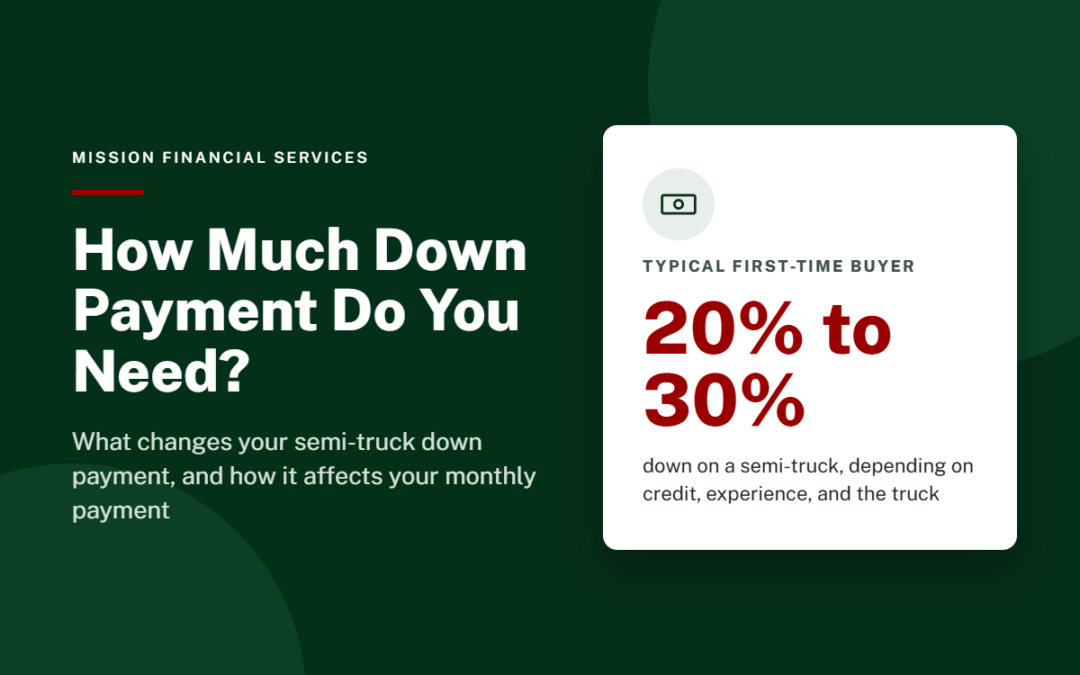
In our experience, first-time buyers usually put 20% to 30% of the purchase price down. Your number can land higher or lower, because lenders set it from your credit, your driving experience, and the truck you want to buy.

This guide shows what moves your down payment, how it changes the monthly payment, and how to lower it.

Quick answer

Most first-time semi-truck buyers put 20% to 30% down, depending on credit, driving experience, and the truck. Older trucks and lower credit scores usually call for a larger down payment. A bigger down payment lowers your monthly payment and the interest you pay. Apply first to see what your lender will ask for.

Typical Semi-Truck Down Payment Ranges

A first-time buyer financing a used semi-truck should plan on 20% to 30% down.

That’s the range we see most often in semi-truck financing at Mission Financial Services. Where you land depends on your credit and other factors:

  • Strong credit and a newer truck: closer to the low end, and some lenders may ask for less.
  • Limited driving experience: toward the high end or above it.
  • Bad credit or an older, high-mileage truck: often above 30%.

The percentage only means something once you know the purchase price. Start with what a semi-truck costs for the truck type you need, then work out the dollar amount. Our first-time buyer loans don’t require prior truck credit or homeownership.

What Changes Your Down Payment
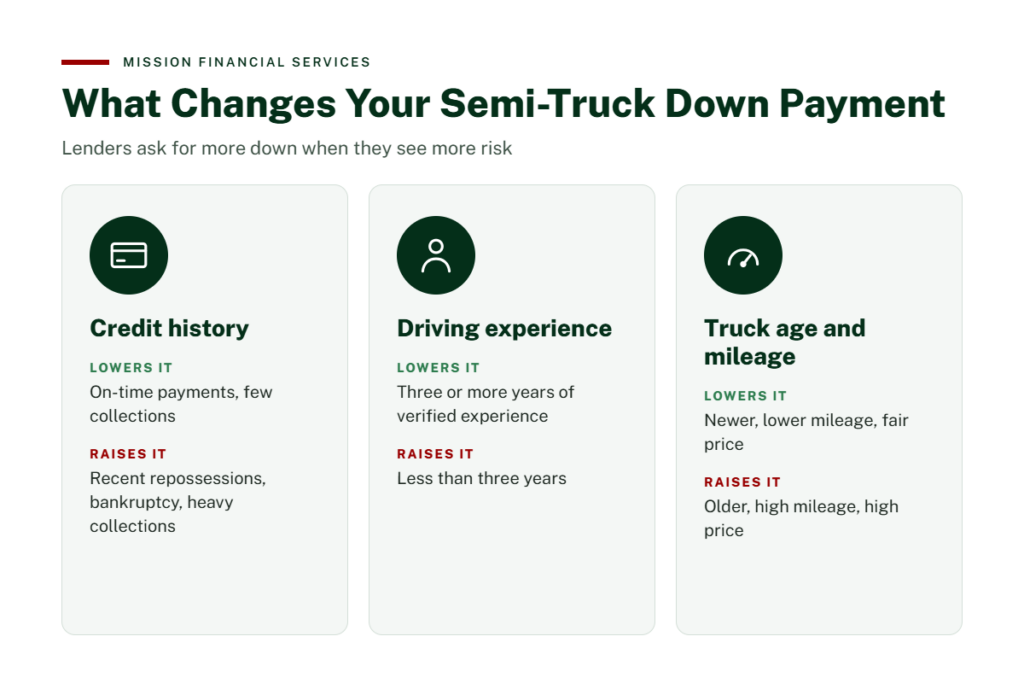
Infographic showing what affects your down payment on a semi-truck

In commercial truck financing, lenders ask for more down when they see more risk, and they judge that risk from three areas: your credit, your experience, and the truck.

Factor Lowers your down payment Raises your down payment
Credit history On-time payments, few collections Recent repossessions, bankruptcy, heavy collections
Driving experience Three or more years of verified experience Less than three years
Truck Newer, lower mileage, fair price Older, high mileage, high price

Credit Score and Credit History

Your credit score and credit history affect both approval and the down payment a lender asks for.

Many truck lenders review personal credit, especially for new businesses with no business credit yet. Checking your own score first is a soft credit pull, and according to myFICO, soft inquiries don’t affect your FICO score.

At Mission Financial Services, we look at your whole credit report rather than the score alone, so on-time car or mortgage payments count in your favor.

The credit score you need varies by lender, so ask each one what it looks at.

CDL and Driving Experience

Lenders weigh driving experience alongside credit, because time in the trucking industry shows you can keep the truck earning.

We look for drivers with at least three years of verified driving experience. Drivers with less experience can still qualify, and we review those files case by case with a larger down payment. Bank statements or tax returns showing steady income help your case too.

Truck Age, Mileage, and Price

Older trucks with high mileage usually need a larger down payment.

Choosing a used truck under 10 years old in good condition can lower your down payment and monthly payment. An older truck requires more upkeep, so if you’re financing an older truck, budget for a bigger down payment and a repair fund. Paying a fair price keeps the loan amount down.

How Your Down Payment Changes the Monthly Payment
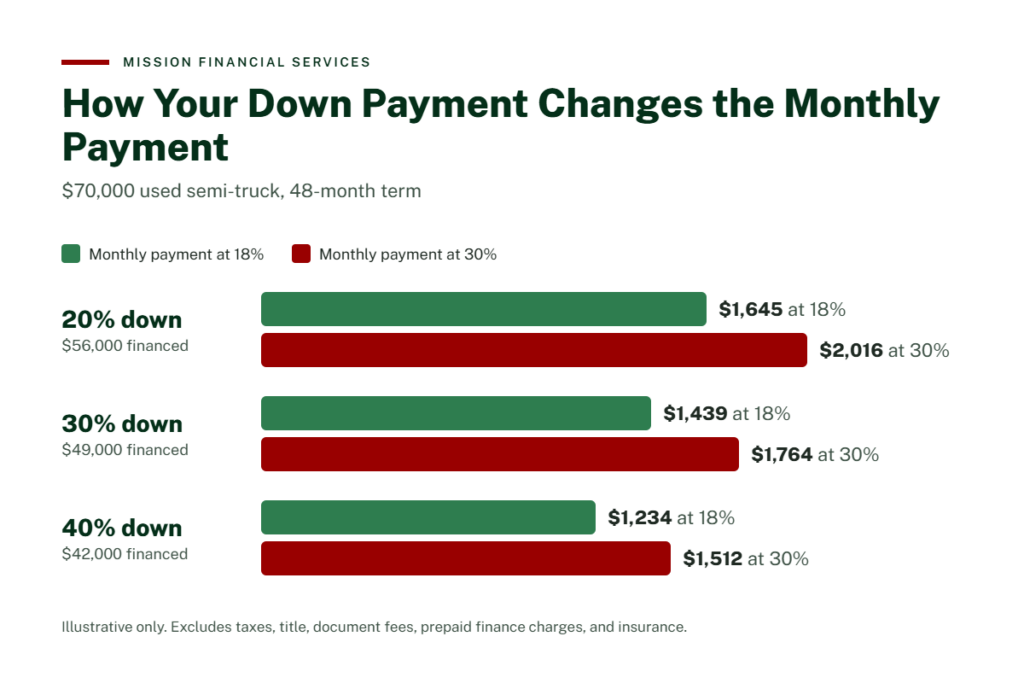
Payment chart showing how your down payment affects your monthly payments for a semi truck

A larger down payment lowers your monthly truck payments, because you borrow less.

The table uses a $70,000 used truck, a 48-month term, and two rates.

Down payment Amount financed Monthly payment at 18% Monthly payment at 30% Total interest at 18%
20% ($14,000) $56,000 $1,645 $2,016 $22,960
30% ($21,000) $49,000 $1,439 $1,764 $20,090
40% ($28,000) $42,000 $1,234 $1,512 $17,220

Illustrative only. Excludes taxes, title, document fees, prepaid finance charges, and insurance. Your interest rates and loan terms depend on your application and the lender.

Moving from 20% to 40% down saves about $411 a month at 18%, and $5,740 in interest over the loan. Before you compare offers, check the APR, because it includes fees the rate leaves out.

Getting pre-approved before you visit a dealer tells you your own down payment and gives you an offer to compare with the dealer’s financing, a step the CFPB recommends for vehicle buyers. To find out your own number, start your credit application before you shop.

Semi-Truck Down Payment With Bad Credit

With bad credit, expect to put more down, often above 30%. A larger down payment lowers the lender’s risk, which improves your approval odds. These steps also help:

  • Show steady deposits. Recent statements showing steady income tell a lender your truck can generate revenue.
  • Bring proof of on-time payments. A car loan or rent paid on time counts.
  • Choose a newer, cheaper truck. A lower purchase price means a smaller down payment in dollars.
  • Add a co-signer. We accept co-signer statements on some applications.

Our bad credit financing options are built for owner-operators with past credit problems. Lenders offering no credit check financing usually make up for skipping the check with a larger down payment or a higher rate.

Can You Use a Trade-In as a Down Payment?

Yes, many lenders let trade-in equity count toward your down payment.

Equity is your current truck’s value minus what you still owe on it. If your truck is worth $30,000 and you owe $18,000, you have $12,000 in equity.

Get the trade-in value written on the sales order so the lender can see it.

Ways to Lower Your Down Payment

You can lower the down payment by reducing the lender’s risk or the price of the truck:

  1. Buy a lower-priced truck. The same percentage on a cheaper truck means less cash.
  2. Pick a newer used truck. Trucks under 10 years old often need less down.
  3. Improve your credit before you apply. Pay down collections and keep current accounts on time.
  4. Add a co-signer with stronger credit.

Zero down financing is rare for first-time buyers, and it usually costs more over the life of the loan.

Stack of $100 bills fanned out of a black leather wallet

Loan vs Lease Down Payments

Leases often ask for less cash up front than a purchase loan, but you don’t build equity in the truck. A lease down payment buys use of the truck for the lease term, while a loan down payment buys equity from day one.

Mission Financial Services offers purchase loans only, so every dollar you put down goes toward a truck you’ll own.

Final Thoughts

Most first-time buyers need 20% to 30% down, and your credit, experience, and truck decide where you land.

Know your number before you shop, so you can match the truck to your budget. Apply for your truck loan and we’ll get back to you with what you’ll need.

Frequently Asked Questions

How much down payment do you need for a semi-truck?

Most first-time buyers put 20% to 30% of the purchase price down. Strong credit, three or more years of driving experience, and a newer truck push you toward the low end. Bad credit, limited experience, or an older, high-mileage truck push it higher. Your lender sets the final number after reviewing your application.

Can I buy a semi-truck with no money down?

It’s possible but rare, especially for first-time buyers. Zero down loans usually go to buyers with strong credit and business history, and they often carry higher rates. Without a down payment, you borrow more and pay more interest. Mission Financial Services requires a down payment on its purchase loans.

How much down payment do I need with bad credit?

With bad credit, expect to put down more than the usual 20% to 30%. Lenders ask for more because a larger down payment lowers their risk. Steady bank deposits, on-time car or rent payments, and a fair-priced truck can improve your odds and terms.

Does a bigger down payment lower my rate?

A bigger down payment always lowers the amount you borrow, your monthly payment, and your total interest. It can also improve your approval odds. Whether it lowers your rate depends on the lender, so ask each one how your down payment affects the rate it offers.

How much is the monthly payment on a $70,000 semi-truck?

With 20% down, you’d finance $56,000. Over 48 months, that’s about $1,645 a month at 18% or $2,016 at 30%. With 40% down, the payment drops to about $1,234 at 18%. These figures exclude taxes, fees, and insurance.

Can I use my current truck as a trade-in?

Yes, many lenders count trade-in equity toward your down payment. Equity is the truck’s value minus your loan payoff. Get the trade-in value written on the sales order. Ask your lender whether it accepts trade-ins before you shop, because policies vary.
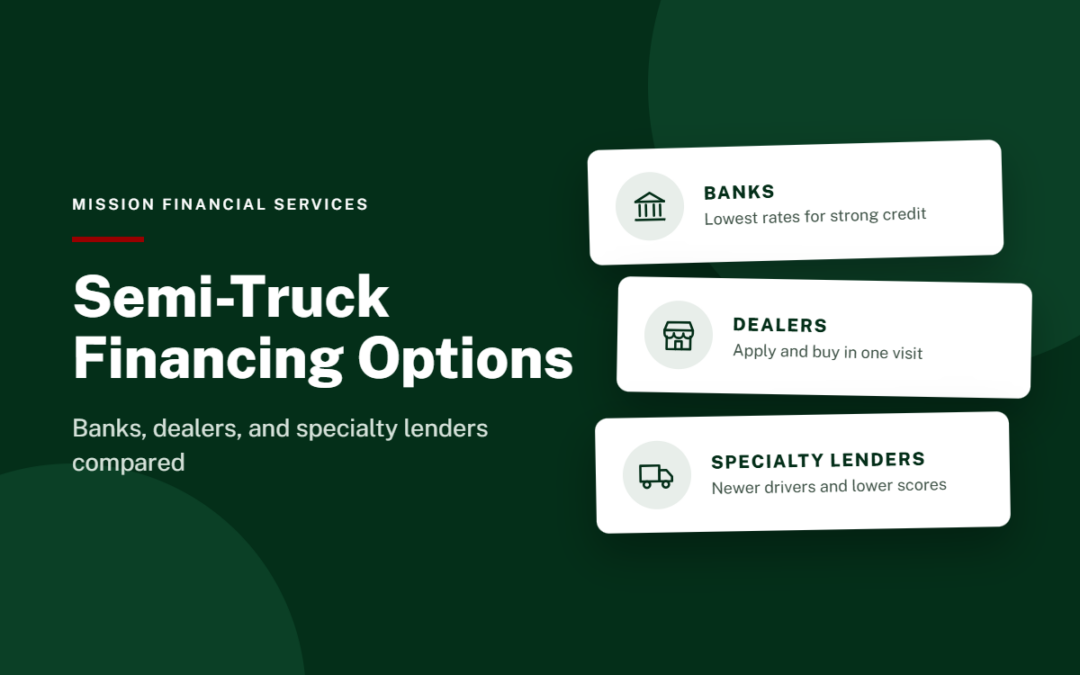
Semi-Truck Financing Options: Banks, Dealers, and Specialty Lenders Compared

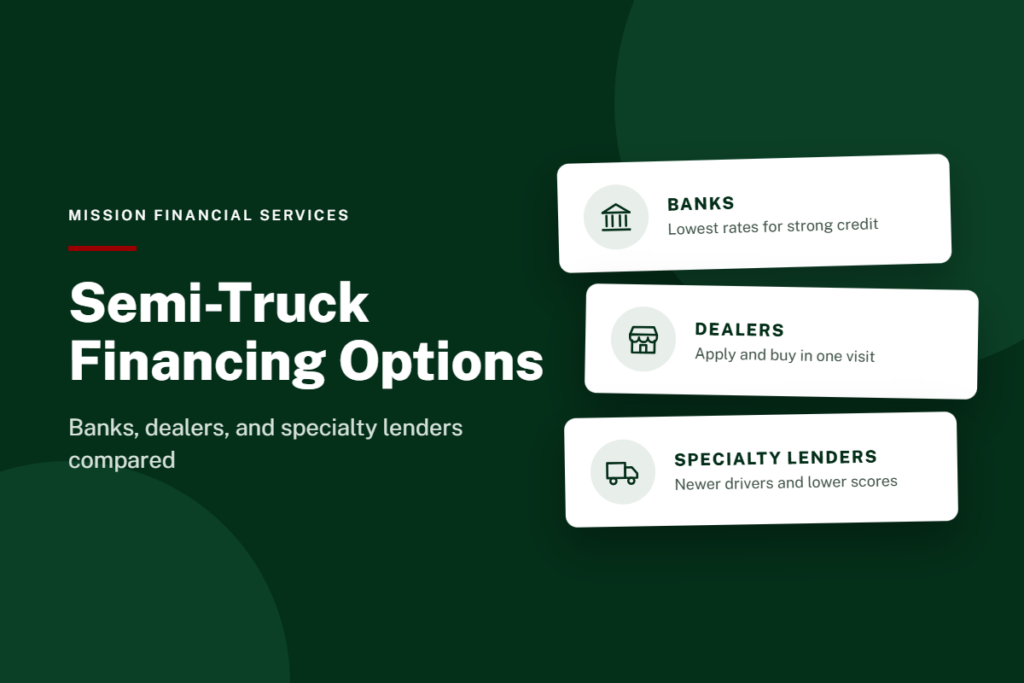
Semi-Truck Financing Options: Banks, Dealers, and Specialty Lenders Compared

Semi truck financing options

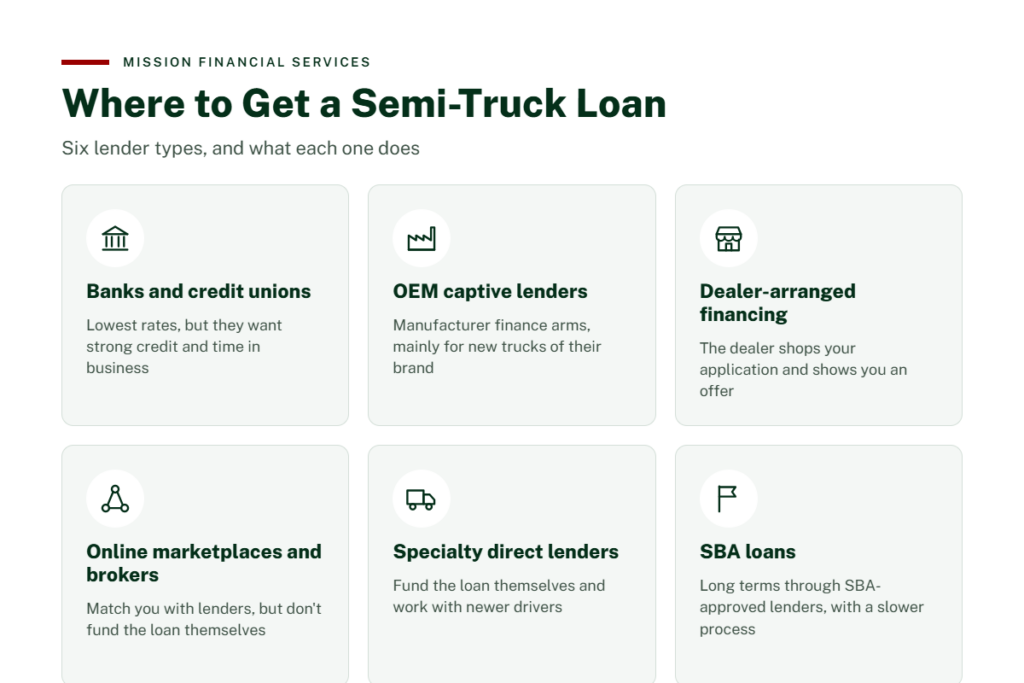
There are more places to borrow for a semi-truck than most first-time buyers realize. Banks, credit unions, truck manufacturers, dealers, online brokers, and specialty truck lenders all offer commercial vehicle financing.

Many new owner operators apply at their bank first, but a bank turning you down doesn’t mean every lender will. Each lender type sets its own rules for credit, down payment, and truck age, so how semi-truck financing works for you depends on where you apply.

This guide compares every option, shows who each one suits, and lists the questions to ask before you sign.

Quick answer: Your semi-truck financing options are banks and credit unions, OEM captive lenders, dealers, online brokers, and specialty truck lenders. Banks usually offer the lowest rates but want strong credit and time in business. Specialty direct lenders work with newer drivers and lower scores. Compare APR, fees, and truck age limits before you apply.

Semi-Truck Financing Options at a Glance

The table compares the main truck financing options on credit, approval speed, down payment, and truck age.

Lender type Credit requirements Approval speed Down payment Truck age limits Who it suits
Banks and credit unions Strong credit and business history Days to weeks Lower for strong credit Often prefer newer trucks Established businesses with strong credit
OEM captive lenders Usually strong credit Fast, at the dealer Promotions for qualified buyers New and select used trucks of their brand Buyers of new trucks
Dealer-arranged financing Set by the lenders the dealer uses Often same day Set by the approving lender Set by the approving lender Buyers on a dealer lot
Online marketplaces and brokers Wide range Fast to match, slower to fund Set by the lender Set by the lender Buyers who want several quotes
Specialty direct lenders Flexible, often review overall credit Hours to days Often larger for newer drivers Often accept older trucks First-time and credit-challenged buyers
SBA loans Strong credit and business history Weeks to months Set by the lender Set by the lender Established businesses that can wait
Mission Financial Services Overall credit, not just your score Answer within four hours First-time buyers usually 20% to 30% Used trucks up to 15 years old First-time buyers, limited experience, bad credit

Banks and Credit Unions

Banks and credit unions usually offer the lowest rates, but they want strong credit and time in business.

Banks often set tighter limits on truck age and mileage, which is important to note if you’re looking to finance older trucks. Many banks won’t finance a used semi-truck for a first-time owner-operator.

A bank suits an established business with strong credit, steady revenue, and a newer truck in mind.

Credit unions can also offer competitive rates, but you need to become a member first.

OEM Captive Lenders

OEM captive lenders are the finance arms of truck manufacturers. They mainly finance new trucks of their own brand, although some will also finance select used trucks sold through their dealer network.

Their main advantage is promotional rates on new trucks, which usually go to buyers with strong credit and an established business.

If you’re buying a used truck from another brand, a captive lender usually isn’t an option.

Dealer-Arranged Financing

With dealer-arranged financing, the dealership sends your credit application to outside lenders and shows you the offer it picks.

It’s convenient, because you can often apply and buy in the same place. The trade-off is that you usually see one offer, even if several lenders reviewed your file. The dealer can also add a markup to the lender’s rate.

Getting pre-approved somewhere else first gives you a rate to hold against dealer financing offers.

Online Marketplaces and Brokers

An online marketplace or broker matches you with lenders, but it doesn’t fund the loan itself. That can get you several quotes quickly, but some brokers charge a fee and your file may reach multiple lenders.

Ask up front whether each lender will run a hard credit check, because several hard inquiries can lower your score.

Specialty Direct Lenders

Specialty direct lenders focus on commercial vehicle financing and fund the loan themselves, so they set their own approval rules.

Many offer flexible financing solutions to buyers a bank would turn down, including newer drivers, borrowers with lower credit scores, and buyers of older trucks. In exchange, their rates are usually higher than bank rates.

Mission Financial Services is a direct lender. We review your overall credit, including on-time car and home payments, not just the number on your credit report. We work with drivers who have at least three years of verified driving experience, and we review newer drivers case by case.

SBA Loans for Trucking

SBA loans come from banks and other SBA-approved lenders, with the U.S. Small Business Administration guaranteeing part of the loan.

According to the SBA, 7(a) loans provide long-term financing for a range of business purposes. Longer terms can mean lower monthly payments, but the application takes more paperwork and time than most truck loans, and the lender sets the eligibility rules.

SBA financing suits an established trucking business that can wait. It’s not the best route for someone who needs a truck next month.

Where to get a semi-truck loan: graphic outlining the different options and lender types

How Interest Rates Compare by Lender Type

Semi-truck loan rates in 2026 run from roughly 6% to 35% APR, according to FreightWaves’ May 2026 review of the truck financing market. Your rate depends on your credit, your time in business, the truck’s age and mileage, and the lender you choose.

  • Banks: About 4% to 8% APR, per the same FreightWaves review. For comparison, banks reported median rates of 6.7% to 7% on new variable-rate small business term loans (all industries) in Q2 2026, according to the Kansas City Fed’s Small Business Lending Survey. Those low rates go to borrowers with strong credit and years of business history.
  • Dealer financing: The rate depends on the lender the dealer picks, plus any markup the dealer adds.
  • Specialty lenders: FreightWaves found that a credit score below 680 adds roughly 2 to 5 percentage points at most specialty lenders. So a carrier with a 620 score buying a 2017 truck with 650,000 miles could see rates of 15% to 25%.

A lender only gives you your actual rate after a full application, so compare APRs on written offers, not advertised starting rates.

A few things can move you toward the lower end of your lender’s range:

  • Documented income: Bank statements or tax returns that show steady income give the lender proof you can make the payments, which can help you get a better rate.
  • A newer truck: Newer, lower-mileage trucks are easier to finance.
  • A business plan: A plan that shows your lanes, expected revenue, and operating costs can strengthen your application. The SBA notes that business plans can help you get funding.

Bank Loan vs Specialty Truck Lender: Which Is Better?

A bank loan is a decent option if you have strong credit, an established business, and a newer truck. A specialty truck lender is better if you’re new, have damaged credit, or want an older truck.

Pick based on where you stand today:

  • Choose a bank if you can wait, your financial history is clean, and you want the lowest rate.
  • Choose a specialty lender if a bank turned you down or you need flexible financing and a fast answer.
  • Apply to both if you’re on the line. Then compare the offers on APR and total repayment.

A larger down payment can help with either lender. It lowers the amount you borrow and your monthly payments, which protects your cash flow for fuel and repairs.

Questions to Ask Any Truck Lender

Ask every lender the same questions so you can compare offers side by side:

  1. What’s the APR? The APR includes fees as well as interest, so it’s a better comparison than the rate alone.
  2. What fees apply? Ask about document fees, prepaid finance charges, and hidden costs outside the payment.
  3. Is there a prepayment penalty? Paying early without a charge gives you payment flexibility in a strong month.
  4. Is there a balloon payment? Balloon financing lowers monthly payments, then ends with a large final payment.
  5. Do I sign a personal guarantee? If you do, your personal assets back the loan.
  6. What insurance do you require? Lenders usually require physical damage coverage before they fund.
  7. What’s your truck age limit? This decides which equipment you can shop for.
  8. What’s the total repayment? Multiply the monthly payment by the number of payments, and add any balloon payment. Add your down payment to see what the truck costs in total.
  9. Are you a broker or a direct lender? A broker passes your file on.

With the answers side by side, you can choose a truck lender on total cost rather than the monthly payment.

Truck driving at night

What About Leasing?

Leasing usually comes with lower monthly payments than a loan, but you don’t build equity in the truck.

Most leases also set mileage limits, which can cost you if you run long routes. Over time, a loan usually costs less than a lease because you end up owning the truck. Our loans are for purchases, and we also finance lease-purchase buyouts.

Final Thoughts

The right lender depends on your credit, your time in business, and the truck you want to buy.

Banks tend to look for strong credit and a long business history. Dealer financing is quick when the truck is on the lot, but you’ll usually see only the one offer that the dealer has picked.

A specialty lender like Mission Financial Services gives you more ways to get approved and helps you navigate the financing process.

We fund semi-truck loans through dealerships in 28 states and lend directly to owner-operators in the lower 48, so you can buy from a dealer or a private seller. We work with first-time buyers, drivers with limited experience, and borrowers with bad credit.

Found your truck? Start your credit application today.

Frequently Asked Questions

What are the best semi-truck financing options for owner-operators?

The best option depends on your credit and time in business. Banks and credit unions suit established owner-operators with strong credit. Specialty direct lenders suit first-time buyers, drivers with limited experience, and buyers with bad credit. OEM lenders suit buyers of new trucks. Apply where you meet the lender’s rules, then compare APR and total repayment.

Is a bank or a specialty truck lender better?

A bank is a good option if you have strong credit, an established business, and a newer truck, because its rates are usually lower. A specialty lender suits you better if you’re new, have a low score, or want an older truck. Specialty lenders also tend to approve faster. It’s always best to compare a few options before making your decision.

Can I get a semi-truck loan as a new owner-operator?

Yes, if you apply with a lender that accepts limited business history. Mission Financial Services offers first-time buyer loans to drivers with at least three years of verified driving experience. Drivers with less experience may qualify with a larger down payment, reviewed case by case. Banks usually want more time in business.

Do banks finance used semi-trucks?

Some banks finance used semi-trucks, but they often set tighter limits on age and mileage. A bank may only consider trucks a few years old with low miles. If you’re buying an older used truck, a specialty lender is more likely to approve it, although an older truck can also mean a larger down payment.

What questions should I ask a truck lender?

Ask for the APR, all fees, and whether there’s a prepayment penalty or balloon payment. Ask if you must sign a personal guarantee and what insurance the lender requires. Check the truck age limit and the total repayment over the full term. Ask whether you’re dealing with a broker or a direct lender.

What is the difference between a broker and a direct lender?

A broker shops your application to other lenders and may charge a fee for the match. A direct lender reviews your application and funds the loan itself, so you deal with one company from approval to payoff. Mission Financial Services is a direct lender.

Archives

Sign Me Up!

Stay up to date with the latest news in the commercial trucking industry.

Contact Us
close slider