

If you’ve logged into the FMCSA Portal recently, you’ve probably noticed something new staring back at you. That’s Motus, the agency’s new registration platform. It’s not a small update. It’s the biggest change to federal carrier registration in over a decade, and it lands alongside a broader wave of trucking industry regulations owner-operators are already tracking this year.
Here’s a clear breakdown of what changed, what stayed the same, and what you should do next.
TL;DR
FMCSA’s new Motus registration system replaced the old FMCSA Portal and URS in May 2026. Your MC number and USDOT number aren’t changing, and fees are the same as before ($300 per authority, free USDOT number).
The big changes are a required Login.gov identity verification (photo ID and facial scan, done by the owner personally) and a single dashboard for registration, insurance filings, and biennial updates.
Carriers are seeing longer processing times since launch, so apply early and double-check your account details, especially the Login.gov email tied to your company official.
FMCSA also paused USDOT deactivations for missed biennial updates since June 1, 2026, but that grace period is temporary.
What Is The FMCSA Motus Registration System?
Motus is the Federal Motor Carrier Safety Administration’s new online registration platform. It replaces the old Unified Registration System (URS) and consolidates several outdated tools into one dashboard.
From Motus, you can apply for a USDOT number, request operating authority, file your biennial update, and manage who has access to your company account.
FMCSA rolled Motus out in two phases:
- Phase one launched in December 2025. It only applied to supporting companies, like BOC-3 filers and insurance providers.
- Phase two opened Motus to every regulated entity, including motor carriers, brokers, and freight forwarders, in May 2026. FMCSA also retired the legacy URS and Licensing and Insurance filing systems that same week, so Motus is now the only path for new registrations and updates.
Why FMCSA Built A New System
For years, FMCSA registration lived across several separate systems that didn’t connect with each other. That included the Unified Registration System (URS), the Motor Carrier Management Information System (MCMIS), and the Licensing and Insurance System.
Each one held a different piece of a carrier’s record. For example, a carrier’s insurance status might update in one system without syncing to another.
That fragmentation created real openings for fraud.
Someone could hijack a legitimate carrier’s USDOT number and use it to book loads that never get delivered – a scheme known as double brokering. Others impersonated real carriers using stolen identity details, or registered a business at a fake address, like a P.O. box or a shared mail drop, just to look established on paper.
FMCSA has publicly warned carriers about this kind of identity theft for years, and has also flagged cases involving foreign actors targeting freight and cargo.
The purpose of Motus is to close those gaps.
It pulls registration, insurance filings, and compliance history into one centralized environment. And every account must have a verified Login.gov identity instead of a simple username and password.
That makes it much harder for someone to change a carrier’s contact information, hijack a DOT number, or set up a shell business using a fake address. Most schemes rely on that kind of unauthorized account access, so tightening it at the source should cut down on a lot of the scams carriers deal with today.

What Changed And What Didn’t
Here’s a look at what’s changed under Motus, what hasn’t, and where FMCSA’s own guidance stands right now.
MC Numbers Are Not Going Away
You may have heard that MC numbers are being phased out or eliminated. FMCSA has confirmed that that is not part of this Motus rollout.
Docket number prefixes (MC, MX, and FF) aren’t changing. Your existing USDOT number and docket number stay exactly as they are, and they remain the primary identifier for regulated entities.
USDOT Suffixes Only Apply To New Registrants
Motus does add letter suffixes to USDOT numbers, like a “-C” for a property carrier or a “-B” for a broker. But these suffixes currently apply only to companies registering for the first time.
If you already have a USDOT number, you won’t see a suffix added to it right now. FMCSA hasn’t announced a timeline for changing that.
Identity Verification Is Real And Strict
Motus requires the company official to verify their identity through Login.gov, which includes a photo ID scan and facial verification. This has to be done personally by the company owner or an authorized employee. It cannot be delegated to a consultant or a third-party service.
No New Permits, No BOC-3 Changes, Yet
FMCSA has confirmed that Motus does not introduce a new “Safety Registration” program at launch, and it hasn’t changed how BOC-3 process agent filings work.
Both of those have been floated as possible future changes, but neither is in effect today.
Registration Fees Haven’t Gone Up
Motus is a new system, not a new fee schedule. A USDOT number is still free. Operating authority still costs $300 per authority type, paid at the time you apply. BOC-3 filings and insurance costs work the same way they always have.
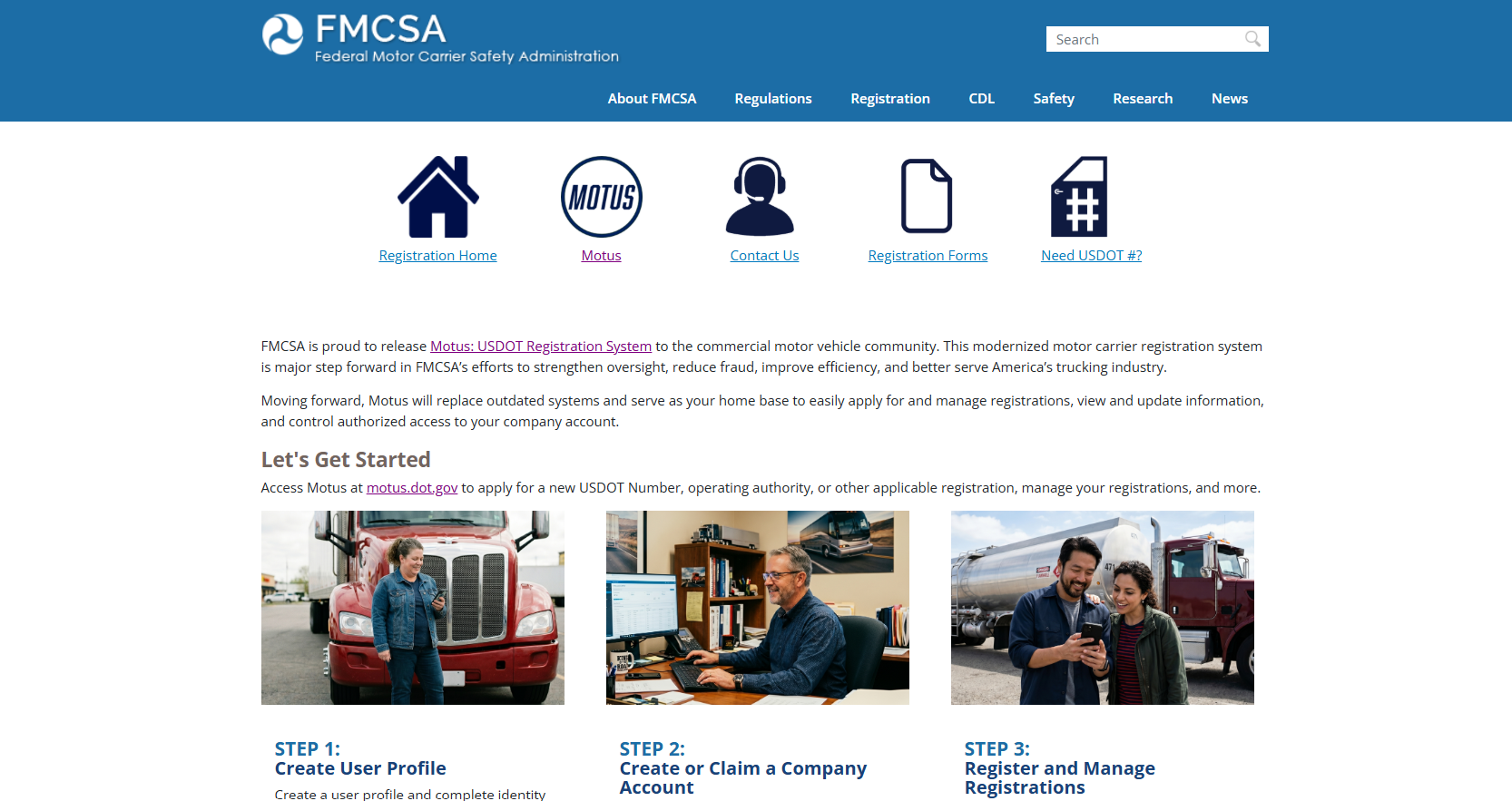
How To Claim Your USDOT Number In Motus
If you already operate under a USDOT number, you’ll need to claim your existing record rather than start over.
Here’s the general process:
- Log into Motus using the same Login.gov email tied to your old FMCSA Portal account.
- Complete identity verification, including the photo ID and facial scan step.
- Confirm your USDOT number is linked to your profile when it appears.
- Review your business information, including your address and vehicle count, for accuracy.
- Submit your claim for FMCSA review.
If your Login.gov email doesn’t match what’s on file, check your FMCSA Portal account first and confirm who’s listed as the company official. If that person has left the business or the email is outdated, update it in the Portal before you attempt to claim your number in Motus.
If you’re still locked out after that, call FMCSA’s Registration Customer Service Center or submit a ticket through Ask FMCSA and ask them to link your account to the correct record.
Expect Some Delays Right Now
Since Motus launched, a lot of carriers have reported longer wait times than usual. New authority applications, BOC-3 updates, and insurance filings have all been slower to process while FMCSA works through the backlog from the system switch. Some carriers are seeing this take several weeks rather than the near-instant approvals the old system sometimes offered.
If you’re applying for a new authority or making an urgent change, build in extra time. Submit early, double-check every field before you hit submit, and don’t assume a delay means something’s wrong with your application.
Behind On Your Biennial Update? Here’s Some Breathing Room
Every carrier has to file a biennial update every 24 months, based on the second-to-last digit of your USDOT number.
Missing that deadline normally deactivates your number. But since the Motus launch caused access problems for a lot of carriers, FMCSA has temporarily paused inactivations tied to missed updates since June 1, 2026.
That pause is temporary and FMCSA hasn’t said when it will end. If you’re behind on your update, don’t wait for the deadline to move again. File as soon as your Motus account lets you.

Why This Matters Beyond Compliance
An active, accurate USDOT record affects more than roadside inspections.
When you apply for operating authority to grow into new lanes, or when you’re financing your next truck, lenders and brokers check your FMCSA status before they’ll work with you.
A lapsed or inaccurate registration can slow down a loan approval or a load booking just as easily as it can trigger an out-of-service order.
A Quick Checklist For Getting Motus-Ready
If you haven’t touched your FMCSA Portal account in a while, run through this list:
- Confirm your Login.gov email matches your FMCSA Portal company official on file.
- Make sure the company official is the actual owner or an authorized employee, not an outside consultant.
- Check whether your biennial update is due this year, based on your USDOT number’s last digits.
- Gather a government-issued photo ID before you attempt identity verification.
- Review your business address and vehicle count for accuracy before you submit anything.
Carriers who are just getting started, or who are working through a start-up checklist for their first truck, should plan for this identity verification step from day one. It’s now a standard part of getting your authority in place.
The Bottom Line
Motus is a real shift in how FMCSA manages carrier data, but it’s not the dramatic overhaul some headlines suggest. Your MC number is safe for now. Your USDOT number won’t suddenly grow a suffix.
What has changed is the login process, the identity checks, and where you go to manage your registration.
Take the time to confirm your account details are accurate. It’s a small task now that can save you a lot of trouble later, whether that trouble shows up at a roadside inspection or during a truck financing application.
If you’re weighing your options for financing your next truck, having a clean, current FMCSA record is one less thing standing between you and an approval.